Category Archives: Publishing

Cold comfort

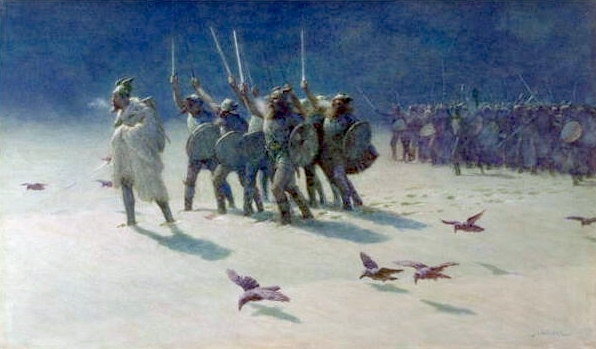
I was going to celebrate a pretty good day by posting some kind of YouTube video associated with Vikings. I don’t know what. Just something. But YouTube doesn’t seem to be functioning tonight. So I chose the painting above, The Ravager by John Charles Dollman (ca. 1909). Because it’s cold and snowing up here, and it seemed appropriate. Even with the stupid winged helmets.

But it’s still a good day, never mind the weather. Or the wings. Did a reading of one of my theological translations for the Georg Sverdrup Society at the seminary this morning. That went well.

Also signed the contract for my book translation with Saga Publishers International. That means a direct connection between the wealth of Norway and my personal bank account. Also the tremendous respect that being a certified professional scholarly translator brings. And the groupies, of course.

Not coincidentally, I sent the completed first draft of the translation to Saga.

I even got a good parking place at the grocery store – one of those where I could pull forward into the next slot and so leave without backing up.

I should have asked some random woman on a date. But there are limits to a good day.

Solstice news

Tomorrow is the winter solstice, the shortest day of the year, known in the church calendar as St. Thomas’ Day. It was on St. Thomas’ Day in the year 1028 that Erling Skjalgsson, hero of my novels, The Year of the Warrior, West Oversea, and (soon) Hailstone Mountain, was killed at the battle of Soknasund. (Or Boknasund.)

By coincidence or divine appointment, I have today reached verbal agreement with Baen Books to re-release The Year of the Warrior in e-book form. Look for it soon.

Addendum: Thanks to Ori Pomerantz for facilitating the negotiations.

Can Anyone Return from Heaven?

Very Steep Cliffs in Heaven's Gate MountainsPhil Johnson has an article on the recent rash of supposedly eyewitness accounts of heaven. He says it’s nothing new:

Various survivors of near-death experiences have been publishing gnostic insights about the afterlife for at least two decades. Betty Eadie’s Embraced by the Light was number one on the New York Times Bestseller List exactly 20 years ago. The success of that book unleashed an onslaught of similar tales, nearly all of them with strong New Age and occult overtones. So psychics and new-agers have been making hay with stories like these for at least two decades.

Johnson points to an upcoming book by John MacArthur on heaven and these books. He argues that the Bible forbids the possibility that anyone can return from beyond the grave. “All the accounts of heaven in Scripture are visions, not journeys taken by dead people,” MacArthur writes. “And even visions of heaven are very, very rare in Scripture. You can count them all on one hand.” Moreover, the biblical accounts focus on God’s overwhelming glory, not all the fun junk we might do in heaven.

In his excellent book Gospel Deeps: Reveling in the Excellencies of Jesus, Jared Wilson touches on this in a paragraph near the end.

Can I tell you one of the problems with books like Heaven Is for Real? Aside from the obvious honesty issues, they very often demote Jesus to a Character in heaven like one of the costumed players at Disney World. He is Santa Claus, an attraction of some kind. Continue reading Can Anyone Return from Heaven?

Bible Recommendations

J. Mark Bertrand is a remarkable man. He probably hunts elk on weekends and subs occasionally at Chez Dakota for his sous chef friends. He’s also an author and reader, has been an editor, if he isn’t still, and blogs about Bible design at his blog called… Bible Design Blog.

He doesn’t always drink beer, naturally, but when he does–you get the idea.

All to say he has a fascinating article on which Bible to buy for yourself or your dear, dear friend on First Things. The article has many recommendations, but I’d like to highlight one to which a reader points: The Four Holy Gospels, ESV Bible (Slipcase), illuminated by the wonderful painter Makoto Fujimura. It’s not a bible you take to church really, but I’m sure it’s one that will inspire your meditation.

More cover crowdsourcing

As promised earlier, we have a few more possible book covers for you to look at. Here’s a sentimental favorite (with me at least): Another version including all my buddies, utilizing the central space for a blurb from Hal Colebatch:

Continue reading More cover crowdsourcing

Lost sheep in translation

If I were really professional, I’d probably have postponed beginning my translation of Norge i Vikingtid until I had a signed contract, but phooey. Most of my novels were written before I had a contract, or even the promise of one. And I’m excited about this project. It vitalizes me.

Translation can be a disorienting process. I suspect it’s extremely complex, neurologically. There’s a sort of mental dance that goes on between the original text and the translator’s thoughts. You can get a semi-passable (sometimes) translation of a text by running it through something like Babelfish, but the results testify to the very complex and subtle nature of language. There are nuances in the text that have to be caught, music you need to transpose. Sometimes an accurate translation takes you a moderate distance from the precise words of the original, because the original language is accustomed to taking different paths to the meaning than English is.

I read somewhere that the Italians have a joke, based on the fact that the words “translator” and “traitor” are very similar in that language. I think it’s also the Italians who say (my apologies to anyone who might be offended), “A translation is like a wife. If she is faithful, she is probably not beautiful, and if she is beautiful, she is probably not faithful.”

I have an ambition – and I don’t think it’s entirely arrogant – to make this translation both beautiful and faithful. I honestly think I can do that, or something pretty close.

One of the weird aspects of the process, at least for me, is what I think of as “losing my English.” I’m reading along in the Norwegian, and understanding it just fine, and then when I turn to my laptop to render it my native language, I can’t for the life of me remember the English word I want. It’s there, I know, but I just can’t put my hand on it. It’s very similar to the experience we’ve all had where we search for a word we know perfectly well, but temporarily can’t find it for some reason. Only when I’m translating this happens constantly, again and again. I generally put in a not-as-good word, highlight it, and move on. If I ignore it, it’ll come wandering back eventually, like Little Bo Peep’s flock.

I suspect (I haven’t researched it) that different languages occupy different parts of the brain, and that I’m in the process of running new data lines from the Norwegian section to the English. Perhaps the problem will diminish as I spend time at it.

I bet you I’ll still stink at understanding spoken Norwegian, though.

Writing because I got work

I got good news today. I received a favorable reply to an offer I’d made (by invitation) to Saga Bok Publishers in Norway to do the English translation of Prof. Torgrim Titlestad’s recent book, Norge i Vikingtid. That would be Norway in the Viking Age in English.

I lowballed my offer, because I’m unproven in professional translating and I’m keen on this project, and on establishing a working relationship with Saga Bok.

Years ago, as I began to work on a novel about Erling Skjalgsson, I came to certain conclusions about what his principles were, on the basis of the saga accounts.

It was with some delight that I discovered later that there was a Norwegian historian who shared, to a large degree, my views on that particular subject. That historian was Prof. Titlestad.

The project looks to be fairly easy, except for the length of the book, which is considerable. But most of my translation to date has been of 19th Century Norwegian writings, with flowery language and often convoluted sentence structure. Prof. Titlestad, on the other hand, writes in a simple, clear style.

I don’t expect that this will interfere with my fiction writing to any great degree.

In any case, I need the money.

Of the Books Written on Lincoln There Shall Be No End

“There are so many Lincoln geeks that buy everything new that comes out,” Cathy Langer, the lead book buyer at the Tattered Cover Book Store in Denver, tells Stephanie Cohen of the Wall Street Journal. Cohen goes on to report Langer’s claim “that in her years as a buyer, she has rarely turned down a title about the 16th president.” One such book is Killing Lincoln, which has sold over two million since its release a year ago September. Cohen states some 16,000 books have been written about President Abraham Lincoln, and there’s more to come.

To illustrate the volume of existing Lincoln works, the Ford’s Theatre Center for Education and Leadership in Washington created a three-story, 34-foot tower sculpture out of Lincoln titles, meant to “symbolize that the last word about this great man will never be written,” according to the center.

Perhaps I should start writing a series of short volumes on the ignored presidents, like Polk, Hayes, Tyler, and Garfield. I could call them Thrilling Histories, e.g. The Thrilling History of James K. Polk. Or maybe they should be called the Presidential Insider’s Guides. Or maybe the What You Didn’t Learn series. (via Frank Wilson)

More Odd, Less Gore

Last night as I was getting ready to turn in, I turned on Dennis Miller’s talk show, which is delay-broadcast here. A married couple was sitting in for him (I forget their names), and they announced that their next guest would be their friend Dean Koontz, to talk about his new novel, Odd Apocalypse.

I listened to the interview and took the book’s release date, my birthday, as a sign from heaven that I was meant to buy it now, and not wait for a lower price when the paperback comes out.

I’ll review it soon.

In other literary news, Gore Vidal has died.

They say you should speak no ill of the dead.

I have nothing more to say.

Interview with Keith Urbahn

Coffee and Markets talks to Keith Urbahn about his new firm, Javelin, and publishing conservative authors. “As the only full-service book writing and publicity firm in the nation’s capital, Javelin is the first of its kind,” says Urbahn’s LinkedIn bio, “offering concrete, multi-channel services from crisis communications and social networking solutions to speech and book writing.”