Yes, you’re in the right place. This is where you get my occasional book reviews, but more often you get excuses for why it’s been several days since the last review. Not that you’d expect me to read a book every day. I know you pretty well by now, Gentle Reader, and you’re not unreasonable. As a matter of fact, I think you’re pretty gosh-darn patient.
It was a weekend full of translation work for me. Which is good. I approve, and am grateful. Only Christmas’ wingéd chariot keeps drawing near, and I haven’t started my cards yet. No, that’s not quite true. I gave the address labels a start yesterday. And then got confused and lost all my work. I shall resume, Sisyphus-like, tonight. If I can work up the energy. (My cold is better, but I’m still a little tired.)
The book I’m reading at the moment is Dorothy Sayers’ classic Five Red Herrings, which is considered a masterpiece of the railroad timetable school (which was very popular at the time). But I feel I’m not doing it justice, because I’m not making spreadsheets of all the data. Thus, my progress is slow.
But I share the little video above, which is the original titles for the BBC production of Clouds of Witness, back in the 1970s. Broadcast in the US on Masterpiece Theater. I always liked that music.
By the way, have I mentioned I did translation work on a production that was broadcast on Masterpiece Theater last spring? I’ll tell you about it if you insist…
Benjamin Moser talks about finding a somewhat old library of English books and how he began to change his opinion of translating world authors into English.
In recent years we have seen writers outside English become global phenomena: Elena Ferrante, Karl Ove Knausgaard, Haruki Murakami. But such a literary life, the popularity owed to translation, began to seem a little fake to me. And when I read Mizumura I found myself agreeing that, strictly speaking, literary universality does not exist. The books I loved were, after all, about something, not everything. But even in practical and commercial terms, the prominence of English created more losers than winners, favoring, like so many other forms of globalization, a handful of instantly recognizable and inoffensive brands.
…
Translation — not the thing but the unquestioned emphasis on its virtue — started to feel to me like another philistinism masquerading as worldliness.
By worldliness, Moser means people travel the world–or read from around the world–and they start to think they own the place.
Micah Mattix discusses the essay in the latest Prufrock email, saying maybe readers or literary opinion makers should lighten up a bit. “A healthy curiosity is a virtue, of course, but there is nothing wrong with enjoying a work on its own.”
Today, of course, I worked at translation. Made good progress, too, and I’ll put some more time in tonight. I’ve got personal business to handle as well, but everything’s in hand.
Started reading a book by an unfamiliar author the other day. A bargain book for Kindle. According to the description it’s a Christian book, and it has a lot of good reviews.
Alas, so often the descriptor “Christian” indicates poor craftsmanship. So it was here.
I won’t tell you the author’s name or the book’s title. They might be favorites of yours. Many people better than me in almost every respect enjoy – or even write – books that don’t please me. It’s not for me to look down my nose at them. I know I’m turning into a literary snob in my dotage.
The author just hadn’t mastered the craft. The story may have been good – I tried to hang with it, to see if the plot grabbed me when the prose didn’t – but in the end I couldn’t hack it. I was opening it out of duty rather than anticipation.
So much in writing depends (as in jazz) on the notes you don’t play. There are lots of things you don’t need to tell the reader, if you can suggest them – through word choice, rhythm, juxtaposition. When the reader expects you to say something and you don’t, that makes him guess at your reasons. Such things make the reading experience a collaborative one, a kind of dance. It draws the reader in.
This author knew nothing of these things. He may learn the craft in time. You’ve got to start somewhere. I wish him well.
Above, a video of The Dragon Harald Fairhair, the largest Viking ship replica ever built. She was constructed in Haugesund, Norway, and I hoped to see her back in 2016, when she was supposed to come to Duluth. But that was prevented by maritime regulations. She’s been sitting in Mystic Harbor, CT for a couple years now, and I wonder what her future will be.
Anyway, this is a cool video, mixing comments by crew members with epic sailing footage. I believe I haven’t seen it before, which means somebody probably sent me the link once, and I was too busy to look at it.
No translation work today. But no book review either. Maybe tomorrow. Today I’ve been preparing a couple lectures I’ll be delivering to a class at our seminary on Thursday. I’ll talk about the Viking raid at Lindisfarne and the conversion of Norway. I have Things to Say on both subjects, springing from my ever-ready stock of opinions, based on life-long study and my association with a certain independent-minded scholar.
I always try to make it clear that the theories I talk about are theories only. “Don’t look at me! I’m just the errand boy!”
The book I’m reading right now is Dorothy Sayers’ Strong Poison. It’s a landmark volume in the series, because it’s here that Lord Peter Wimsey first meets the novelist Harriet Vane. She’s on trial for murder, and he makes up his mind to save her, largely because he’s fallen in love with her and can’t conceive of the woman he loves being a murderess.
It was adapted for TV back in 1987, with Harriet Walter as Harriet Vane, and Edward Petherbridge as Lord Peter. I quite liked Miss Walter in her role. Petherbridge I found less successful. He looked more like the character than Ian Carmichael in his classic performance (though too tall), but I didn’t like his portrayal. It had a strong basis – the author’s own statements that Lord Peter was basically depressed due to being shell-shocked in the Great War and disappointed in love. His Wodehouseian persona was an act. But Petherbridge played him as a sort of mope who cracked jokes. I think Lord Peter carried the thing off rather more elegantly than that.
Anyway, Strong Poison includes one of my favorite Sayers characters – “Blindfold Bill” Rumm, the reformed safecracker. Bill is a man of no great intelligence or sophistication, but is an absolute master at the art of lock-picking. He turned from that life after Lord Peter caught him breaking into his own safe one night, and pumped him for knowledge rather than turning him in. Soon after he was converted to Evangelicalism (there’s a suggestion that it might have been through Chief Inspector Parker, who’s an evangelical), and now he pastors a house church. However, when Lord Peter needs his help in training someone to crack a lock, Blindfold Bill happily assists. He believes (erroneously) that Lord Peter is also a believer, and (correctly) that all he does is in the service of good.
Dorothy Sayers was a well-known Church of England believer (not an evangelical), who wrote brilliant apologetics. Yet she wrote her mystery stories for the publisher Victor Gollancz, who was an influential Communist. The idea of writing a story in the C.S. Lewis vein, with an evangelical lesson, would have repelled her. And by her own account, she took offense when people suggested she’d make Lord Peter a believer eventually (“Keep your hands off my character!”). I find that perfectly understandable as a novelist, and rather sad as a Christian.
But Blindfold Bill shows how she did include Christian themes in her work, consistent with her views of art. Bill is no Christian Mary Sue, no fantasy-fulfillment character for the Christian reader. He’s remarkable only for two things – his skill (however illicit) as a craftsman, and his unashamed (even awkward) gospel witness. His testimony isn’t intellectually compelling or very appealing. But it’s sincere, and one feels his heart is good.
In short, Blindfold Bill is a realistic Christian character. We’re allowed to laugh at him a little, but he leaves a strong positive impression. I think that’s a subtle kind of apologetics.
Work has descended on me today, like a squall off Cape Horn. It had been a long-ish calm, and I was getting nervous about it. But today, first of all, I got a referral from a satisfied customer, recommending me to another possible client. That’s gratifying in the extreme. Don’t know if it’ll come to anything, but approval is approval, and I suffer from a constitutional deficiency. Then a substantial script came in for translation, which means a decent pay day coming up over the horizon. Which, as it happens, I can use.
I’ve been reading a book (I’ll review it whenever I get it finished) about the last days of the great sailing ships. I read this stuff with a special fascination, knowing that some of my ancestors were involved in merchant sailing (one of them is supposed to have sailed to China). The author is doing an excellent job describing the hellish conditions under which those old sailors worked, even late in the 19th Century – insanely dangerous duties up in the rigging, miserable food, brutal discipline, dreary drudgery and heart-in-your-throat peril from the elements. For little pay. (That explains the shanty performance I embedded at the top of this post.)
When I think about the fact that I can eke out a living working at a keyboard under my own supervision, in a warm, dry house with enough food to keep me fat, I realize that I certainly belong to the 1% of humanity, from a historical perspective. And so, probably, do you, unless you’re a Chinese or Muslim slave, just because you were born into a lucky century.
Russian Bill. Photo from americancowboychronicles.com
I reviewed John Boessenecker’sRide the Devil’s Herd the other day. The book is an impressive account of the deadly conflict between the Earp brothers, Virgil, Wyatt, and Morgan (note how I list Virgil first – he was the oldest of the three, and I’m an oldest too. We oldests have to stick together) and the rustler gang known as the Cowboys.
The book includes many interesting anecdotes, some of them surprising, some of them shocking, some disillusioning. One story amazed me. It’s one of the weirdest western yarns I’ve ever read, and I’m amazed I’d never heard of it before.
There was a member of the Cowboys known as “Russian Bill” Tattenbaum. He was an educated man of about 30, older than most of the other cowboys. He spoke French, Russian, Spanish, and English. He dressed expensively, with gold pieces on his buckskins, a silver hat band, and silver-plated, ivory-handled six-shooters. He had a reputation as a blowhard – he bragged about his crimes and depredations, but was considered all hat and very little cattle. One of his brags was that he was a European nobleman. Nobody believed that any more than his other tall tales.
He was finally arrested by a deputy and jailed in Shakespeare, New Mexico, in an adobe hotel, along with another Cowboy named Sandy King. According to newspaper accounts, they were “loud and demonstrative in their threats against the citizens, declaring that the people of the town would have an opportunity to dance to their music inside of twenty-four hours.”
At 2:00 a.m. the next morning, a group of local citizens, faces masked, overpowered the guard, took the pair to the bar room, and hanged them from a ceiling joist. Sandy King, according to witnesses, went to his death with dignity, but Russian Bill “begged for his life,” claiming he hadn’t committed any crimes at all, and was really a Russian nobleman who’d fled his native land because of a love affair. The vigilantes, neither convinced nor impressed, let Russian Bill swing.
A coroner’s jury the next day declared their deaths “suicide.”
Here’s the payoff:
…Five months later, in April 1882…, Sheriff Harvey Whitehill received a letter from the U.S. consul in St. Petersburg, Russia. The consulate had been contacted by a Russian countess whose son was in New Mexico and had not written to her since the previous May. The consul wrote… that the missing man’s name was “Waldemar Tethenborn” and provided his photograph. It was Russian Bill. Sheriff Whitehill replied to the consul and, to spare the mother’s feelings, reported that her son had committed suicide.
My own photo of the reconstructed Viking houses at L’Anse Aux Meadows, some years back.
File this under “News That Surprised Absolutely Nobody:”
Counting tree rings reveals that wooden objects previously found at an archaeological site on Newfoundland’s northern peninsula were made from trees felled in the year 1021. That’s the oldest precise date for Europeans in the Americas and the only one from before Christopher Columbus’ voyages in 1492, geoscientists Margot Kuitems and Michael Dee and colleagues report October 20 in Nature.
1021 is actually fairly late in the game, if you give the sagas any credence. But most of us believe the Greenlanders were here for quite a few years. The sagas describe three expeditions in detail, and it seems probable that the Greenlanders would have exploited American resources (especially lumber) for quite a long time, even after they gave up on the idea of a colony.
I hold to the widely-held theory that the L’Anse Aux Meadows site in Newfoundland is not the entire Norse American enterprise, but merely a station – possibly a pretty insignificant one. The only real activity we can identify there from the archaeology is boat repair and its ancillary crafts.
Growing up in rural Montana, I was a bit removed from the Norwegian enclave in western North Dakota that my mom’s family is from. We ate lefse at Thanksgiving, but other than that, compared to my cousins I was not particularly in touch with my Norwegian heritage. I never felt a particular connection to Norway as a country, but do mention my heritage to Norwegians I meet, as there are a surprisingly high number of them in the Middle East, where I’ve spent much of the last decade. Reading Giants in the Earth, however, was an enlightening experience, and it brought to life the journey that my ancestors took from Norway to the Dakotas.
After reading O. E. Rolvaag’s Giants in the Earth and Peder Victorious, the writer goes on to ponder Scandinavian cinema (I myself have seen The Last King and The King’s Choice, but none of the other films he describes). The article is interesting, though I was wondering by the end what its point was.
I personally am not a fan of much Scandinavian literature or film, as I expect I’ve made pretty clear. I read Giants In the Earth in college, and my major take-away was what a depressing book it was. I never read the sequel, Peder Victorious, but a friend described it to me, and the description didn’t appeal much (here’s a hint – the name “Victorious” [Norwegian Seier] is darkly ironic). The same friend described other books by Rolvaag, like The Boat of Longing, and that sounded even worse. I do not recommend reading Rolvaag if you struggle with suicidal ideation.
Scandinavians have a bent for looking at things coldly and in a brutal, unsentimental light. When the Scandinavians were Christian, I think, they found ways to mitigate that brutal honesty. Now that they’ve mostly “transcended” Christian faith, they seem to have settled on a glum fatalism, like those dogs in the famous Learned Helplessness experiments.
I think that probably explains most of their current social policies.
Still got some reading to do before my next book review. Picked up yet another book about Wyatt Earp and the OK Corral. I don’t know why I keep reading these things. Officially, I’m a Wild Bill Hickok partisan, but there aren’t as many books being written about the Prince of Pistoleers (got to check if there’s anything new out there). But that OK Corral business just keeps fascinating people. The book I’m working on seems promising, in terms of fresh information.
That put me in the mood to watch “Tombstone” again. Like all Earp movies, it falsifies all sorts of stuff, but it works so well as a film – and they did make the effort to make it look authentic. Love those costumes.
And it has some great epic moments. I so love epic moments, where your heart soars a few yards, like Soti in The Year of the Warrior. Made me wish I could write some of my own.
And what do you know? I have some to write! A Work In Progress nearing completion, just needing a few more edits to steer it the tradition of Cecil B. DeMille. Or Sergio Leone. Or whoever directed “Tombstone.” (I forget.)
I finished another draft of King of Rogaland last night. Then this morning as I got up, I thought of a few lines I needed to add, to contribute to the general transcendence of the epic as a whole. Tonight, I start another read-through. I’m close now, I think. This book seems to have more moving, intersecting parts than anything I’ve written before. I think I’ve got most of my ravens in a row now – I’m only aware of one point I’m still not sure about.
Of course, you never know what self-inflicted follies, of my own creation, still lie in wait for me. That’s all part of the (epic) process.
Ronni Kurtz describes the encouragement he finds (along with Pip) in Great Expectations: Don’t long for a future time after you’ve studied and learned all the thing; be grateful for who you are today.
Well, Pip, be it so, or be it son’t, you must be a common scholar afore you can be a oncommone one, I should hope! The king upon his throne, with his crown upon his ‘ed, can’t sit and write his acts of Parliament in print, without having begun, when he were a unpromoted Prince, with the alphabet–Ah! And begun at A too, and worked his way to Z.
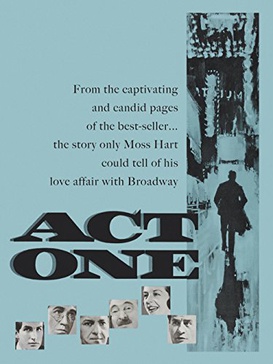
It’ll be a day or two until my next book review. I’m reading Act One, the autobiography of Moss Hart, the renowned Broadway playwright and director. It came up as a bargain e-book on Amazon, and it’s about two things I like – writing and the theater. It is an interesting book, and I’ll have much to say about it when I’ve finished reading.
The book was made into a biographical movie in 1963. I didn’t see it, of course (we rarely saw movies in our family), but I caught part of it on TV at some point over the years. My perception of the film (which got mediocre reviews) is marked by an article I saw in Parade Magazine at the time of the release. At least I’m pretty sure the article was about this movie. There’s a scene that exactly corresponds to what it described.
According to the article, when they were casting the parts of famous people who only appear briefly, they hired some of those people’s actual children to play them. I’m pretty sure a son of Robert Benchley played him in the scene where there’s a gathering in George S. Kaufman’s apartment. (Might have been Nathaniel, but I can find no mention of it online). There were others as well — I forget who. IMDb says nothing about this casting gimmick, but I like to believe I remember correctly.
There’s a formula in the movie business, I read somewhere: “When you’re casting famous real-life characters, the smaller the part, the more they must resemble the person they’re playing.”
That sounds paradoxical, but it makes sense in practice. When you’re dealing with a lead, you’ve got the whole length of the production to convince the audience that (taking an example purely at random) Kyle MacLachlan is Franklin Roosevelt. But when you bring somebody on for a minute as, oh, Humphrey Bogart, you don’t want the viewer to be diverted from following the story to ask, “Is that supposed to be Bogey?”
The movie that jumps to my mind when I consider this rule is “The Plainsman,” a 1936 film by Cecil B. DeMille, which stars Gary Cooper as Wild Bill Hickok. Except in height, Coop bears no resemblance whatever to Hickok. His nose is the wrong shape, his hair is way too short, and there’s no mustache at all (Hollywood, after World War I, adopted a long-standing tradition of erasing almost all mustaches from historical characters. Only the Hippie Era shook them off it). But Buffalo Bill Cody wears the proper long hair and imperial goatee. As does General Custer.
I’m not sure how they managed to preserve Buffalo Bill’s beard and hair style in 1944’s movie, “Buffalo Bill,” starring Joel McCrae. But they got away with it. I suppose Buffalo Bill’s appearance was so iconic they couldn’t escape it.
Note to future producers: If a movie is ever made of my life, you have my permission to cast somebody thinner and taller to play me. But you need to keep the pigtail in the older scenes.
Websites store cookies to enhance functionality and personalise your experience. You can manage your preferences, but blocking some cookies may impact site performance and services.
Essential cookies enable basic functions and are necessary for the proper function of the website.
Name
Description
Duration
Cookie Preferences
This cookie is used to store the user's cookie consent preferences.
30 days
These cookies are needed for adding comments on this website.
Name
Description
Duration
comment_author
Used to track the user across multiple sessions.
Session
comment_author_email
Used to track the user across multiple sessions.
Session
comment_author_url
Used to track the user across multiple sessions.
Session
These cookies are used for managing login functionality on this website.
Name
Description
Duration
wordpress_logged_in
Used to store logged-in users.
Persistent
wordpress_sec
Used to track the user across multiple sessions.
15 days
wordpress_test_cookie
Used to determine if cookies are enabled.
Session
Statistics cookies collect information anonymously. This information helps us understand how visitors use our website.
Google Analytics is a powerful tool that tracks and analyzes website traffic for informed marketing decisions.
Used to monitor number of Google Analytics server requests
10 minutes
__utmb
Used to distinguish new sessions and visits. This cookie is set when the GA.js javascript library is loaded and there is no existing __utmb cookie. The cookie is updated every time data is sent to the Google Analytics server.
30 minutes after last activity
__utmc
Used only with old Urchin versions of Google Analytics and not with GA.js. Was used to distinguish between new sessions and visits at the end of a session.
End of session (browser)
__utmz
Contains information about the traffic source or campaign that directed user to the website. The cookie is set when the GA.js javascript is loaded and updated when data is sent to the Google Anaytics server
6 months after last activity
__utmv
Contains custom information set by the web developer via the _setCustomVar method in Google Analytics. This cookie is updated every time new data is sent to the Google Analytics server.
2 years after last activity
__utmx
Used to determine whether a user is included in an A / B or Multivariate test.
18 months
_ga
ID used to identify users
2 years
_gali
Used by Google Analytics to determine which links on a page are being clicked
30 seconds
_ga_
ID used to identify users
2 years
_gid
ID used to identify users for 24 hours after last activity
24 hours
_gat
Used to monitor number of Google Analytics server requests when using Google Tag Manager
1 minute
_gac_
Contains information related to marketing campaigns of the user. These are shared with Google AdWords / Google Ads when the Google Ads and Google Analytics accounts are linked together.
90 days
Marketing cookies are used to follow visitors to websites. The intention is to show ads that are relevant and engaging to the individual user.
A video-sharing platform for users to upload, view, and share videos across various genres and topics.
Registers a unique ID on mobile devices to enable tracking based on geographical GPS location.
1 day
VISITOR_INFO1_LIVE
Tries to estimate the users' bandwidth on pages with integrated YouTube videos. Also used for marketing
179 days
PREF
This cookie stores your preferences and other information, in particular preferred language, how many search results you wish to be shown on your page, and whether or not you wish to have Google’s SafeSearch filter turned on.
10 years from set/ update
YSC
Registers a unique ID to keep statistics of what videos from YouTube the user has seen.
Session
DEVICE_INFO
Used to detect if the visitor has accepted the marketing category in the cookie banner. This cookie is necessary for GDPR-compliance of the website.
179 days
LOGIN_INFO
This cookie is used to play YouTube videos embedded on the website.