Sherry has some interesting books coming in 2011. (via Out of the Bloo)
Category Archives: Reading
Reading Poll – L.A. Times
The L.A. Times Jacket Copy blog asks how many books you’ve read (this year (Sorry for the omission, Michael (2 more demerits for you))). Not many answers yet. Perhaps the left coast is still waking up. The highest percentage of votes has been in the 101-150 category, followed by 51-75. I don’t keep a clear number of books I’ve read, but comparatively, it isn’t that many.
Let me ask for your comment on this idea. Not all books need to be read completely, that is from cover to cover, to be considered read. Some readers may take them in completely, but many readers should feel no compulsion to read all of a book they don’t like or don’t need to read. I’m reading The World Encyclopedia of Coffee this week, and I don’t plan to read all of the recipes in the last third of it, but if I get through most of it of the rest, I will consider it read. Other books have only four or five chapters suitable for a particular reader. Can’t that reader consider the book read, once he has read from it? Isn’t thoughtful reading of a portion better than cover-to-cover reading for the sake of it?
2010 Book Lists, Recommendations
The Millions has been summarizing the year in books with a month’s worthy of posts. Here’s the month long index with scads of links.
I doubt any of the books praised here by Aaron Armstrong are in the posts above. He has focuses on Christian theology, living, and biographical books.
Author Mary Demuth has a different list for 2010, one of regrets.
The Tattered Covers blog has several author recommendations, by which I mean recommendations by authors. Click the Older Posts link to read more posts in this category. This is getting to be like a big literary party, without the spiced eggnog, by which I mean spiked eggnog.
Spiked eggnog may be the reason The Thinklings have not posted a 2010 book recommendation list, despite their claims of tee-totaling. They could be innocent, but where’s the list, I ask you? Where’s the list?
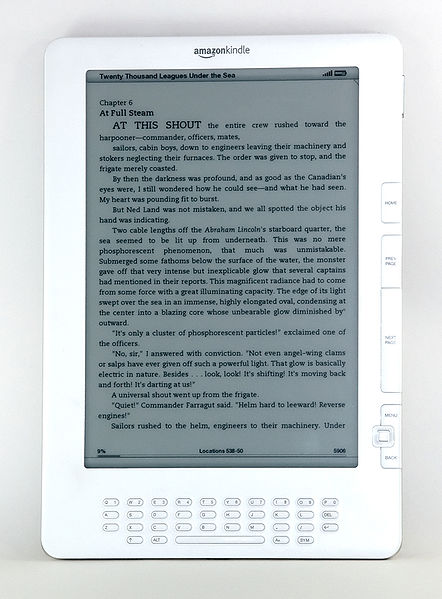
Five E-book Trends
Philip Ruppel, president of McGraw-Hill Professional, notes five trends he says will change the publishing industry.
- Enhanced E-Books Are Coming and Will Only Get Better
- The Device War Is Nearly Over
- The $9.99 E-Book Won’t Last Forever
- The Contextual Upsell Will be a Business Model to Watch
- Publisher Editing and Design Will Be More Important Than Ever
Flaherty on Lewis in the Wall Street Journal.
I don’t remember who pointed this out to me, but Micheal Flaherty at The Wall Street Journal offers a brilliant defense, both of Sarah Palin and of C. S. Lewis, against Joy Behar’s ignorant dismissal of the great Oxbridge scholar and Christian apologist as somebody who wrote children’s books.
An amazing slip-up on the part of someone who, we seem to be constantly assured, is one of the great minds of our time. I suppose I could say I was Surprised by Joy’s Ignorance.
The Guardian of Children's Books
I don’t know if my kids would go to a children’s library section with this thing on the ceiling. Whoa.
Are the scary books right beneath it?
The weight of heroism

Wild Bill Hickok
I’m reading a novel right now, by a very good author, which is taking me forever to get through. (I won’t say what novel—maybe I’ll review it at the end of the line.) It’s a pleasant story with an interesting narrator. But it’s so… languid. It starts with a murder, but then the plot takes the hero (and the villain) to an entirely different location, and the villain proceeds to do nothing very sinister for a considerable time. The hero is wearing himself out trying to catch the villain at something, but there seems to be nothing to catch. Thus the book lacks that sense of urgency that drives the reader to keep turning pages, and pick the book up anxiously whenever there’s a free moment.
It’s slow.
My analysis of the problem is this—the author has failed, thus far, to raise the stakes. In order to keep your audience’s attention, you need to keep the villain busy doing bad stuff. And that stuff must be devastating and costly. People who matter to the reader, and to the hero, need to be placed in imminent, horrifying danger (unless it’s the hero himself who’s in peril). The good characters’ awful pain and fear are the very elements that transfix the reader.
I think there are very few authors who don’t have a problem raising the stakes like this (I know I do). Most of us are nice people. We don’t enjoy inflicting pain. Raising the stakes is emotionally hard.
This relates to life too. I’ve written more than I have a moral right to about heroism. I believe in the necessity of heroism. I believe that faith and heroism are closely related (all heroism isn’t faith, but all true faith is heroism).
It’s easy to forget that heroism has a high cost. Continue reading The weight of heroism
"Light But Not (Too) Dumb"
Cynthia Crossen writes about literary books that aren’t depressing or leaning heavily on tragedy. Light, she notes, is relative.
National Gaming Day at the Library
In this photo, Jennifer Love Hewitt is performing at the L.A. Public Library in 2003 for Sony’s announcement ceremony for the Playstation 2 game “Karaoke Revolution.” It fits with Daniel Flynn’s article on libraries drifting toward amusement centers, such as renting video games and hosting noisy National Gaming Day events. Flynn writes:
Allen Kesinger, organizer of Newport Beach Public Library’s National Gaming Day, concedes that video games are entertainment but defends their intellectual merit. “Video games have evolved and instead of being endurance tests designed to eat up quarters, they have become a medium to deliver sophisticated, emotionally charged stories. BioShock is the story of an underwater city torn apart by civil war. Heavy Rain is an intense character drama surrounding a father’s loss of his child. Silent Hill 2 is a deep, psychological thriller about a man searching for his deceased wife. Because of this strong focus on narrative, we can use video games . . . [to] attract hesitant readers.” His library’s “celebration of video games” will host a birthday party for the iconic Mario (of Donkey Kong and Super Mario Bros. fame); feature a rotation of games, including Katamari Damacy and Lego Star Wars; and participate in the nationwide Super Smash Bros. tournament.
Flynn worries that libraries have rejected a vision of cultivating the life of the mind. What is the mind, after all, but a spacesaver between your ears? I mean, if you have the right opinions, who cares if you can really think about them, right? Dude, where’s my game? (via First Thoughts)
Boogieman as Censor
Loren Eaton talks about censorship in light of last week’s banned books celebration. Did you attend any book burnings or Protest The Read rallies? I was out of town, so I missed the usual fun.
From the Wall Street Journal article to which Loren links, complaints are as good as actual bans for the American Library Association (ALA): “For the ALA, what makes them censors is that they spoke up at all: ‘True’ patriots, presumably, would have kept quiet. Who, then, is afraid of discourse?” Indeed.