
Category Archives: Reading

Reading report: ‘The Letters of J. R. R. Tolkien’

Theologically (if the term is not too grandiose) I imagine the picture to be less dissonant from what some (including myself) believe to be the truth. But since I have deliberately written a tale, which is built on or out of certain ‘religious’ ideas, but is not an allegory of them (or anything else), and does not mention them overtly, still less preach them, I will not now depart from that mode, and venture on theological disquisition for which I am not fitted. But I might say that if the tale is ‘about’ anything (other than itself), it is not as seems widely supposed about ‘power.’ Power-seeking is only the motive-power that sets events going, and is relatively unimportant, I think. It is mainly concerned with Death, and Immortality; and the ‘escapes’: serial longevity, and hoarding memory.

(Letter, Oct. 14, 1958, from J. R. R. Tolkien to Rhona Beare)

I’ll have to admit that I’ve always thought that The Lord of the Rings was about the temptations of Power, but Tolkien himself says, in more than one letter in The Letters of J. R. R. Tolkien (which I continue to read), that the story is about death.

Sauron (if I remember correctly) is a Valar, an incarnate angelic being (fallen in his case). He is not the equivalent of Satan, but of a powerful lesser demon. A creature like he (again, if I understand it right) would ordinarily live till the end of the world. But Sauron, as a repeated rebel, has been “killed” and reborn more than once. He knows, or suspects, that if he’s killed again, he’s not coming back in Middle Earth – and he has no reason for hope where his spirit is going after that. He’s struggling to stay alive, even in the hellscape he’s made for himself in Mordor.

Smeagol has been enslaved by the One Ring, and was given (or suffered) extended life thereby – but the life the Ring imparts is not wholesome. Bilbo, who experiences the same thing, says he feels “stretched.” It’s an addiction too – as the pleasure decreases, the craving grows.

Aragorn, on the other hand, who was granted a very long life through his Numenorean blood, will voluntarily lay down his life before it runs out completely. This is regarded as a noble act (not, I’m confident, comparable in any way with assisted suicide).

The elves regard human death as a gift. It’s a mystery to them, but they envy it in a curious way.

These are matters worth pondering, for a man who, like me, is growing old. I can’t say that my whole Erling Saga is about death, but The Baldur Game certainly is. And I was aware of that before I read these letters.
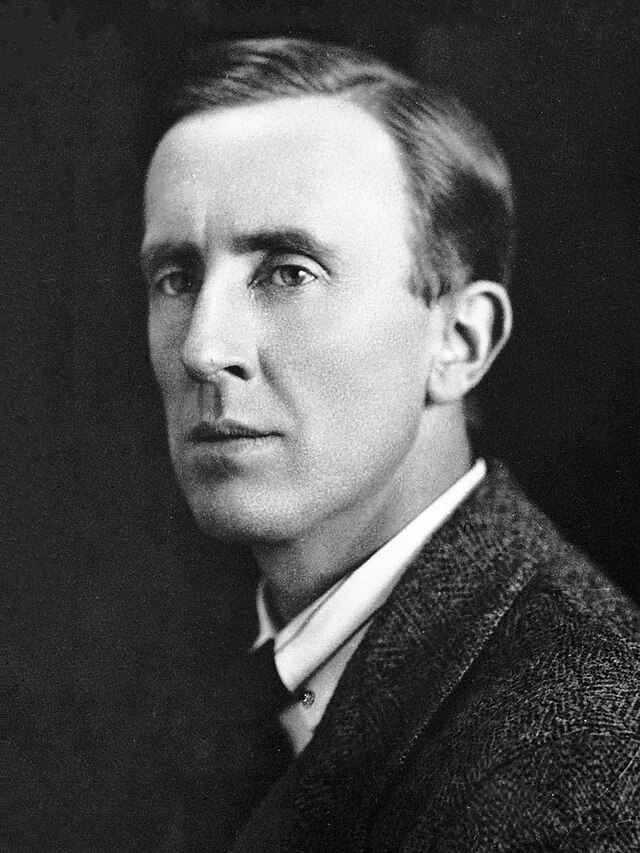
Reading report: ‘The Letters of J. R. R. Tolkien’

J. R. R. Tolkien in the 1920s. Photo public domain.

I’m still working my way through The Letters of J. R. R. Tolkien. It’s quite a long book (though not nearly as long as the 3 volumes of C. S. Lewis’ letters. But this collection makes no claim to being complete).

In any case, the business takes time. So I hope you’ll forgive my giving the book my “reading report” treatment. I suspect there’s enough interest in Tolkien’s work among our readers to warrant multiple posts.

What may strain your tolerance more is my selection of passages from the letters that I relate to my own writing. I’m keenly aware that, even standing on the shoulders of authors like Tolkien and Lewis, I’m shorter than they are. But as I obsess my way through the final stages of producing The Baldur Game, I snatch at any straw of reassurance I can find – or imagine I find.

Anyway, here’s a nice one, from a September 30, 1955 letter to a reader (friend?) named Hugh Brogan. Brogan had written with a criticism of the archaic prose style Tolkien used in The Two Towers. The professor never actually sent this letter, but dispatched a note instead, saying “it would be too long to debate.” But he kept the letter in his files.

He agrees with Brogan’s rejection of what they called “tushery” – the use of archaic words in literature to give an impression of antiquity – words like “tush,” “forsooth,” and “eftsoons.” Victorian writers liked to toss such morsels into their dialogue, but they’re now considered an affectation.

However, Tolkien insists that he does not employ tushery:

But a real archaic English is far more terse than modern; also many of the things said could not be said in our slack and often frivolous idiom.

I jumped at this, because it relates to my own style (in my Viking books). I actually avoid archaic words, unless I can find no modern equivalent. (I’d love to use the word “leif” as an adjective, meaning “to wish to”, for instance. But I don’t think I ever have, because nobody knows the word anymore.)

I’ve actually chosen to simplify my word choices to achieve an antique effect in these books. The general modern writer’s rule, “Don’t use a Latin word when an Anglo-Saxon word will do,” is taken to an extreme. Rather than use a word derived from Latin or French, I’ll sometimes even invent a compound word (in the German fashion) made out of two simple English ones.

In addition, I make use of my knowledge of Norwegian. Norwegian sentences are often constructed differently from the English. I discovered that when I re-cast a sentence in Norwegian word order, I get an effect that “feels” like Old Norse.

I like to think it works. The most satisfying praise I ever got for my writing was back in the 1990s, when a reader told me he looked up from Erling’s Word and was surprised to find himself in the 20th Century.

Reading report: ‘The Letters of J. R. R. Tolkien’

I picked up the first version of The Letters of J. R. R. Tolkien, getting it a bargain rate that day. You, if you want the book, will probably prefer to get the Revised and expanded edition, which has the further advantage of being cheaper (in the Kindle edition) than the one I’m reading (which, aside from containing fewer letters, features an unfortunate number of typos – “orcs” often comes out as “ores,” for instance.

It is, for me, a somewhat emotional read. Though I am not such a coxcomb as to compare my own work to The Professor’s, I can certainly identify – within my limits – with the agonies he went through getting the whole thing written down and published – a process that took something in the neighborhood of two decades. (He openly admits that he probably wouldn’t have finished it without the encouragement, or even the nagging, of C. S. Lewis.)

His publishing history, at least, is almost as complicated as mine. George Allen & Unwin published The Hobbit. They very much wanted a sequel, but when Tolkien went to work, his story expanded in an alarming way. His correspondence with them, over many years, focused on his frequent excuses why he hadn’t been able to do much work, because of obligations at Oxford. Which was no doubt true, especially during the war years. He was also working on the Silmarillion, and he seems to have come to consider that work the real center of the project, with the Lord of the Rings a more peripheral matter. Allen & Unwin were interested in the “Hobbit sequel,” and happy enough to discuss that, whenever it would be finished at last. When they decided against publishing the Silmarillion, Tolkien clearly took offense. When another publisher (Collins) made noises of interest, Tolkien actually tried to push Allen & Unwin away. He says in one letter to them:

My work has escaped from my control, and I have produced a monster: an immensely long, complex, rather bitter, and very terrifying romance, quite unfit for children (if fit for anybody); and it is not really a sequel to The Hobbit, but to The Silmarillion.

But Allen & Unwin didn’t want the Silmarillion (at that point). Then the Collins editor changed his mind, and Tolkien seems to have despaired, having gone from a strong to a weak negotiating position. Eventually Rayner Unwin, his former student, reopened communications, and Tolkien – visibly humbled – agreed at last to let Allen & Unwin publish it without the Silmarillion, and (against his preferences) in three volumes.

The rest is history.

I too know the experience of wrong-footing it with a publisher – without quite so happy an outcome. But I could identify, certainly. One feels so attached to one’s own books that it’s hard to distinguish literary criticism from personal slight. No matter how you try to be objective, it’s hard to keep feelings leashed. The situation is too subjective; there are no landmarks to go by. Especially if you’re slightly unstable – and what author was ever very stable? Publishers must lead frustrating lives and require thick skin, dealing with us. Some of them are rumored to drink, and it’s hard to blame them.

As for my own delayed work The Baldur Game, I’ve got all the notes from my readers now, and am doing (what I hope is) the final read-through. Still waiting for my cover art, which I’m confident will be a masterpiece, and well worth the wait.

Swiveling the street signs

Photo credit: Ernesto Brillo. Unsplash license.

I was reading this particular book, one of those free ones I pick up in promotions. The book had numerous flaws (such as you routinely find in self-published works), but it also showed signs of promise. Not enough research had been done on the historical period in which it was set, but the author seemed to do a good job establishing atmosphere. And I was interested in what would happen to the characters.

But I could not finish the book. I tried. I held out for about a third of its length, and then I had to give it up.

The main problem was punctuation. The author got punctuation wrong in various ways, but particularly in the area of quotation marks. Let me remind you of the rules:

“The rules for quotation marks in dialogue,” said the lecturer, “are as follows. First of all, you start all direct quotations with the aforementioned marks. If the speech involves more than one paragraph, the first paragraph will end with a simple period. The lack of ‘close quotes’ here signals to the reader that more of the same speech is coming up.

“Then you start the next paragraph, once again, with opening quotation marks,” he went on. “And when the speech is done, you finish with ‘close quotes’ to signal that fact.”

The author of this book did not understand these rules. In fact, he got them precisely backwards. It was like driving in a town where some trickster has turned all the street signs 90 degrees. In every patch of dialogue, I had to stop and figure out who was talking now. Finally, I couldn’t take it anymore. I had to give up reading, even though the story interested me. The author was trying to make me do his work for him.

I don’t entirely blame him. No doubt he’s young and publicly educated, which means he’s been taught little about English. I salute the perseverance with which he must have struggled to do a job (writing a book) for which school had not prepared him in any way.

But it isn’t fair to the reader.

Punctuation has a bad reputation nowadays. It takes work to learn the rules. And rules are unpopular in their own right.

But like Chesterton’s Fence, rules exist for a reason. This author’s inability to deploy quotation marks in a useful way lost him, in my case, both a reader and a review.

This brings semicolons to mind. Semicolons aren’t as vital to comprehension as quotation marks, but they have their proper uses. They too are unpopular today. Many writers have sworn off them. They say that semicolons don’t do anything you can’t do with a period.

But that’s not true. As a reader with a history of reading aloud, radio announcing, and acting, I can tell you that a semicolon serves a subtle but useful purpose. A semicolon indicates a brief pause – perhaps a slight intake of breath — before the speaker goes on to a further – but related – thought.

A period indicates a full stop (indeed, they call them full stops in England). The speaker’s voice tone drops in a way that sounds final. A full breath may be taken.

For a writer, such distinctions can be very useful. I treasure my semicolons; you’ll have to pry them from my cold, dead hands.

From Undset to Valhalla

At sunset Kristin was sitting up on the hill north of the manor.

She had never before seen the sky so red and gold. Above the opposite ridge stretched an enormous cloud; it was shaped like a bird’s wing, glowing from within like iron in the forge, and gleaming brightly like amber. Small golden shreds like feathers tore away and floated into the air. And far below, on the lake at the bottom of the valley, spread a mirror image of the sky and the cloud and the ridge. Down in the depths the radiant blaze was flaring upward, covering everything in sight.

Just a passage from my reading in Sigrid Undset’s Kristin Lavransdatter today. I thought it was rather nice. I’m nearing the end of the second book, having watched Kristin’s half-smart husband gradually weave the rope that will hang him in the end – in terms of his ambitions, at least.

I’ve also, of course, been watching “Vikings: Valhalla.” And simple justice demands that I admit that it surprised me – I like it better than I expected. Though my expectations, as you probably guessed, were pretty low.

But the fact is that the writers and showrunners of “Vikings: Valhalla” seem to have made the decision to pull in their horns a bit. The “Vikings” series, especially in the later seasons, just went loopy. They let their freak flag fly, so to speak, to the point where it almost came loose from the flagpole. They produced the wildest fantasies and impossibilities and anachronisms, pinning them now and then to odd points of history or saga.

“Vikings: Valhalla” seems a little more controlled, at least as far as I’ve watched so far. Time is still compressed, but not as radically as it was in the first series. Instead of making the same man the attacker of both Lindisfarne (793 AD) and Paris (845), this story seems to be concentrating on the stories of Canute the Great, Saint Olaf, Harald Hardrada, and Leif Eriksson. In this series, all those men are involved in Canute’s conquest of England in 1016 – at which time the real-life Leif had already discovered America and had (I believe) settled down as chieftain of the Greenland Colony. And Harald Hardrada was an infant. Still, all these people could have conceivably met each other in real life.

Many of them show up in my Work In Progess, The Baldur Game. I doubt that Erling will show up here, for which I’m grateful.

The most audacious liberty taken is making Jarl Haakon a Strong Black Woman (and, of course, as is the custom in our times, she is the story’s great font of wisdom). Actually, she’s supposed to be Haakon’s widow, Estrid, who took his office over for him (women could not do that in real life – they could inherit a chieftainship, but needed to get a man to exercise it) and uses his name as her last name. The fact that the Vikings didn’t have last names in the sense we understand them seems to be outside the producers’ ken.

But the costumes (though not in the least authentic) are a little less radically imaginative than the ones in the previous series, and the haircuts are generally much better. I’m grateful for that.

As we age, we learn to be grateful for small mercies. And I’ve aged a decade watching these programs.

Kristin Lavransdatter’s Husaby

The video above shows the farm and neighborhood landscape which Sigrid Undset appropriated for the setting of the second novel in her Kristin Lavransdatter trilogy — The Wife.

This is not the kind of Norwegian scenery that generally gets promoted in the world. This is in the Trondelag, one of Norway’s best agricultural areas. The Viking kings made the town of Nidaros in the Trondelag their capitol — today it’s called Trondheim. Stiklestad, where Saint Olaf was killed, is also in the Trondelag (that will be described in The Baldur Game, and I promise I’m working at it as fast as I can). I had some ancestors from that area myself.

The farm where Kristin and her husband Erlend live in the novel is called Husaby. This is a significant name — historians note that many farms belonging to kings were called Husaby (it means “house town,” I think). So when Erlend brought Kristin to a farm called Husaby, we’re meant to understand that it was a place that carried some prestige, regardless how poorly he’d been managing it.

Yes, thanks for asking, I am still reading The Wife. Got some distance to go.

Have a wonderful weekend.

Booklisti, and a reading report

First of all, business. Feel free to check out the new listing I have on Booklisti. They asked me to make a list books of my own, and one of books that I wanted to recommend, for any reason. A fascinating look into my fascinating mind. For which the world, of course, has been eagerly waiting. Feel free to share it with seekers after truth and beauty.

Updating my personal situation, I’m delighted to report that my air conditioning is operative again – at last. (Just in time for a heat wave.) I haven’t checked precisely, but I think I was without it for about a month. Roughing it. Living as my ancestors did – or as I did when I was a kid, to tell the truth. I’m old enough to remember when air conditioning was still a luxury in northern states.

The problem, as I’ve explained, was that my home warranty company (which shall remain nameless) preferred to go the cheap-but-lengthy route of repair over replacement. I suppose there must be some way to register a complaint on their webside, but if there is, it’s pretty carefully concealed from the customers.

I’ve tackled another long book, which will delay my next review. I can give updates as I go, though. I’m reading The Wife, volume 2 of Sigrid Undset’s Kristin Lavransdatter (I reviewed the first volume a little while back). A passage that caught my interest today was this one, involving a visit by Kristin’s father, Lavrans, to her and her husband Erlend’s new home at Husaby (near Trondheim):

…they were accompanied by two gentlemen whom Kristin didn’t know. But Erlend was very surprised to see his father-in-law in their company—they were Erling Vidkunsson from Giske and Bjarkøy, and Haftor Graut from Godøy.

Like any crank, I know things most people don’t – about matters of no interest to anyone else. What sparks my attention in this passage is the estates this Erling Vidkunsson owns. Giske was the home of Thorberg Arnesson, who married Erling Skjalgsson’s daughter Ragnfrid (as described in my novel King of Rogaland). And Bjarkøy was the home of Thore Thoresson (remembered by history as Thore Hund, Thore the Dog), whose brother Sigurd married Erling’s sister Sigrid. The fact that this man (who’s likely a documented historical character – there are plenty of them in these books) carries Erling’s name suggests he’s a descendent of these people, and thus a descendant of Erling himself.

That’s all. It just pleases me to discover Erling connections in my reading.

Let The Words Wash Over You

Reading Passively: “One of the problems of shouldering one’s way through books—worldview machete in hand—is that we become the kind of readers who get from a book only what we bring to it.” Professor Jermey Larson writes about reading for experience and enjoyment and letting active learning take a back seat. He leans on C.S. Lewis’s effort to equip readers of medieval literature to stay with the story instead of looking at commentaries every other page.

And the Gulag Remains: The Gulag Archipelago in English is 50 years old this year. Gary Saul Morson writes, “Before Solzhenitsyn, Western intellectuals of course knew that the Soviet regime had been ‘repressive,’ but for the most part they imagined that all that had ended decades ago. So it was shocking when the book described how it had to be written secretly, with parts scattered so that not everything could be seized in a single raid. Solzhenitsyn offered an apology for the work’s lack of polish: ‘I must explain that never once did this whole book . . . lie on the same desk at the same time!’ ‘The jerkiness of the book, its imperfections, are the true mark of our persecuted literature.’ Since this persecution is itself one of the work’s themes, its imperfections are strangely appropriate and so, perhaps, not imperfections at all.”

The Past that Binds: Gina Dalfanzo reviews The Blackbird & Other Stories by Sally Thomas. “Our pasts are always part of us, shaping who we are, and that includes the people in them.”

Remembering How We Cooked: Writer Megan Braden-Perry talks about authentic New Orleans gumbo and how strangers change historic recipes. “To me, the composition of gumbo is a topic serious enough to invade my dreams. Recently I had the most awful nightmare, that I made gumbo and forgot all the ingredients and spices. It was just a roux and broth.”

The Steel Man Cometh: How the music business can course correct on artificial intelligence. “I guess training AI to replace human musicians is evil—unless they can make a buck from it.”

Photo: John Margolies Roadside America photograph archive (1972-2008), Library of Congress, Prints and Photographs Division.

Borges on the magic of English

I need to read some Jorge Luis Borges. Pretty much all I know of him, I like. But I’ve only read one or two of his stories, and those in school. Pure laziness on my part – or a fear of finding myself out of my intellectual depth.

Anyway, this Argentine author has astonishing things to say about the English language in this little clip. He expresses an idea I first encountered years ago in Writer’s Digest magazine. It was in an article also written by a writer who used English as a second language. People learning English often – and very understandably – complain about the size of the vocabulary you need to learn. Which is fair enough. But, this author pointed out, once you’ve mastered it you’ve got an unparalleled instrument in your hands, like a huge organ with a hundred stops. You can get an infinity of subtle effects out of it.

Borges notes here that most every word in English has a light or a dark version, depending on whether you choose the Latin or the Germanic option. He also talks about combinations of verbs and prepositions, which I hadn’t been aware of before.

In my Erling books, I’ve tried to employ Germanic words as much as I could, for two reasons. First, when I was learning to write (I took a sort of correspondence course and studied Writer’s Digest religiously), I was instructed to generally choose the Germanic (Anglo-Saxon) word. Anglo-Saxon words, they said, are punchier, stronger. They make your writing more vivid and active.

I took that advice, and still believe in it (though I’m sure there’s an element of cultural bias involved. In the 18th Century, writers aspired to sound Classical, and always opted for the Latin word). But I had a further reason for going Anglo-Saxon. I was writing about Vikings, and I wanted to evoke a northern, Germanic mood. I like to think my diction contributes to a sense of place and time.

How do I master this vast English vocabulary, you ask? Read. Read a lot. Read above your comprehension level (authors like Borges, for instance). If you read on Kindle, they’ve got a neat feature where you can highlight a word right on the page and get a definition as if by sorcery.

Getting into Classical Music, Reading

Speaking of Norway, when I began earning spending money in my late teens, I agreed to receive the initial offer from The Musical Heritage Society. You could receive the monthly featured album (tape or CD) very naturally (they would just assume you wanted it) or refuse it. They sent a small musical review to let you know what you would receive with plenty of time to opt out. That’s how I was introduced to Camille Saint-Saëns’s Symphony No. 3 which added a pipe organ to orchestra. It’s how I fell in love with Dvorak’s Symphony No 9 (The New World Symphony) and judge every other recording of it by the one I played repeatedly in my 20s. I was familiar with “Flight of the Bumblebee” and Scheherazade from the radio, so I bought four tapes of Rimsky-Korsakov’s music, one with the Arabia Nights piece, the other three with several works I didn’t know, like the “Procession of the Nobles.”

The Musical Heritage Society is also how I purchased a tape of Edvard Grieg’s Peer Gynt, recorded with full choir for The Hall of the Mountain King and a gorgeous soprano for Solvieg’s Song. This recording, which I think only had voices in these two pieces,

I listened to this music so much, I engrained it in my mind. Later I forgot where certain familiar melodies (one or two) came from. I remembered them casually, almost as if I’d made them up, and lo, they were from Peer Gynt. Moments like that make me think I haven’t had an original thought in my life. Maybe all of my ideas are just a snatch of something I heard in the past, ripped from its context, its source forgotten.

Anyway, what else do we have today?

Reading: A video reflection on reading carefully and how you evaluate your speed.

Is it real or is it math? Patrick Kurp offers this post about math, sort of, and poetry. I feel too dim-witted to get it, at least at the moment.

Poetry: Take a moment for this poem, “Shiloh” by Alyssa Souza

Fleeing the war Refugee Letters: At the height of World War II, three women flee Europe with the Bruderhof community for a pioneer life in South America

We had realized for many months the insecurity of our position in England as there was so much hate growing in the hearts of the general populace. This could be understood because we had many German members; also the pacifism of our English members roused a bitter spirit in nationalistic minds.

Photo: Image by wal_172619 from Pixabay