
From Twitter: @ScottyWardSmith: “May the gospel be the sweetest manna and sin be as rotting lutefisk in our mouths.”
Category Archives: Religion
Updated and corrected: Nuggets of nonsense from Norway
Bruce Bawer at the PJ Tatler offered a couple links the other day to a brace of rather alarming opinion columns in the Norwegian newspaper Aftenposten (I’m not sure about his characterization of Aftenposten as “Norway’s most conservative” major paper; I guess that may be true, in the sense that Lenin is the best-preserved Russian revolutionary).
One was written by Stein Lillevolden, a Norwegian leftist, about the new book by Danish editor Flemming Rose, the man who published the “Muhammed cartoons.” I won’t translate the entire article, but the gist of it is that (Lillevold claims) Rose wrongly appeals to the book I Will Bear Witness to the End, by the Jewish-German philologist Victor Klemperer. Lillevolden thinks Rose misses Klemperer’s true point, and anyway it’s apples and oranges. Continue reading Updated and corrected: Nuggets of nonsense from Norway
Against the Strømme
I promise there will be a point somewhere further down in this post, but the first part involves a lot of Norwegian stuff. I apologize for that, after the fashion of one who apologizes for a vice he has no intention of giving up.
Someone gave our library a couple books recently, and I’ve been reading them in preparation for accessioning them, because of their historical value. They’re translations, done a few years back by a very small publisher, of a couple books by a Norwegian-American pastor and journalist named Peer Strømme (1856-1921). Strømme was quite well known—within our community—in his own time, but because he wrote mainly in Norwegian, and was not great enough to invite translation on the scale of Ole Rølvaag, he’s not much remembered.
The Memoirs of Peer Strømme (not available on Amazon, though this volume, which seems to be the first part of it, is) tells of the author’s life from his boyhood in eastern Wisconsin, though his education at Luther College, Decorah, Iowa and Concordia Seminary, St. Louis, to his installation as a Norwegian Synod pastor on the prairies of northwestern Minnesota (he would later leave the ministry and become a journalist in Chicago). Continue reading Against the Strømme
Tim Keller Interview with DG (Part 2)
Desiring God has the second of their 45 minute interviews with author and pastor Tim Keller. This one is stirring, talking about social justice and a Christian obligation to help the poor and reject a middle class mentality.
I listened to this tonight after having a difficult day for multiple reasons, one of which was my grief over the circumstances of a homeless, jobless man I know. I don’t want to pay for one night’s hotel room, because that doesn’t help him stand on his own, but what do you do when a man tells you he has no where to stay and he’s afraid he’ll freeze to death? I called around to ask for help and got a good answer from a friend in my church, but that wasn’t the answer my homeless buddy took.
I hope I don’t hear from him tomorrow, but if I do, I know what I will say. I respect him as a man made in God’s image, and I want to help him overcome his current struggles, but I can’t enable him to live in a twisted type of freedom. There’s another man he needs to go see who will develop him, a man he needs to give another chance.
I need to stop thinking about this. The Lord is far more capable than I have ever been to handle a life of hard knocks.
The blog post that was Thursday
My interview with Tom Roten of WVHU radio in Huntington, West Virginia this morning went just fine, thank you. I’m racked with self-doubt about the quality of my performance, of course, but I’ve learned to sort of disregard that reflexive reaction. It’s sort of an emotional tax I pay for existing at all.
Tom says he’ll soon have a podcast of the interview available for download at the station site. Just click on his name in the box over to the right, and keep coming back till it shows up.
My only real disappointment was that he didn’t ask me what the weather was like up here. I was all prepared with a boffo response—“It’s so cold, you have to carry an ax around to chop your way out of your own breath.”
And it is cold. Traditionally we have a January thaw at some point this month, but it hasn’t shown up this year. We’re in the odd situation of having both an unusually cold month, and an unusually snowy one, running concurrently. Usually you get one or the other.
Here’s an interesting article from Fox News about Christianity in China. It’s possible that Christianity may be the wild card that changes the whole game in that country.
If China interests you, I would refer you to this blog, Seeing Red in China, written by an American teacher who’s been living there for several years. I find the blog interesting for its own sake (things over there aren’t always what I expect), but it doesn’t hurt that the author is my nephew-in-law, husband to my niece. They’re on furlough in the U.S. right now, but going back before long.
My theory, what it is. And whose it is.
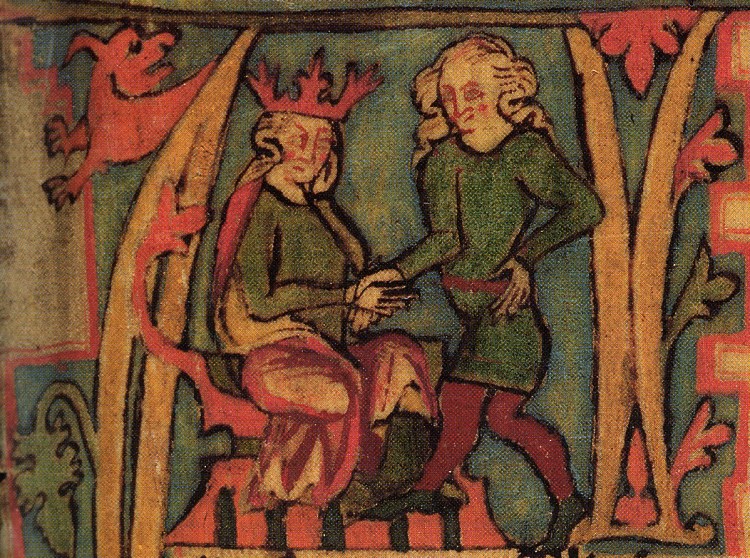
King Harald Finehair (standing) from a a saga manuscript.
Fair warning—we shall trudge a good distance into the deep Viking grass in this post. I’m going to propose a new paradigm for thinking about the Vikings, which will surely change Scandinavian studies forever. So if you come to this blog in spite of my Viking stuff, you’ll probably want to skip what follows.
I’ve written about some of these ideas before, but my surviving brain cells recently sparked across a couple gaps, and came up with Walker’s New Theory of Viking Norway.
It all starts with the origins of the Viking Age. The most common explanation for the sudden violence, quoted to this day in most books on the Vikings, is Overpopulation. The theory is that the Norse had so many babies that Scandinavia ran out of food and arable land. So hungry younger sons had to sail abroad to make their fortunes by the sword.
The problem with this theory is that there is not a scrap of evidence, either in archeology, the sagas, or outside accounts, for any food shortage at that time. This was in fact during the Medieval Warm Period, and life seems to have actually been pretty good. The popularity of the theory seems to arise solely from the fact that it harmonizes with Marxist ideology. Continue reading My theory, what it is. And whose it is.
Deconstructing Jared
I apologize for adding to the sum total of posts about Jared Loughner. This will be the only one I do—I hope.
I found this post by Rich Horton at Blue Crab Boulevard extremely interesting. If you want a plausible scapegoat for the shootings, why not Jacques Derrida?
But if you absolutely need to blame someone else, why not look to the things that obviously did inspire Loughner? Like a lot of other people I too looked at Loughner’s YouTube ravings, and it became clear to me there was something Loughner drew upon as “inspiration” of a sort. Clearly Loughner had either been introduced to in college or read on his own something of the philosophical perspective known as “deconstructionism.” You can see this in his obsession with “grammar” and the supposed meaninglessness of language. Something like this was obviously the source of Loughner’s nonsense question to Giffords back in 2007. Loughner gets introduced to the idea that texts have no set meaning, and when confronted by a member of Congress whose very position and status is defined by a text (i.e. the Constitution) Loughner now believes is devoid of content, well, he begins to think of her as a charlatan or tyrant.
One of the most common accusations we hear from atheists is that religion drives people to violence. Many arguments against religion are framed in terms of religious people being inherently prone to murder, because we value dogmas over people. “Religion has killed more people than anything else in history,” we are told (such people never seem to notice the fact that, in the one century in which atheist governments have actually existed, they’ve managed to even—or better—the score).
But look at a non-religious methodology like Derrida’s deconstructionism. (I can’t claim to speak knowledgeably about deconstructionism. My comprehension of it is at the bonehead level. As is, without a doubt, Loughner’s). Deconstructionism, as I understand it, involves a belief that reality is so incredibly complex that we can’t actually know it in any way, that when we imagine we understand anything, we’re fooling ourselves. We can’t understand what words mean. We can’t be sure of our own experiences or memories. We can’t be sure that we interact with other human beings in any meaningful way. Under such a world view (at least as dummies like me and Loughner would understand it), we are utterly alone in the universe, adrift and unconnected.
Now please note my next point. I am not saying that deconstructionism leads inevitably to insanity and violence like the shootings in Arizona. I have no doubt that many deconstructionists are decent people, good neighbors, and caring parents. (Whether their lives are consistent with their philosophy is not the issue here.)
What I’m saying is that whatever world view you adopt, a metaphysic comes with it. And that metaphysic provides a form for the nut’s nutty ideas. Religion does not drive people to madness or violence. Religion—like ideology, and even literary theory—simply forms an armature on which the insane person builds his personal monster.
In fact, if a man must be insane, wouldn’t you rather he thought he was Jesus (and tried to act like Him) than that he thought he was Napoleon?
Organizations: One bad, one going bad
Doktor Luther’s Twitter Feed directs us to this item from the London Daily Mail, featuring recently published color photographs from Adolf Hitler’s Nazi Party “Christmas” celebration in 1941.
Details not included in the article’s photos, but very important, are noted in the accompanying article:
But the Nazi Christmas was far from traditional.
Hitler believed religion had no place in his 1,000-year Reich, so he replaced the Christian figure of Saint Nicholas with the Norse god Odin and urged Germans to celebrate the season as a holiday of the ‘winter solstice’, rather than Christmas.
Out of sight at the top of the tree behind Hitler was a swastika instead of an angel, and many of the baubles carried runic symbols and iron cross motifs. The remarkable pictures were captured by Hugo Jaeger, one of the Fuhrer’s personal photographers.
No, Nazism was not a Christian movement. No matter what Bill Maher tells you.
Also, another fine piece at the American Spectator by my friend Hal G. P. Colebatch, about the British YWCA’s recent decision to drop the organization’s historical name (with it’s icky C, standing for Christian), and to change its name to Platform 51:
In a further maneuver in the one-way war against British traditions and values, what was known for 156 years as the Young Women’s Christian Association has dropped the word “Christian,” along with the rest of its title, changing its name to Platform 51. Continue reading Organizations: One bad, one going bad
God Works Even With the Foolish
“And behold, the star that they had seen when it rose went before them until it came to rest over the place where the child was.” Matthew 2:9
 Since Lars is talking Christmas, let me throw out this holiday thought. The star which brought the Magi to Bethlehem to find the newborn king (cf. Matthew 2:1-12) was either a supernatural event or a natural one. If we say it must be an angel or a divine light shone only for the birth of Christ Jesus, then we have nothing more to say. An astronomer who has written a book on the Bethlehem Star notes this view has had credibility from good men over the years. “The great astronomer/astrologer Johannes Kepler,” Mike Molnar writes, “thought the Star was a miracle accompanied by natural phenomena such as a triple conjunction and a supernova similar to what he observed in 1604.”
But if we hope to find a natural explanation, there are many options and a great deal of research to do. I heard an expert on the radio say that new explanations for the Star of Bethlehem are offered almost every year, and Molnar has a whole book on his explanation of a natural occurrence. He gives a good bit away in the FAQs on his site.
Not long ago I told my girls that the star had to be supernatural because the Bible says it moved before the Magi and stopped over Jesus’ location. Now I am second-guessing. My only thought for this post, small and nearly pointless it may be, is that we know the Lord uses even foolish reasoning for his purposes, so it is entirely possible for the Magi, being astrologers, to interpret the Star’s normal behavior in the sky as guiding them in ways we would believe to be crazy if we could have them explained today. These wise men saw Jupiter approaching a part of the sky, and they interpreted as it to mean a king will be born in Judea. Apparently the astrology all works out for regions to have symbols and planets to have meanings. In this way, the Magi believed they had seen heavenly signs of a Judean king, so they went to Jerusalem to ask about him. Herod’s scribes told them Micah’s prophecy, and they went to Bethlehem.
The Magi may have believed the Star was directing them (moving and stopping) in ways we would not agree had we been there to argue about it, and isn’t that the way God works sometimes. He blesses good-hearted people who run with out-of-context verses. He helps those who have bad theology–not often, but often enough to notice. That’s no excuse of laziness in worship or Bible study, but it is a good reason to praise him for his grace and mercy.
A cut-rate carol from Sears
Christmas is over for many of us (discounting those who observe the Twelve Days, the Eastern Orthodox, and me [because my family’s gathering this weekend]). So perhaps it would be OK for me to vent a little about a Christmas pet peeve.
As you may have noticed, I’m pretty tolerant of Christmas observances (or so I imagine. Don’t correct me, please). I don’t bemoan the commercialization much, I don’t attack Santa Claus, I don’t denounce the Christmas tree as a heathen shibboleth. When it comes to colored lights I’m essentially a little kid, and it’s pretty easy to make me happy with a Christmas tree and chocolate.
But I have a few gripes, primarily in the music department.
I don’t mean the obvious stuff. I won’t go into that Christmas Shoes song they keep playing on Christian stations (kill me now!). I’ll pass by The Little Drummer Boy, making his racket to keep a new Mother and her Baby awake all night. I won’t even spend time on Santa Baby.
I want to go where a deeper problem is. I want to single out a beautiful, well-written carol which I love, and which seems to me slightly insidious.
The carol is It Came Upon the Midnight Clear, by Edmund Sears: Continue reading A cut-rate carol from Sears