Category Archives: Writing

‘Homophobia’ Dropped from AP Stylebook

In the upcoming update to The Associated Press’ online stylebook, the suffix “-phobia” “should not be used ‘in political or social contexts,’ including ‘homophobia’ and ‘Islamophobia.’

AP Deputy Standards Editor Dave Minthorn explains the move:

“Homophobia especially — it’s just off the mark. It’s ascribing a mental disability to someone, and suggests a knowledge that we don’t have. It seems inaccurate. Instead, we would use something more neutral: anti-gay, or some such, if we had reason to believe that was the case.”

“We want to be precise and accurate and neutral in our phrasing,” he said.

If current argumentative trends apply here, this move will be described as homophobic.

Losing to win, in stories

One change owning a Kindle has made in my reading habits is that I’m now a whole lot more likely than I used to be to dump a book that fails to please me.

When I was younger, it was kind of a point of honor to finish any book I started. (This sprang in part from the fact that books were copied by hand on calfskin in those days.) But as I got older, and especially as I crystallized my political and social views, I became more willing to ashcan a book whose author (as I imagined him/her) obviously wouldn’t want a person like me for a reader.

The Kindle makes this easier because I’ve been getting a lot more free books, especially from the Free Kindle Books and Tips blog. Easy come, easy go. A lot of these books are fully worth their price of nothing, and I feel no guilt (OK, not much guilt) in showing them the virtual door.

I dumped one book yesterday, and another today, which I think is a new record.

One was a mystery/thriller, pretty competently written. The characters were mostly good, and the writing slipped only rarely. But around half way through I discovered that the evil District Attorney, whom we had been schooled to hate (the one-dimensionality of his character was one of the book’s weaknesses from the start) was a political conservative, getting money from those evil conservative political action committees.

I could have finished it. I’ve finished worse. But I wasn’t in the mood. Maybe it’s the election season.

The second book was more congenial in viewpoint, being a sort of contemporary Christian fantasy. And the writing was pretty good for Christian literature. But then the main character, a non-Christian, got into a conversation with his Christian neighbor at one point, and it all went south as far as I was concerned.

I have strong views about how conversations about matters faith in novels ought to go. I like to think I do it pretty well in my books, but maybe other people find my approach as offputting as I find so many that I see.

Here’s how I think such conversations should be handled—generally.

1. Avoid easy victories. Christians love anecdotes about how some Christian silenced an atheist through a single pithy, incisive remark. In my experience this never happens in real life. In real life the atheist has a good laugh, and the Christian trickles away humiliated (this isn’t necessarily bad. I know of instances when such conversations have resulted, eventually, in the conversion of the atheist). You gain realism points if you allow your Christian character to lose at least the initial skirmish.

2. Remember that the point of the exercise is not winning the debate, but winning the person. The action of the story is where the non-believer will have his world-view truly challenged. A story where he gets converted merely by an argument is by nature a weak story. Use the rising tension of the story’s action to make him doubt his preconceptions. This is both good storytelling and true to life.

3. Eschew Triumphalism. This really summarizes the two points above. James Bond is not a Christian. The smooth character who always makes the right choices and is always in control of the situation is not realistic, and would be a poor example in any case, since none of us live that way. The Christian conquers through bowing, through dying, through the way of humility.

And no, I’m not going to tell you the names of the books I dumped. I deleted them from my Kindle, and I don’t think I remember the titles. I’m sure I don’t remember the authors’ names.

Writing on the Job

Your day job can be a means to an end by putting food on your table while you write, but it could be an end to your means by sucking the life out of you. This Writer’s Digest blog takes the first approach, describing the benefits of interacting with people and learning non-writing job skills. How else are you going to learn the sound of man’s last breath after he has been stabbed? You learn that kind of thing on the job.

Elsewhere on the web, Joss Whedon didn’t need a vacation after shooting The Avengers; he needed a working vacation on a radically different movie. So his wife insisted he take up an adaptation of Much Ado About Nothing.

“I’m a huge proponent of the no budget movie,” Whedon says. “I love working on location. It makes you a better filmmaker. You don’t have everything conveniently placed for you. People are using the environment and it spices things up. I think of myself as a classical storyteller, which is why the digital era excites me. Classical storytelling is about getting a story told. It started with cave people around a campfire saying, that wooly mammoth was enormous, you should have been there! For me, that’s all that matters. It’s why I love writing comic books and I love writing prose. I love all mediums.”

Down on the dumps


“Hillside Dump,” Gene Daniels, Photographer.

As you’ve probably noted, I’ve read a number of novels by obscure writers in the last year or so, when they became available free or very cheap for Kindle. I think such reading is actually beneficial for a writer, because it teaches vicariously, through others’ mistakes.

The previous paragraph, by the way, can be described as exposition. Exposition tells back story, sets up the situation, and prepares the reader for what is to come.

And what is to come is a post about exposition.

The dreaded Info Dump is one of the most common mistakes I observe among fledgling novelists. You’ve probably run across it yourself. The characters are going along, doing whatever it is they do, and then the author stops everything to

a)Tell you the back story of the characters, or the country, or the world, in his own voice, or

b)Have one of the characters do it.

In general, option b is better than option a, but either can annoy the heck out of your readers if done clumsily.

There’s a particular fantasy writer, of whose books I have read one and a half. In the second book I tackled, his main character rode into a new country about half way through the story, and everything stopped while the author delivered an extended lecture on the whole history of that country. I dropped the book and never tried another of his.

Now this author is far more successful than I am, so he probably possesses many virtues I lack. But I still say there was no warrant for that kind of info dump.

There are good ways to give your reader the same information, without braking to a full stop.

One of the best is simply to introduce a character who’s a stranger, and get somebody (or several people) to explain things to him. That’s why so many good books center on strangers going to new places.

(By the way, the information doesn’t have to be dispensed all at once. You can introduce it bit by bit, as the story warrants. The stranger character asks, and he gets his answers. It’s natural and true to life, and pretty painless for the reader. It’s also not necessary to satisfy the stranger’s curiosity right away. Let him be mystified for a while. The reader will share his mystification, and it will add to the intrigue of the story.)

One caveat — For heaven’s sake, have the person who is informed be someone who needs informing. Nothing destroys a story’s credibility like the dreaded “As you know,” speech, such as, “As you know, Fred, I am your elder brother.”

If you have to do an info dump, for heaven’s sake break it up a little. In Wolf Time, my main character is a college instructor who gives a lecture on Norwegian history that provides background for the supernatural occurrences to come. But I don’t just transcribe his lecture text. I have students interrupt and argue with him. This allows us to get to know him better, to see what kind of man he is, even while information is being imparted. People tell me that worked pretty well.

You can always “show, don’t tell,” too. Instead of having somebody explain how your character’s grandfather came to possess the Mystic Snoose Tin of Wanamingo, you can add a vignette, perhaps (but not necessarily) at the beginning of the story, presenting that discovery as a self-contained story within the narrative.

Those are a couple of techniques for exposition that come to mind offhand. There are probably more, and I’ll share them if I think of any.

Patience and Perseverance

John Vorhaus writes about writing:

So that would seem to leave us with a pretty clear choice, wouldn’t it? Write, and improve; or don’t write, and don’t improve.

Why is it not that simple?

Because the forces of evil are arrayed against the desire to write. And the biggest evil of all is the need to be good. Burdened by the unrealistic expectation of all quality all the time, we often find that we just can’t write at all.

Two ways of storytelling


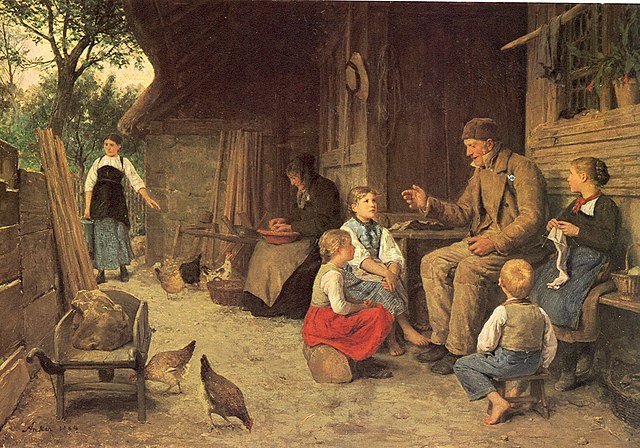
Albert Anker: Der Grossvater erzählt eine Geschichte, 1884

A commenter was kind enough to leave his opinion on one of my reviews from a couple weeks back. (No, I won’t link to it. But I won’t delete it either.) He wasn’t happy with my comments on a certain novel. He said the novel talked about things he knew from first hand experience, and he’d found it a great story. My criticisms of the author’s writing style and use of words (if I understood his comment correctly) were out of line, in his opinion. Nobody cared about that stuff.

In a way I sympathize with him. There’s a difference between good writing and good storytelling. There are a number of well-regarded wordsmiths out there who can’t tell an interesting story to save their lives. And plenty of guys who’d keep you fascinated telling tales at a campfire, who couldn’t write a coherent sentence. There’s some injustice in the fact that the first group is considered superior to the second.

I’ve known a couple fellows myself, in my time, who could keep an audience mesmerized, even though they butchered the English language. They made good use of the verbal storyteller’s tools—intonation, facial expression, changes in volume, dramatic pauses, gestures. Continue reading Two ways of storytelling →

Stamina, Willpower

Novelist Haruki Murakami writes, “Most of what I know about writing I’ve learned through running every day.” He says it’s important to push yourself to create your vision and to train yourself to push.

In which I am cruel to be kind

Sunday was Danish Day at the Danish American Center in Minneapolis. You may recall that I came out of that event damaged last year, with a finger broken. This year I’m OK, largely because I did no fighting at all. There were a couple young guys to carry the load, and I’m still trying to fight off this bronchitis that’s draining my energy like a gestating alien in my chest cavity.

Sold a few books, and one of my buyers expressed interest in becoming an author. I tried not to encourage him too much, since only a sadist would point anyone in the direction of that pitiless muse.

“Being an author would be great,” he said. “You could travel all over the world and deduct it!”

I had to burst that little bubble, as it was burst for me long years since. “Unfortunately, that’s not true,” I said. “If you travel to attend a professional conference, or do a lecture, or something like that, you can deduct it. But just going someplace to get local color for your story—the IRS considers that a vacation, and you can’t deduct it.”

I could see the hope die in his eyes.

Which is, of course, a good thing.

Tonight I am prepping, in a way I shall not detail, for a medical text I shall not identify, scheduled for tomorrow morning. If I don’t post anything in the evening, it’ll be because I’m too mellow.

The Truth? How Inconvenient.

Daniel Darling talks about the writing life in this post on inconvenient truths. ” For example:

4) You must fight for space to do your work. Because you will not get rich writing, it’s likely that you will have to write in the margins of your daily life. This means you’ll have to create time and space to do it, in between your job, your family obligations, and your church responsibilities. Jon Acuff, in his book Quitter, calls this “hustling at 5am.” In other words, if you really want to do this, get up early and write (or in my case, stay up late). And you’ll have to constantly discipline yourself and fight for it.