Still reading That Hideous Strength, so what shall I blog about? Are you interested in the fact that I fell down the basement stairs the other day? Moving too fast for a man my age; I’d just come inside and my rubber shoe soles were wet. One of them slipped on a stair tread, because I took it too close to the edge, and I went down a few steps.
No major damage that I could tell. Nothing seems to be broken. I can’t even see any bruises; maybe they’re in back, out of my view in the mirror. But I assume there’s a muscle bruise in one of the stabilizing muscles on the left side of my trunk. Walking’s a little painful, but it’s getting up and sitting down that hurt most. Today I did some shopping, and I took my cane. It helped. Surprisingly, I’ve been feeling a little better each day (isn’t the third day supposed to be the worst?), so I expect I’ll be fairly mobile by the weekend.
I did some noodling on the internet and found the “trailer” above – a fake somebody mugged up. I like it, though I can’t endorse all the casting. Hopkins is way too old to play Ransom, and where’s the sweeping golden beard? Gielgud is dead, always an inconvenience. I used to dream of doing a film of the book myself – even had the first shots planned out. I wanted Orson Welles as Merlin – he’d have done it too, if we’d had the money; he’d take any role at the end. I’m glad other people feel the same way about THS; I’m always surprised when anybody likes the book – I’ve encountered so much hostility to it over the years.
Reader’s impressions: First of all, we’re told that Jane Studdock’s maiden name was Tudor. That’s significant for any Arthurian – the Tudors were the dynasty that really promoted the revival of the Arthurian legend in the late Middle Ages. As a Welsh family, and thus Celtic/British, they claimed through Arthur a prior right of sovereignty over the upstart Normans.
I expect it’s the character of Jane that offends people the most in our time – the idea that she’s missed her true vocation by refusing to bear children. But in the context of the book, Jane is far less in the wrong than her husband Mark. She’s merely petty; Mark runs the danger of genuine corruption, becoming part of something worse than the Nazis.
He picked one of [the fruits] and turned it over and over. The rind was smooth and firm and seemed impossible to tear open. Then by accident one of his fingers punctured it and went through into coldness. After a moment’s hesitation he put the little aperture to his lips. He had meant to extract the smallest, experimental sip, but the first taste put his caution all to flight. It was, of course, a taste, just as thirst and hunger had been thirst and hunger. But then it was so different from every other taste that it seemed mere pedantry to call it a taste at all. It was like the discovery of a totally new genus of pleasures, something unheard of among men, out of all reckoning, beyond all covenant. For one draft of this on Earth wars would be fought and nations betrayed. It could not be classified…
I told you yesterday that I was reading C. S. Lewis’ Perelandra. As the taste of the fruit in the passage above surpassed the narrator’s powers of description, I have a hard time expressing the effect this wonderful book had on me. I’ve read it several times before – once aloud, in fact – but though the plot is familiar, the experience is always a surprise.
Perelandra was the first book of Lewis’ science fiction trilogy that I read, long ago. My preference is to read series in order, but this was the only one they had in the little church library from which I borrowed it. I was still just getting to know Lewis at the time, and I little imagined what I was letting myself in for.
The book opens with the only instance I recall in Lewis’ works where he inserts himself into one of his own stories (reminiscent of his theological argument comparing the Incarnation to Shakespeare writing himself into a play. Amusingly, a couple of Lewis’ real-life friends get mentions). He describes walking to Ransom’s cottage at night, in response to a pre-arranged summons. He finds the journey surprisingly difficult; he’s assailed by irrational fears and sudden resentment against Ransom. When he arrives, Ransom isn’t home – but Something is. After an encounter with a genuine angel (Eldil), Ransom shows up at last and Lewis helps him to prepare for a journey to Perelandra (the planet Venus) by supernatural means.
The choice of conveyance here is emblematic of the whole book. Out of the Silent Planet was perfectly adequate in its attempts at hard science fiction writing by a non-scientist, imagining some kind of theoretical higher physics propulsion system. But by this point Lewis had figured out that his strength wasn’t in the direction of hard SF. He was a fantasist at heart, and from here on the books would be science fantasy. Science fantasy can be a lazy shortcut, when a writer is doing something like Buck Rogers space opera. But for Lewis, this approach provided a springboard for a deep dive into metaphysics.
At the time Lewis was writing (mid-World War II), our knowledge of the planet Venus was negligible. This offered tremendous scope for the imagination. Lewis’s brain conceived the idea of an ocean planet where organic islands bearing paradisical fruits and fantastical animals floated constantly on a golden sea. And ruling the planet, a pair of naked, green-skinned human beings, the unfallen Adam and Eve of that world. The man and the woman have been separated. Ransom meets the woman. Then Ransom’s old enemy Dr Weston shows up (by “conventional” spacecraft), and it falls on Ransom to protect a second Paradise from a second Fall.
I told you about it yesterday – sometimes I had to just set this book down for a while, because it was too beautiful to bear. The authorial challenge Lewis takes on here is supremely audacious – to imagine a true state of innocence in a way that won’t be misinterpreted by dirty minds. To describe colors the reader has never seen and tastes he’ll never taste, without sounding precious. To provide a parable of the life of faith that even skeptics can appreciate – even if they don’t get the point.
But it works. It works in every line, every paragraph. This is Lewis at the height of his creative powers. This is the kind of work Tolkien dreamed “Jack” would do more of, when he arranged for him to get a chair at Cambridge – something which, in God’s economy, was never to be. That Hideous Strength is a worthy sequel, but Perelandra stands alone – not only in Lewis’ oeuvre, but in the science fiction genre as a whole. An amazing book.
It seemed to Ransom that he had never looked out on such a frosty night. Pulsing with a brightness as with some unbearable pain or pleasure, clustered in pathless and countless multitudes, dreamlike in clarity, blazing in perfect blackness, the stars seized all his attention, troubled him, excited him, and drew him to a sitting position.
Yet another book that I love and haven’t read in a while is Out of the Silent Planet, first in C. S. Lewis’ science fiction trilogy. Perhaps the least noted of the three books, because it’s less lyrical/symphonic than Perelandra and less controversial than That Hideous Strength, it is nevertheless one of the great space travel books of the 1930s, and (I believe) a game-changer in the genre.
If you haven’t read it before, we meet our hero, philologist Elwin Ransom, out on a walking tour. Traveling later than he intended due to a disappointment in accommodations, Ransom encounters an old woman, weeping and searching for “her Henry.” Henry is her son, who is a little “simple.” Henry works at a nearby facility run by two rich men, one of them a university don. Hearing about this don, a colleague who might offer a night’s rest, Ransom offers to go look for the boy. He manages to get onto the facility grounds, where he sees two men trying subdue poor Henry, who cries out that he doesn’t want to go “in there.” Ransom interferes, enabling the boy to escape. Then he finds that one of the men is in fact someone he knows (and has always disliked), a man named Devine, once a scholar, now a businessman. He introduces his colleague Weston, a world-famous physicist. After some initial unpleasantness, Ransom is indeed invited in to spend the night.
What he doesn’t know is that Devine and Weston are planning a trip to “Malacandra” (Mars). They’ve been there before, and encountered creatures called Sorns. The Sorns asked them to bring them someone “of their own kind.” Assuming the Sorns want a human sacrifice, they’d intended to use poor Henry. But if Ransom insists on interfering, he’ll do just as well.
So soon Ransom finds himself on a spherical spacecraft, headed to Mars. He finds space (wonderfully) different from what he expected. Once he’s arrived on Malacandra (brilliantly imagined according to the scientific knowledge of the time), he gets free from his captors and soon encounters a “Hrossa,” one of the three indigenous sapient species. Again and again, what he finds confounds his presumptions and expectations. Aliens aren’t what he expects, the universe isn’t what he expects, and at last he even gets an objective look at humanity itself, through alien eyes. Then finally through Eyes even more alien.
I’m not an expert on Science Fiction in the 1930s-40s period, but my impression (reinforced by references in this book) is that the common assumption in the field was that aliens were either hostile super-intellects or primitives. Lewis lampoons this latter view in the character of Weston, who gives a ridiculous, patronizing, “me give-um you pretty beads” speech to an Intelligence infinitely above his comprehension. It’s a brilliant satirical scene, and – I suspect – stories like “Avatar” may be the distant descendants of this seminal book.
It goes without saying that I recommend Out of the Silent Planet unreservedly.
He went out, walked half the distance to the elevators, and retraced his steps. Effie Perine was sitting at her desk when he opened the door. He said: “You ought to know better than to pay any attention to me when I talk like that.”
“If you think I pay any attention to you you’re crazy,” she replied, “only”—she crossed her arms and felt her shoulders, and her mouth twitched uncertainly—“I won’t be able to wear an evening gown for two weeks, you big brute.”
He grinned humbly and said, “I’m no damned good, darling,” made an exaggerated bow, and went out again.
Working my way through books I’ve read and remember fondly, I picked The Maltese Falcon by Dashiell Hammet off my shelf. It’s a fascinating book, and I have much to say about it.
Of course, it’s impossible to contemplate this work without considering the looming image of the classic 1941 movie directed by John Huston, starring Humphrey Bogart and Mary Astor. After I finished reading, I immediately took out my DVD and watched the flick. I also watched a few clips from the original 1931 version, starring Ricardo Cortez, available on YouTube. It’s a much inferior movie, far more loosely paced, and Cortez (physically a better casting choice) plays the role with a constant leer, as if it’s all a joke, even when he’s giving up the girl he “loves.”
The first thing you learn when you read the book is that Sam Spade looks nothing like Humphrey Bogart. He’s tall, broad-shouldered, muscular. His face is “made up of v’s,” so that he looks “rather pleasantly like a blond Satan.”
In case you’ve never read the book or seen the movie, Sam is a San Francisco private eye, in partnership with a guy named Miles Archer (with whose wife he’s carrying on an affair). When beautiful, young Brigid O’Shaughnessy walks in and asks them to put a tail on a man who’s holding her sister against her will, they lick their lips (both at the fee and at Brigid) and Miles takes the job. The next morning Sam learns that Miles has been shot to death.
What follows is a complicated dance that goes on for some time before Sam even learns that Brigid is in competition with some other sinister types to get ahold of a figurine of a black falcon, believed to be worth a fortune.
The Maltese Falcon is a seminal book in the history of mystery literature, an archetypal hard-boiled tale. And hard-boiled it is. Sam is a shockingly tough character – he appears utterly insensitive, not only to the woman he’s committing adultery with, but to his starry-eyed young secretary (far more vulnerable in the book than the tough cookie played by Lee Patrick in the 1941 film); with men he’s just brutal. He’s big and strong, and it does no good to pull a gun on him, because he’ll just take it away from you. He appears to have no principles, either – he deals and double-deals on equal terms with the Fat Man and Joel Cairo.
It’s only at the end that you begin to see something deeper. This is a man with a list of certain principles – probably not a long list, but the ones he has he sticks to. At the end of the story, he stands left with nothing, and it’s by his own choice. Which makes Humphrey Bogart, in the end, a better Sam Spade than Ricardo Cortez. Bogart expresses the foundation of the character; Cortez portrays its façade.
There’s a running theme of sacrifice (of a cynical kind) in The Maltese Falcon. The famous scene at the end (spoiler here) where Sam tells Brigid he won’t “play the sap” for her is paralleled earlier by the scene where Gutman decides to sacrifice Wilmer, his catamite, as the “fall guy” for the murders. Author Hammet had it on his mind that there are things more important than being in love. Since Hammet was a Communist, I couldn’t help thinking of Stalin’s callous murder of millions “for the greater good.” But a Christian can also appreciate this, as our Lord told us that whoever loves father or mother, son or daughter more than Him is not worthy of Him. (Communism is, after all, only the most successful Christian heresy.)
In style, Hammet was, I think, a little inferior to Raymond Chandler. You look in vain here for Chandler’s lyrical, epigrammatic descriptive passages. The Maltese Falcon is heavy on description, but it’s punctilious description. Hammet tells you what everyone wears, down to details of style and color. He likes to set a scene, to leave nothing to the imagination. The dialogue, however, is sharp and tight. Read the book and watch the film, and you’ll see that the script writers’ main job was cutting. What you hear the actors saying in the film is almost always straight out of the book.
The Maltese Falcon is a tremendous hard-boiled mystery. Highly recommended.
I almost liked this book very much. In the end I wasn’t quite satisfied, but there’s a lot to be said for it.
The hero of Dangerous Behavior (first volume in a series) is Dr. David Rothberg, who has recently taken a job as a psychological counselor at an upstate New York prison, for various complicated personal reasons. His first challenge is a big one – he’s supposed to do an evaluation for a parole recommendation on Victor Janko, “the baby carriage killer.” This man was convicted years ago of murdering a young woman while her baby daughter watched. Victor doesn’t seem like the type to commit such a crime – but then, murderers often don’t. Is he a very devious psychopath, or could he possibly be genuinely innocent?
Complicating the evaluation are Victor’s manipulative murder-groupie girlfriend, and a sadistic prison guard whom David knows to be abusing Victor.
I have to say that Dangerous Behavior did a great job of keeping my interest. I actually sat up late to finish this book, something I don’t often do at my age.
However, I thought the plotting was a little forced; characters sometimes seemed to break character in order to make dramatic points happen. Also, the climax was surprisingly understated. In addition, the portrayal of a Catholic priest hinted at an authorial attitude that usually bodes ill for me as a reader.
I don’t know if I’ll pick the sequel up or not. Nevertheless, I have to admit that Dangerous Behavior was a good read overall.
‘The Hitlers and Mussolinis of the picture world,’ said George, ‘What do they do? They ship these assortments of New York playwrights and English novelists out here and leave it all to them. Outside talent don’t get a chance.’
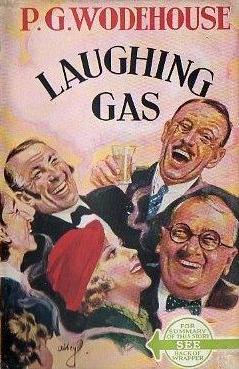
The quote above is self-referential. P. G. Wodehouse was both a New York playwright (in the musical comedy line) and an English novelist, and he had, indeed, been imported to Hollywood in 1929 to work on scripts for a while. He didn’t fit in and left little visible trace on celluloid, but he did mine the experience for comedy in his novels and stories. One of his most explicit Hollywood novels is Laughing Gas (which doesn’t seem to be available as an e-book, or even as a reasonably priced paperback, right now. But the link will take you to an audible book).
Reggie Swithin has recently inherited the title of Earl of Havershot, but he still hasn’t accustomed himself to that status. So he hasn’t the resistance to refuse the family solicitor’s request that he travel to Hollywood, California to disentangle his cousin Egmont from some American girl (who certainly must be inappropriate) to whom he’s gotten engaged.
On the train trip across the American continent, Reggie meets the beautiful April June, a famous movie star, who confides to him that she hates her life of glamor and longs for a simple home where she can be with her books and her flowers and her cooking… why, Reggie’s ancestral manor sounds like just the place!
Reggie is working up his nerve to propose to her as he arrives in Hollywood, where he meets the girl Cousin Eggy is engaged to – awkwardly, she turns out to be Ann Bannister, to whom Reggie himself was once briefly engaged. Then Reggie has an attack of toothache. In the dentist’s office, he finds that another Hollywood star, little Joey Cooley (“Idol of American motherhood”) is having the same procedure done by the dentist’s partner. As they are both under the influence of laughing gas at the same time, some sort of mix-up occurs (“probably in the fourth dimension,” Reggie thinks) and the soul of each transmigrates to the body of the other. Thus Reggie wakes to find himself very small, dressed in knickerbockers, and sporting long golden curls. He’s going to have to figure out how to live a child star’s life – which is made no easier by his guardian, a formidable woman who limits him to a diet based on prunes, to maintain his weight.
We only learn through hearsay what’s happening with Joey, in Reggie’s body, but the boy seems to have a good time. He can get all the sweets he wants now, and there are a lot of people he’s been dreaming of boffing on the nose; Reggie has a healthy young body with a good right arm and boxing training.
And so the story proceeds. Reggie will learn to view April June from a whole new perspective, and will also learn to appreciate ice cream and breakfast sausage in a whole new way. In the end, of course, everything will turn out for the best.
I have to admit I didn’t enjoy Laughing Gas as much as I remembered from my first reading, long ago. It’s not because the story is a poor one; it’s not. It’s just that, for personal reasons, I have trouble with stories about kids in general. It was interesting, though, to see how Wodehouse looked at Hollywood from personal experience.
I am delighted to be able to announce that King of Rogaland, the sixth book in the Saga of Erling Skjalgsson, is available for Kindle download as of today. Makes a great Christmas present for Kindle readers.
‘I mean to say, I know perfectly well that I’ve got, roughly speaking, half the amount of brain a normal bloke ought to possess. And when a girl comes along who has about twice the regular allowance, she too often makes a bee line for me with the light of love in her eyes. I don’t know how to account for it, but it is so.’
I am at one of those points in life where I find it prudent to re-read beloved books from my past, rather than spend money on new ones. Having made that determination, it was but the work of a moment for me to ankle off to the bookshelf and pull a book out of my P. G. Wodehouse shelf. And so I offer my review of Carry On, Jeeves.
The characters of Bertie and Jeeves first appear in a story called “Extricating Young Gussie”, (not in this collection) which was published in 1915. In it, Bertie is dispatched to New York by his formidable Aunt Agatha, because his cousin Gussie has formed an ill-advised attachment to a vaudeville performer. Bertie crosses the Atlantic on this mission, but in the end the whole thing is resolved through a farcical coincidence.
What’s rummy about this story (as Wodehouse himself would have put it) is that, first of all, we’re never told Bertie’s last name (it appears, in fact, to be Mannering-Phipps). Also, Jeeves does nothing brainy at all. He answers doors and takes people’s hats. That’s it. This is a nascent Jeeves and Wooster story. The concept remains in embryo.
It wasn’t until the next story, “The Artistic Career of Corky” (1916), that Wodehouse faced the challenge of solving a plot problem without letting Bertie do anything smart, which would violate his character. It was then that he hit on the idea of making Jeeves a super-intellect. And a wonderful phenomenon came into being.
“The Artistic Career of Corky” is included in the collection, Carry On, Jeeves. But its first story is “Jeeves Takes Charge” (also published in 1916). Here we get the origin story, as “rebooted” (as they say of movie franchises) by Wodehouse himself. The story opens with a wonderful scene in which Bertie, hung-over and temporarily valet-less, opens his door to “a kind of darkish sort of respectful Johnny” who immediately diagnoses his complaint and mixes up his proprietary anti-hangover concoction. Bertie engages him on the spot, and as the story continues, Jeeves contrives to disentangle him from an ill-advised engagement to Florence Cray (“seen sideways, most awfully good-looking”), who had a plan for “making something of him.”
And so it goes on through ten wonderful stories. Sometimes Bertie helps a friend out with a spot of matrimonial trouble. Sometimes Bertie’s Aunt Dahlia enlists him in an insane quest to steal some ridiculous object. It’s all light, implausible, and hilarious.
As I read, I couldn’t help thinking about Heaven (see my review on the book about Near Death Experiences, a few inches below). I think Heaven may turn out to be a lot like a Wodehouse story. We never grow old, and the world never changes (Wodehouse attempts to keep up with the times in a couple stories, but they jar). And above all stands the great God of whom Jeeves is a symbol, who (in this life, anyway) allows us to go our wayward ways, knowing that in the end we have no resource but Him, and no one who cares more for our welfare.
The breeze died. The high white sun leaned its tropic weight on the gaudy vacation strip of Florida’s East Coast, so that it lay sunstruck, lazy and humid and garish, like a long brown sweaty woman stretched out in sequins and costume jewelry.
Another classic John D. MacDonald book, non-Travis McGee variety, from The Murder Room. The Beach Girls is an interesting, often impressive tale stressing humans and society more than crime (though there’s some crime). These old paperbacks were intended for a male audience, so there’s also quite a lot of sex, though it’s not explicit. Very little monogamy is on display.
Stebbins’ Marina in Elihu Beach, Florida is a marginal operation. Its owner, an amiable widow, can’t afford to maintain it properly, and local interests are pressuring her to sell it to developers.
But the marina is home to a motley group of boat owners – local fishermen, poor boat bums and rich yacht owners. There are a couple stinkers among them, but most of them get along happily in a live-and-let-live way.
When Leo Rice shows up looking for work, something seems off about him. He’s nice enough, and he’s willing to learn and to work hard. There’s no arrogance about him. But he doesn’t seem to match the story he tells about himself. He has the look of a man used to bigger things, greater responsibilities.
Leo has a secret. He’s got an issue with one of the residents, one of the bad types nobody likes. He came for revenge, but now he can see that he’s not tough enough for that job. And he’s suddenly interested in Christy, one of the marina residents, a girl who’s been damaged in the past and put on a clown’s persona. Is he willing to die trying to get justice, or does he have a future with Christy?
The Beach Girls offers a very fine author’s human insight, empathy, and powers of observation. The mores of the time it describes are very different from ours, and will probably disturb conservatives and liberals alike. The sex is pretty free and easy in this little community, but there’s also a passage that seems to defend wife-beating (in an extreme case). Approach such passages with your sense of history in place.
I was busy translating today, and then I was busy catching up on things I neglected so I could do the translating. So what to post tonight?
My latest default seems to be finding Andrew Klavan videos, because nobody does the writing job better in our time.
The clip above concerns his novel Another Kingdom, so it’s a few years old. I remember the period when he was writing it particularly, because at the time I was enjoying a brief period of personal contact with him. I’d written a glowing review of the Weiss-Bishop novels for The American Spectator, and he e-mailed me to thank me. About the same time he made a request, on the blog he was doing at the time, for recommendations on good Christian fantasies to read, saying he was writing his own first Christian fantasy and wanted to check the field out. I sent him a file of my e-book, Troll Valley.
I never heard another word from him. Ah, well. Maybe I should have sent him Death’s Doors. Or The Year of the Warrior. Or just kept silent. One never knows.
Websites store cookies to enhance functionality and personalise your experience. You can manage your preferences, but blocking some cookies may impact site performance and services.
Essential cookies enable basic functions and are necessary for the proper function of the website.
Name
Description
Duration
Cookie Preferences
This cookie is used to store the user's cookie consent preferences.
30 days
These cookies are needed for adding comments on this website.
Name
Description
Duration
comment_author
Used to track the user across multiple sessions.
Session
comment_author_email
Used to track the user across multiple sessions.
Session
comment_author_url
Used to track the user across multiple sessions.
Session
These cookies are used for managing login functionality on this website.
Name
Description
Duration
wordpress_logged_in
Used to store logged-in users.
Persistent
wordpress_sec
Used to track the user across multiple sessions.
15 days
wordpress_test_cookie
Used to determine if cookies are enabled.
Session
Statistics cookies collect information anonymously. This information helps us understand how visitors use our website.
Google Analytics is a powerful tool that tracks and analyzes website traffic for informed marketing decisions.
Used to monitor number of Google Analytics server requests
10 minutes
__utmb
Used to distinguish new sessions and visits. This cookie is set when the GA.js javascript library is loaded and there is no existing __utmb cookie. The cookie is updated every time data is sent to the Google Analytics server.
30 minutes after last activity
__utmc
Used only with old Urchin versions of Google Analytics and not with GA.js. Was used to distinguish between new sessions and visits at the end of a session.
End of session (browser)
__utmz
Contains information about the traffic source or campaign that directed user to the website. The cookie is set when the GA.js javascript is loaded and updated when data is sent to the Google Anaytics server
6 months after last activity
__utmv
Contains custom information set by the web developer via the _setCustomVar method in Google Analytics. This cookie is updated every time new data is sent to the Google Analytics server.
2 years after last activity
__utmx
Used to determine whether a user is included in an A / B or Multivariate test.
18 months
_ga
ID used to identify users
2 years
_gali
Used by Google Analytics to determine which links on a page are being clicked
30 seconds
_ga_
ID used to identify users
2 years
_gid
ID used to identify users for 24 hours after last activity
24 hours
_gat
Used to monitor number of Google Analytics server requests when using Google Tag Manager
1 minute
_gac_
Contains information related to marketing campaigns of the user. These are shared with Google AdWords / Google Ads when the Google Ads and Google Analytics accounts are linked together.
90 days
Marketing cookies are used to follow visitors to websites. The intention is to show ads that are relevant and engaging to the individual user.
A video-sharing platform for users to upload, view, and share videos across various genres and topics.
Registers a unique ID on mobile devices to enable tracking based on geographical GPS location.
1 day
VISITOR_INFO1_LIVE
Tries to estimate the users' bandwidth on pages with integrated YouTube videos. Also used for marketing
179 days
PREF
This cookie stores your preferences and other information, in particular preferred language, how many search results you wish to be shown on your page, and whether or not you wish to have Google’s SafeSearch filter turned on.
10 years from set/ update
YSC
Registers a unique ID to keep statistics of what videos from YouTube the user has seen.
Session
DEVICE_INFO
Used to detect if the visitor has accepted the marketing category in the cookie banner. This cookie is necessary for GDPR-compliance of the website.
179 days
LOGIN_INFO
This cookie is used to play YouTube videos embedded on the website.