Category Archives: Fiction

‘The Big Dark Sky,’ by Dean Koontz

For as long as Ophelia had been wise enough to see the world as it really was, she’d been aware that it was shifting away from truth and light, sliding farther every year. But she would never give up and slide with it. Truth mattered, always striving for the light. As long as there were people like Colson, there was light in the world, a chance that the slide could be halted, even reversed.

It did not take me long to buy, read, and finish Dean Koontz’s latest novel, The Big Dark Sky, just released. I wouldn’t say it’s one of my Koontz favorites, and the title’s weak, but even an average Koontz is more delightful than most books I read.

Joanna Chase is a successful novelist living in Santa Fe. She has fond memories of her childhood on a ranch called Rustling Willows in Montana, though her time there ended in tragedy.

But now she’s started to get mysterious messages, through her TV and her phone and other devices. A voice calling for help, saying they’re in a dark place. As she finds herself compelled to return to Montana in response, she begins to remember things she’d forgotten. For instance, she’s entirely forgotten her best friend – a mentally disabled boy. How did that happen?

Meanwhile, the new owner of Rustling Willows, a multibillionaire, has hired a private investigator to take a close look at the place. Strange things have been going on there. He doesn’t feel safe bringing his family until they stop.

And nearby, a megalomaniac kidnaps a young woman, as an early step in his grand plan to exterminate the entire human race, which in his view has proven itself unworthy of the planet.

What I liked best about The Big Dark Sky was that, although things got very dark (and Koontz can write dark with the best of them), it’s mainly a book about hope. Exactly the kind of book we need in 2022. Though the last line contains an intriguing grim joke.

As far as religion goes, Koontz’s Catholicism is not very evident here. The Gandalf figure of the story, Ganesh, can be presumed to be Hindu. But the scientific/mystical themes are suitable for most anybody.

Cautions for language and a sex scene.

‘Cult Justice,’ by Dennis Carstens

It’s a common complaint among writers, especially new writers, that editors will return a manuscript without reading past the first page or two. The writers feel they haven’t been given a fair trial.

What they don’t understand is that all editors, and many readers, have developed the ability to spot a clunker at a very early stage. Certain common mistakes immediately mark a writer as an amateur, and most editors have no time to give free writing lessons to every stranger who shoots a story over the transom.

I’m an editor in a small way, and I think I’ve been reading long enough to have some of that instinct myself. When I started reading Dennis Carsten’s Cult Justice, I spotted some caution lights, and didn’t think I’d stay with it for the long haul.

But in this case I was wrong. The prose has undeniable weaknesses, but the story grabbed me and turned out more engaging than I expected.

Ben Sokol is a self-hating Jew and committed leftist, a tenured professor at a state university in Minneapolis. He’s convinced his genius is unappreciated, and he envies more famous and wealthier colleagues. But one day he and a student decide that what society needs is more direct action. There’s been enough talk. It’s time to take violent action – by, for instance, robbing banks. For good causes, of course, though Ben will need to keep a percentage for his expenses…

He assembles a team of idealistic students who scout locations and plan carefully. Soon the news is reporting a series of lightning-fast bank raids, efficient, profitable and bloodless.

Until there is blood.

Meanwhile, Marc Kadella, Minneapolis attorney, is involved in the divorce case from purgatory. The couple seems like a pair of normal, prosperous citizens, but he can’t keep them out of each other’s faces, in one way or another. Until the wife is murdered, and the husband, Marc’s client, is arrested for her murder.

Who would think her death is actually related to the rash of bank robberies?

At the beginning of Cult Justice, I was (strange as it may seem) put off by how much I agreed with the politics. I’m so used to seeing second-rate literature from my side of the fence that I’m afraid I’ve grown prejudiced. And in actual fact, author Carstens does have weaknesses as a writer. One of his besetting sins is misplacing the object of a clause (I’m sure there’s a technical term for that, but I’ve forgotten it): “Having grown up on the East Coast, January was still too much for Ben to take.”

But the story was fun, and the characters were fun, in the tradition of legal and police thrillers. One element that intrigued me was the description – or lack thereof – of Marc’s girlfriend Maddy. Unless I missed something, we are never told what she looks like, not even whether she’s blonde, brunette or redhead. All we know is that everybody talks about her as the hottest thing on two legs. I thought that was a very creative way to present a character – until I found out this was the tenth book in the series, and author Carstens probably just assumed we already knew.

I thought the plot could have been tighter. I would have liked (for the sake of balance) to have had at least one sincere, intelligent leftist in the cast, rather than just scoundrels and dupes (it annoys me when leftist writers treat us that way).

Still, it was fun to read an engaging, fairly professional mystery written from a conservative point of view. You might like it too. Cautions for language and adult stuff.

‘Judge Me Not,’ by John D. MacDonald

“You stay in town long enough, and I’ll own you too. I tell you to eat grass and you’ll eat grass. I know. You’re telling yourself you’re a big strong guy and you’d die before you’d take orders like that. That’s fairy story stuff, Morrow. Hero stuff, like in the books. People aren’t like that. You can break people. You can break anybody in the world, if you know how to go about it. If you want to be smart, just join my team. Dennison doesn’t have to know. Keep the five grand. You like this little girl? Take her home with you. She’ll do anything you tell her to do.”

I said of the last old, republished John D. MacDonald novel I reviewed that it felt like a “programmer,” a quick project slapped together to meet a deadline. MacDonald did, after all, work on contract for the pulp paperback trade.

Judge Me Not, the latest one I read, is a very different specimen. Though written for the paperback market, and at a very early point in his career, and though it follows the conventions of the pulp genre, it transcends all that and (in my opinion) achieves the level of serious literature. It belongs up there with Hemingway – or at least with Dashiell Hammet.

Teed Morrow is a sort of professional reformer. He served in the occupation forces in Germany after the war, and then teamed up with his former commander to work for civic reform. They’ve gotten themselves hired as city manager and assistant in the town of Deron, New York. They’re on schedule with their plan to expose and oust the current mayor and the gang that supports him.

But Teed isn’t quite the straight arrow his boss, a widowed father of two daughters, is. Teed’s a bit of a swinger. And right now he’s sleeping with the mayor’s wife. Who could it hurt?

What he and his boss don’t realize is how seriously corrupt and vicious the gang running the town is.

That becomes very clear when Teed wakes up one day to find the mayor’s wife murdered in his lake cabin. He manages to dump the body before the cops show up (heroes disposing of women’s bodies seems to have been one of MacDonald’s go-to tropes at the start of his career; it’s featured in the last three of his novels I’ve read), but that doesn’t prevent his being arrested and beaten within an inch of his life by the cops.

And that’s just the beginning. It will get much, much worse before Teed manages to take the fight back to the enemy.

Judge Me Not’s plot genuinely surprised me. It was troubling and a little shocking. Very bad things happen to people who don’t deserve it, but there’s a moving redemptive element too.

I was highly impressed with Judge Me Not. Cautions for sexual situations (1950s vintage, so they’re not very explicit). Highly recommended.

‘Woman in the Waves,’ by William J. Cook

This book grabbed me on the first page, with a well-written description of a walk on the beach.

Unfortunately, it lost me soon after that. But I stayed with it out of an odd sort of train-wreck fascination.

Woman in the Waves by William J. Cook is part of a series, and apparently wraps up business from previous books. But it stands alone all right. I certainly won’t be going back for the preliminaries.

Peter Bristol is a college professor in Driftwood, Oregon, a widower who has regimented his life strictly to regain a sense of control. One day, on his weekly walk on the beach, he sees a woman in a wedding gown walking into a heavy surf. Although he tries to rescue her, she’s gone in a moment.

Then, not long after, he finds a woman’s severed arm on the beach. On one of its fingers is a valuable diamond ring.

Policeman Charley Whitehorse is chief of police in Driftwood. In spite of the coincidence of Peter reporting both incidents, he doesn’t suspect him. His thoughts can’t resist turning to a man he knows to be a killer, who eluded him in a previous case – another college professor with a sexual taste for young coeds.

The story itself was okay, though melodramatic at the end. But the storytelling was highly amateurish. It read very much like a lot of well-meant Christian fiction – and often slipped into theological discussions. But no particular faith was affirmed, and a fair amount of profanity was present. Also there was premarital sex without criticism.

The author’s main problem was over-writing, something I complain about in a lot of my reviews. One of the characters asks at one point, “Is everybody around here becoming a [expletive deleted] philosopher?” A moment of self-awareness by the author, because everybody does philosophize in this book. Which leads to another problem – all the characters think and talk the same way. Gangsters and cops and college professors – you can’t tell them apart by their speech. In general, it’s a good idea to convey information to the reader through thought and dialogue rather than information dumps. But there are limits. Not everybody thinks out everything they’re doing every time they perform habitual acts, but they do in this book. A lot of very unnecessary information gets conveyed.

Also, the characters tend to make theatrical gestures, like leaping up and shaking their fists at the heavens. Scenes like that need to be used judiciously, if at all.

So I did not enjoy Woman in the Waves, and I do not recommend it.

The Wingfeather Saga Animated Series Coming End of Year

The first season of the animated adaptation of Andrew Peterson’s Wingfeather Saga will be streaming from Angel Studios after Christmas 2022.

Angel Studios is the company responsible for The Chosen series as well as two clean comedy shows, Drybar Comedy and Freelancers (The first season of Freelancers is mad-cap hilarious.)

Last week, World News Group released an interview with two men behind The Wingfeather Saga series, Neal Harmon, co-founder of VidAngel and Angel Studios, and the series showrunner, Chris Wall.

The interview has a few points of interest, and I want to share only one of them here. Wall talked about some of the difficulties in finding partnering studios who may push or insist their story hit certain cultural values they don’t want to hit. Angel Studios said, “You guys make your show. Like, we’re happy to provide feedback for what we think works, you know, audience metrics and that sort of thing. But you know your people, you know your content, go make that.”

Netflix wouldn’t have it that way. Wall said, [edited] “We were told they’re not going to do Wingfeather Saga, they’re not into it over at Netflix, because it’s patriarchal in structure. And we’re not going to do those kinds of stories. . . . because we have a grandfather and a mother and these kids that live together and like we’re not into that. It has to be, you know, a single mom or a dad and any other kind of gender or sexual things you can put in there, they’re into it.”

‘Dead Folks’ Blues,’ by Steven Womack

A surprising number of older mysteries are showing up these days, a development that pleases me a lot. Such books are enjoyably un-Woke, by and large. Dead Folks’ Blues, by Steven Womack, is a pretty good book with roots in classic hard-boiled.

Harry James Denton is recently divorced, and recently fired from his job as a newspaper reporter in Nashville, Tennessee. He moved into a smaller apartment, switched to a smaller, older car, and set up as a private eye. So far, most of his income has come from repossessing cars and skip tracing for a buddy in that business, and his operation is sinking fast.

Then in walks Rachel Fletcher, blonde, beautiful and rich. Once upon a time, Rachel and Harry were in love. But they drifted apart, and she married a successful surgeon. Now she’s living the good life.

Except it’s not as good as it looks. Her husband, she tells Harry, has a gambling problem. She’s pretty sure someone has threatened his life over unpaid debts. She’s willing to pay Harry – generously – to keep an eye on him.

The money, on top of Rachel herself, is irresistible. But this case will be full of surprises. Harry will find himself unconscious on top of a corpse, followed around by sinister characters, and beaten within an inch of his life before – belatedly – the whole plot comes together for him.

Dead Folks’ Blues was fun to read. Author Womack does a pretty fair job with his hard-boiled narration, though he needs to learn when to stop talking and trust the reader to get the joke. Also, I figured out Whodunnit pretty early.

Not sure if I’ll carry on with this series. It shows promise, but there are suggestions of leftish political leanings – and such things tend to only get worse. But it was worth reading. I do recommend it.

‘Alexandria,’ by Paul Kingsnorth

Well, I have done it. I have completed reading Paul Kingsnorth’s Buccmaster Trilogy. Frankly, if I’d known what I was getting into, I’d probably have given it a miss. But in the end, it did grab me.

Alexandria, the third book of the trilogy, almost seems to take us back to the 11th Century setting of the first book, The Wake. It’s about people living a primitive life in fen country. Only this isn’t the past, it’s the post-apocalyptic future, some time after global warming (one assumes) has permanently heated the earth and raised the water levels.

The main characters, who speak in the same kind of crude old English dialect as Buccmaster in The Wake, are all that remains of one of the few remaining, primitive human tribes. Once there were hundreds of them, but they’re down to seven. There are a patriarch and a matriarch, a married couple with a young daughter, one other old man and a young man, who has no sexual outlet except for carrying on an affair with the married woman.

They are a matriarchal society, and they worship an earth goddess. Their creed is the importance of the body – there can be no life without the body. Their great enemy is Wayland. (We remember Wayland as Buccmaster’s god in The Wake. But now Wayland isn’t a blacksmith god, but the guiding spirit of Alexandria, which is an artificial intelligence bank into which most of humanity has uploaded its consciousnesses. Emissaries from Alexandria, strange semi-human creatures in red cloaks, constantly dog them, tempting one tribe member after another away into the supposed delights of Alexandria.

Toward the end, when the villagers have to flee rising waters and head for Glastonbury, where they expect final illumination, I began to actually be engaged with this story. Although there’s no Christianity here, except in passing allusions, the central question is a profoundly Christian one – what does it mean to have a body and a soul? Do body and soul have to be at war? Can there be a marriage between them?

I don’t necessarily recommend Alexandria or the Buccmaster Trilogy, unless your brow is pretty high as a reader. But it’s a meaningful literary exercise from an author who’s now a Christian.

‘You Live Once,’ by John D. MacDonald

Another oldie from John D. MacDonald to review. You Live Once is not, in my opinion, his best work. But I may be prejudiced. (Ya think?)

Back in the mid-50s, when You Live Once was published, there was a particular kind of corporate culture common to several major American corporations (I had an uncle who was involved in this). The company would move young executives around, relocating them every couple years, putting them to work in various divisions on various jobs. The idea was to make them generalists, able to step in and take over wherever they were needed.

Clint Sewell is part of this culture, though unusual in being a bachelor. That suits his boss, Dodd Raymond, very well. Dodd is carrying on an affair with Mary Olan, a wealthy local girl, notoriously promiscuous. Dodd brings Clint along on double dates with his wife and Mary, allowing him to spend time with Mary while Clint amuses his wife. Clint has tried his own luck with Mary, but she put him off.

It’s a great arrangement for Dodd, until everything goes foul. Clint wakes up in his apartment one morning with a bad headache, and finds Mary dead in his closet – strangled with his own belt. Panicking, Clint drives the body to the woods and dumps it (feeling guilty). But that doesn’t put the police off long. Soon he’s a fugitive, looking for someone to turn to for help.

I thought You Live Once was more of a programmer than most of MacDonald’s books, more of a potboiler cranked out for a buck. But my judgment is clouded because the story employs a trope I dislike. That trope may have been quite fresh in 1956, but it’s pretty predictable today. And it’s one that annoys me.

So I don’t give You Live Once my highest rating. Your may like it better.

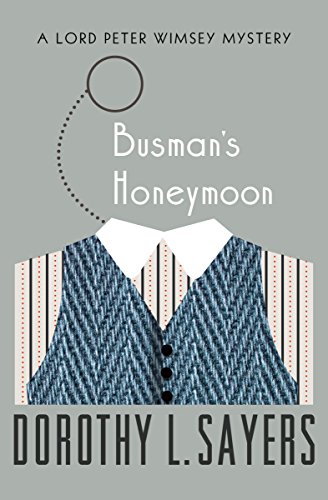
‘Busman’s Honeymoon,’ by Dorothy L. Sayers

Dorothy L. Sayers initially intended to end her Lord Peter Wimsey series of mystery novels with Gaudy Night, in which Harriet Vane finally succumbs to Peter’s charm and agrees to marry him. But later she collaborated with Muriel St. Clare Byrne on a Wimsey play, called Busman’s Honeymoon. In the play, the honeymoon is interrupted by the discovery of a murdered body, to the couple’s frustration and some interesting character revelation.

Later Sayers turned the play into a novel. It’s not considered one of the best of the series, but it has virtues that make it well worth reading.

The story opens with a series of letters written by various characters, describing the wedding and its initial aftermath. Harriet has confided to Peter’s mother that she always wanted to live in a particular house she used to visit as a child, in a village in Hertfordshire. Peter has delightedly bought it for her, and he and his man Bunter have arranged for the house to be ready for their occupation when they show up on the wedding night.

However, they find the house locked and uninhabited, and none of the servants were expecting them. At last they get in, make shift to set up in spite of inconveniences like blocked chimneys, and consummate their marriage. The next morning the missing former owner is found – bludgeoned to death in the cellar.

The local police superintendent takes to Wimsey immediately, being, like him, devoted to collecting literary allusions for insertion into conversation. Lord Peter can’t resist involving himself in the mystery. They will encounter a collection of local eccentrics, all with various motives for wanting the victim dead, but with either insufficient motivations or solid alibis. The final solution will prove to involve a genuine scoundrel and a baffling murder weapon.

The story gets slow in some stretches, especially in what I assume (it’s been a while since I read it) the added scenes not found in the play. The great virtue of the book, in my opinion, is the section at the end where Peter suffers a PTSD reaction as the murderer’s execution hour approaches, and Harriet comforts him.

Recommended. I also think some Christian college ought to stage the original play some time. I wish I’d gotten the chance to play Lord Peter when I was young and thin.

Debunking Electrifying Hobby, Oversharing, Blogrolling

I subscribed to a video service in order to watch a movie last month, and since then I’ve tried to catch a few more in the package before cancelling. So far, it’s been a buy-one-get-four deal.

This week a couple of us watched the original Top Gun for the first time. I’ve heard it’s a frequently quoted movie. It can’t be more than any other well-received flick of its time. Only a couple lines stood out to me from the scant story that links the flying together. But the flying is cool. Dog fighting is cool. Faux drama about possibly running out of gas so you shouldn’t try to help a couple teammates return alive is not cool.

The F-14 Tomcats they fly in the movie have co-pilots, radar intercept officers (RIO). From what you see on screen, they appear to be only a second set of eyes, so I had to look up what they could do in the air–navigation, radio, electronics, and some weapons. Dave “Bio” Baranek, a Top Gun himself, has a book on it.

I don’t plan to watch it again, but then I rarely rewatch anything anymore.

Both sides: “The American body politic, Mamet tells us, is fundamentally diseased, and is slowly being consumed by an ideologically radical political class which, left unchecked, is sure to consume it.” A Playwright’s Life – (lawliberty.org)

Banned by YouTube: Ann Reardon has many great videos on cooking and other videos that debunk “life hack” videos that purport to demonstrate a cool, new time-saver, often food related. Her recent video exposing the dangers of fractal wood burning (“34 deaths”) was removed by YouTube, because somehow the artificial intelligence judged the debunk to be more dangerous than the how-to.

Star Rating? Tyler explains the reasons he doesn’t like Goodreads.

Uncle Tom’s Cabin: A book that changed the world.

Social demands: “Learning to say ‘no’ can be difficult; learning to not reveal one’s conscience on every single issue that hits the news can be even harder, especially in a society where it is seen as good and noble to have a ‘take’ or a strong moral stance on practically everything. . . .”

Stormy Sea with Sailing Vessels by Jacob van Ruisdael

Feature Photo: Christie’s Restaurant sign, Houston, Texas. 1983. John Margolies Roadside America photograph archive (1972-2008), Library of Congress, Prints and Photographs Division.