David J. Gatward’s Harry Grimm books are not great literature, but they’re entertaining “English rural” police stories. Harry, you may recall, is a former English paratrooper who joined the police in Bristol after surviving an IUD explosion in Afghanistan. His wounds left him with rather severe facial scarring, which he cheerfully exploits in intimidating suspects. Transferred to a town in the Yorkshire Dales, he’s finding himself – to his own surprise – settling in comfortably with the laid-back, eccentric local force.
In Blood Sport, one of Harry’s colleagues is still smarting from the death, in a previous book, of a close friend who turned out to be a criminal involved in sheep rustling. When a dog is found dead, torn to pieces, in an abandoned barn, the ensuing investigation into illegal dog fighting leads to links with that sheep rustling operation. It’s all part of a large, organized conspiracy run by greedy and cruel people, something no one had looked for out here in the country. The worst part is that no one can be sure whom to trust.
As the mystery gets resolved, we also get to see Harry Grimm make some surprising new connections in his own life.
Blood Sport is plagued by a few misspellings and typos, but is nevertheless quite enjoyable to read. Only mild cautions.
“It is possible, my lord, if your lordship will excuse my saying so, that the liveliness of your lordship’s manner may be misleading to persons of limited—”
“Be careful, Bunter!”
“Limited imagination, my lord.”
“Well-bred English people never have imagination, Bunter.”
“Certainly not, my lord. I meant nothing disparaging.”
I was first introduced to Lord Peter Wimsey through the BBC production of Clouds of Witness (the subject, in its book form, of this review) broadcast on Masterpiece Theatre back in 1973, with the irresistible Ian Carmichael starring. (He didn’t actually resemble the character described in the books, but once seen, he’s impossible to get rid of.)
Clouds of Witness is one of those stories where coincidence and withheld information combine to confuse a fairly simple problem. Lord Peter Wimsey is in Paris, on his way home from a holiday in Corsica, when he learns that his brother Gerald, Duke of Denver, has been arrested for murder.
The fatal events occurred at a hunting lodge in Yorkshire, where the duke and his family and friends were staying. Denis Cathcart, a slightly-too-smooth young gentleman to whom Peter’s sister Mary is engaged, is discovered in the early hours of the morning, shot to death outside the conservatory. Sir Gerald is standing over him.
Mary claims she was awakened by a gunshot, which is a lie, since the shot had been fired more than an hour earlier. Gerald refuses to explain what he was doing outside at that hour.
Sir Gerald’s lawyer, at his client’s wishes, plans to base his defense on reasonable doubt; the gunshot wound could reasonably have been self-inflicted. But Lord Peter, when he shows up, is determined to get past the intersecting lies and discover what really happened. The true murderer must not be allowed to escape. The investigation will lead him to be shot at, to nearly drown in a Yorkshire bog, and to risk his life on a trans-Atlantic airplane flight in a storm (this story is set in 1920, you must remember).
Clouds of Witness is not Dorothy Sayers at the height of her powers, but it’s a fascinating and original detective problem, enjoyable and well worth reading. I particularly enjoyed the tongue-in-cheek descriptions of the English nobility and their quaint customs.
“…You want to look dignified and consistent—what’s that got to do with it? You want to hunt down a murderer for the sport of the thing and then shake hands with him and say, ‘Well played—hard luck—you shall have your revenge tomorrow!’ Well, you can’t do it like that. Life’s not a football match. You want to be a sportsman. You can’t be a sportsman. You’re a responsible person.”
“I don’t think you ought to read so much theology,” said Lord Peter. “It has a brutalizing influence.”
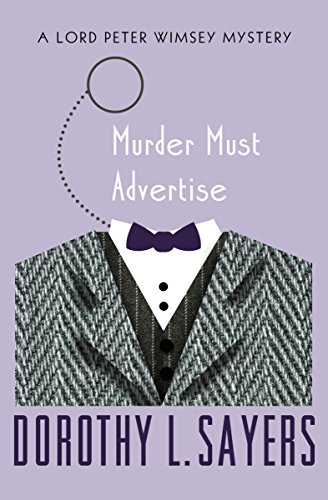
It had been a while since I’d read any of Dorothy L. Sayers’s Lord Peter Wimsey books. Two collections showed up at bargain prices on Amazon recently, so I snapped them up. Then I settled down with the first novel, Whose Body?The author was still finding her voice as a mystery writer here, but it’s a very enjoyable read.
Lord Peter Wimsey, if you’re not familiar with him, is an English nobleman, the younger brother of a duke. He suffered “combat fatigue” in World War I, and immediately after was jilted by his fiancée. He took up detecting crime as a sort of therapy hobby, and is good at it. His success is aided by the fact that he looks and acts very much like Bertie Wooster (Ian Carmichael played both roles creditably), so people underestimate him. (His valet Bunter, by the way, is hard to distinguish from Jeeves.)
When the man who is repairing the church roof at the Wimsey ducal estate is detained by the police, the dowager duchess turns to her son Peter to figure out what’s really going on. The poor workman walked into his bathroom one morning and found a dead man in his tub, naked except for a pair of pince nez glasses. Inspector Sugg of Scotland Yard (a stereotypical character whom the author wisely faded out of succeeding books) loses no time arresting the poor man and his housemaid.
Meanwhile, a well-known Jewish financier, Sir Reuben Levy, seems to have disappeared from the face of the earth. He bore a superficial resemblance to the mysterious body in the bath, but is not the same man.
Lord Peter, assisted by his good friend Inspector Parker, takes advantage of the considerable license the police authorities allow the nobility, and starts his own investigation. It will lead to a horrible discovery and a terrible revelation.
Whose Body? is an enjoyable introduction to a stellar (and groundbreaking) detective series. I was particularly intrigued, on this reading, by certain instances of what today we’d call “cultural stereotypes.” Sir Reuben Levy’s description sounds like a standard, slightly antisemitic trope. But the author is delving deeper. We learn from those who knew him that the man was in fact a capital fellow, and much loved. The same goes for an American character who talks in the kind of broad American accent one sees so often (painfully) in old English books. But again, on getting to know him, we learn he’s an admirable guy. I’ve heard Sayers criticized for “snobbery,” but I think it’s deeper than that. She uses the stereotypes in order to transcend them, and makes a subtextual statement in doing so (Hey! I used subtextual in a sentence!)
I highly recommend Whose Body? Not only is it an intriguing, well-plotted mystery, but there are few literary pleasures that compare with listening to Lord Peter talk piffle.
Long ago, when his career was young, Bernard Cornwell used to write mysteries set in the yachting world. I found some of them in a public library (in Florida, as I recall), and enjoyed them very much. Cornwell stopped writing them because they weren’t selling, and went on to write historical epics, winning fame and fortune. But I’ve often mourned those sailing stories.
So when I saw a bargain on Killer Aboard, by Sean Blaise, about murder on a trans-Atlantic sailing voyage, I grabbed it up, hoping for the same kind of magic.
I was disappointed.
The hero of Killer Aboard is John Otter, who usually works as a skipper of yachts for the wealthy. But he’s bored with that, looking for something more elemental. When he hears of an English university program that would have him captaining a crew including several students who’ll be learning as they go, it seems like just the challenge he’s been looking for, and he signs up. The voyage begins in South Africa.
Among the sailors are the university instructor, who thinks she ought to command the ship, a South African on the run from loan sharks, and several university students whose true motivation is not educational, but a treasure hunt involving Napoleon’s (empty) tomb when they stop over on the island of St. Helena. By the time they leave St. Helena, a local will have been murdered (unknown to Capt. Otter), and the students will be bound in a deadly pact of silence. Then there’s a murder. Then the great storm hits and all the communications equipment is fried.
I had two problems with Killer Aboard. One was the weak writing. Author Blaise’s diction is often awkward, and he never knows where to place his commas. My second problem was the hero. John Otter is not, it seems to me, a very good commander. He commands as I would in his place (I’d be a bad commander too), letting discipline slide until it’s too late. He knows and cites the proper principles – start out like a dictator so there’ll be no question when things get rough – but he doesn’t follow them.
Once the storm comes up and things get hairy, the book does its job as a thriller. But I wasn’t happy about it all, and don’t recommend it.
Captain McGee. Private cruises. Personalized therapy. And a little twinge of pain when the plane took off, pain for McGee, because she was too close to what-might-have-been. If there’s no pain and no loss, it’s only recreational and we can leave it to the minks. People have to be valued.
In 1963, Fawcett Publications (which began, as I’ve told you before, in Robbinsdale, Minn., the town where I live, but had by this time been in New York state for decades) faced a business crisis. Fawcett was one of the pioneers in the field of “paperback originals” – novels published specifically for the paperback market, generally sensational and lowbrow in character. Their most popular writer was Richard S. Prather, author of a series of racy hard-boileds starring a randy private eye named Shell Scott. Prather had received an irresistible offer from Pocket Books, and was jumping over to their house. Fawcett desperately needed a new series detective.
In a moment of sanity (fairly rare in publishers) they turned to one of their most dependable and talented writers, John D. MacDonald. “Give us a series hero,” they said.
MacDonald’s response was a character he planned to call Dallas McGee. Dallas would be a lanky beach bum, living on a houseboat in Fort Lauderdale, Florida. Instead of a private eye, he would call himself a “salvage specialist.” When people were robbed or cheated out of valuable possessions or large sums of money, they could go to McGee. He would try to retrieve them, and if he succeeded he got to keep half.
Fawcett green-lighted the project, and McDonald quickly churned out several short novels starring Dallas McGee to launch the series rapidly. They were nearly ready to release the first one when disaster struck – inconvenience for Fawcett, but tragedy for the nation. Pres. John F. Kennedy was assassinated in Dallas, Texas on Nov. 22. Everyone understood that it would be very poor taste to offer a series hero named Dallas in the present atmosphere. They consulted with the author and settled on a new name – Travis McGee. The pages were all re-set, and the first book, The Deep Blue Goodbye, appeared in early 1964.
Not long ago, a sale price showed up for the e-book version of Nightmare in Pink, the second offering in the series. I figured, “Why not? Let’s see how it holds up.”
I was amazed how much I enjoyed it.
Travis McGee, it is explained, is a veteran of the Korean War. One day during the war, his buddy Mike Gibson was substituting for McGee while he was on leave. Mike came under attack, and ended up crippled and blinded. Today he lives in a VA hospital. McGee visits him from time to time. Now he’s facing life-threatening surgery. He has a favor to ask.
His sister Nina, he says, is a commercial artist in Manhattan. She’s gotten engaged to a businessman, an investment broker. Would McGee check the guy out, see if he’s kosher?
McGee can’t say no. But by the time he’s arrived, the issue seems moot. Nina’s fiancé is dead, victim of an apparent mugging. Only the evidence doesn’t add up. When McGee starts poking around his life and his associations, it looks as if he suspected some crooked goings-on. Could he have been murdered to keep him quiet?
As McGee slips into a relationship with Nina (no surprise there), he also steps on some trip wires, alerting people who are very powerful and very ruthless, who will not hesitate to destroy both him and his new girl.
I had a strange sensation as I read Nightmare in Pink. A clarity, a cleanness I don’t experience with most contemporary novels, even ones with better sexual morals. It was a feeling something like stepping out of a smoke-filled room into the fresh outdoor air.
What Nightmare in Pink was not polluted with was Wokeness. Travis McGee came before men felt obligated to be apologetic about being men. He’s proud to be a man, comfortable in his masculinity. He likes women and they like him. I read books like these to live vicariously, and Travis McGee offers a mainline shot of pure, vicarious testosterone.
I’ve often written about my pleasure in hard-boiled narration. McGee does hard-boiled narration, but in his own way. Instead of the jewel-like aphorisms you find in Raymond Chandler, MacDonald’s McGee offers thoughtful meditations. He makes observations of the world, of humanity, and right and wrong. I don’t always agree with him, but there’s more genuine thought going on here than you’d expect in a straight-to-paperback potboiler from Fawcett.
In short, I had a blast with Nightmare in Pink, and recommend the whole series (though I consider the e-books a little overpriced).
[The book has a new introduction by Lee Child which does little to advance MacDonald criticism, in my opinion. His best argument to persuade modern people to read the books seems to be that MacDonald was ecologically aware. That’s true, but misleading. Current environmentalism tends to the Luddite side, and MacDonald was no Luddite. He had a business degree, and sympathetic businessmen are not rare in his books.]
I didn’t grow up here, but when you come to stay in L.A. it adopts you. It’s a wild crazy aunt of a town, dressed up in boas and bangles and laughing too loud, sometimes getting angry for no apparent reason and throwing a screaming fit, only to calm down and pull you in for a forgiving embrace even though you haven’t done anything to be forgiven for.
I genuinely love James Scott Bell’s Mike Romeo novels. As I’ve said too many times already, there aren’t a lot of Christian writers today who can write a story worthy to play with the big kids in the industry. Bell’s books are that good, and they manage to keep the language mostly PG. Mike Romeo is a particularly interesting hero, a genius, a Harvard drop-out, a martial arts expert and former cage fighter. He’s on a spiritual journey, facilitated now by his new employer, a disabled Jewish lawyer named Ira for whom he serves as investigator.
As Romeo’s Town opens, Mike rescues a clerk in a bookstore from a knife-wielding attacker, braining him with a large volume on Shakespeare by Harold Bloom. Almost predictably, it’s Mike who ends up in trouble with the law. Then he and Ira go to see a new client, a teenaged boy attending an elite private school, who has confessed to dealing drugs. His mother, who hired them, thinks the boy is covering for another student. Mike’s investigation (punctuated by frequent fights, sometimes to the death) leads him into the intersection between the social elite and the narcotics rackets. With some nasty surprises for him personally. Plus a reunion with the love of his life.
Mike Romeo is a fascinating character, and (in my opinion) author Bell does hard-boiled narration better than anybody writing today, but with a sly personal slant. Highly recommended.
I’ve been following Alex Smith’s exciting Robbie Kett thriller series. Book Three, Three Little Pigs, rounds out a narrative cycle in the series.
My review of the first book was, in retrospect, conspicuously lacking in perception. I described the book as psychologically extreme, rather than physically extreme. The second book proved me wrong, in spades, and Three Little Pigs takes it even further. Hero DCI Kett doesn’t actually pull needles out of his arm and stagger out of an ICU unit (as so many thriller heroes are wont to do), but that’s about the only extreme he doesn’t go to in this excruciatingly suspenseful story.
As you may recall, Robbie Kett is a London Metropolitan police detective who was dispatched to the more bucolic city of Norwich after his wife Billie was forcibly abducted and disappeared without a trace, five months back. Robbie had been obsessing over the investigation, and his superiors thought it would be best to get him away and let cooler heads look for her. However, he’s seen plenty of action in Norwich – he’s still healing up from wounds he sustained two books ago, not to mention the ones from the second book.
Then a call comes from London. A woman has been found in a weird, abandoned house that seems to have been set up for cult practices. She’s still in shock in the hospital and not talking, but it looks as if they have a real lead now. Robbie is back in London like a shot. His orders are clear – he can observe, but isn’t to interfere with the investigators. As if that’s going to happen.
As Robbie plunges into things, he’s surprised to find clues where no one has before. Granted, he goes to extremes nobody else will, but it almost looks as if the others weren’t really trying. As he functions as a loose cannon in the investigation, earning repeated reprimands and finally house arrest, he begins to dimly glimpse how big the forces involved here are, and to realize there’s nobody he can trust. Nobody at all.
This book nearly killed me as a reader. The stakes started high and kept rising. What looked like a major resolution toward the end turned out to be only the start of new horrors. Three Little Pigs is a page-turner, without a doubt. As is common in such stories, a certain lack of plot logic hardly counts.
Recommended, if you can handle the tension. Cautions for language and serious perversity.
I think most readers will find few surprises in Colin Knight’s Some People Deserve to Die. It’s a fairly standard revenge story, but it’s told in a compelling way.
Alan Davies is discovered homeless on the streets of Toronto, strung out on booze, drugs, and guilt. After he dries out in a hospital, he discovers he’s actually fairly wealthy now. What he’ll do next is a no-brainer – he’ll get revenge on the people who ruined his life.
As a boy in a small town, Alan was a nerd, a target of bullies. One day those bullies tricked him into committing an act that left him permanently shamed. It didn’t help that his father had died that same year, and his sister had committed suicide. So he went on the road. His wanderings took him first to the South Pacific paradise of Vanuatu, where he got involved with the local drug trade and learned to be a thug. When that went sour, he fled to the North Atlantic to work on an offshore oil rig. Then he followed his drilling team to Nigeria, where they stepped into a hellish world of crime, corruption and bestial cruelty. That led him to a stint as a mercenary, and finally to a quest for oblivion on the streets of Toronto. Then, at last, to his neat, professional, ruthless revenge project. And a shocking discovery.
The revenge story is a difficult challenge for a Christian reviewer. Forgiveness doesn’t enter into this story, but things don’t work out quite as Alan planned, so forgiveness may be conspicuous by its absence. (Though I wasn’t quite sure how to think about the conclusion.) I knew what was coming pretty much all the way through, but the storytelling kept me fascinated (in spite of some typos).
Moderately recommended, if you have a strong stomach for violence and rough language.
It’s not often I finish reading a book with the feeling of, “Glad that’s over.” But that was my response to The Assistant, a stand-alone novel by Kjell Ola Dahl, one of the big guns of Scandinavian Noir.
There are two parallel narrative threads in this book. In 1924, a young man with the non-Norwegian name of Jack Rivers works as a driver for a bootlegger. Though a thrill-seeker and a bit of a rogue, Jack would rather be doing something legal. But there’s a depression on, and he takes what work he can get. Eventually he will be arrested by the incorruptible policeman Ludvig Paaske, who nevertheless takes a liking to him. Jack has a sense of honor and is faithful to his friends, something those friends do not reciprocate.
In 1938, Jack is out of prison, now working as an assistant for Paaske, who has become a private detective. Paaske is approached, in the classic Hard-boiled manner, by a beautiful woman who wants him to follow her husband. She suspects he’s being unfaithful.
Her husband, it turns out, is the bootlegger Jack used to work for, now a successful businessman and politician. And the wife is not being entirely honest. Both Jack and Paaske will have reunions with women they cared about in the past, and each will worry that the other is being manipulated. In addition, Nazi agents are involved.
The Assistant is a moodier and more thoughtful book than the average mystery. I suspect it might be more evocative in the original Norwegian. This translation seemed good to me at first, but seemed to deteriorate as it went along. Sometimes it was ploddingly literal (a vice hard to avoid, as I can say from experience). And sometimes it seemed like a rush job to me, the author having given up on finding the right words. The first time someone made coffee in a “pan,” I thought it was due to their poverty, but eventually I realized the translator must have blanked on the words “pot” and “kettle” all through. And the parliament is referred to as “Stortinget,” which is technically correct but won’t be familiar to many English-language readers.
I need to mention that a Labor Party speech gets fact-checked by Paaske at one point (that’s rare in a Norwegian book), and one character’s Christian piety is treated with respect.
But I didn’t believe this story. It was operatic – the main characters make great, Quixotic gestures that seem both irrational and out of character. And the two different timelines share so much in location, characters and action that they were hard to keep straight.
It has been my fate in life to be one of those people who often observe their fellow men enjoying things that they don’t understand at all. Parties. All sports. Reality shows. Cheese. I’ve learned perforce the truth that my disinterest in a thing is a vote neither for nor against it.
I’d heard high praise of Jasper Fforde’s Thursday Next series. So when I got a bargain offer on The Woman Who Died a Lot, a recent entry, I figured I’d give it a try.
There were a lot of fun elements in this book. I did laugh fairly often.
And yet, I didn’t fall in love with it.
Perhaps I should have started with an earlier volume.
Thursday Next, as many of you know, I’m sure, lives in an alternate universe which diverged from ours (apparently) some time in the 18th or 19th Centuries. They live under a world government (not a despotism – nice trick, that) and she works as a special agent dealing with literary crimes. She has the ability to “read herself” into another dimension where the books we read, and their characters, are real. The stories abound in literary jokes, absurdities, and paradoxes.
But in this book, Thursday has had her wings clipped. Middle-aged now, she has suffered a leg injury that makes it impossible for her to make the physical moves necessary to change dimensions. Also, her whole department has been abolished since the discovery that time travel is impossible, which entirely undoes all the science they’ve been operating on up to now. This has left her oldest son Friday with the ultimate career frustration – instead of becoming head of the division and a hero, he’s scheduled to commit murder and go to prison. Also, God has announced plans to smite the city of Swindon (which, as far as I can figure out, does London’s job in this universe) for its sins, and Thursday’s genius daughter Tuesday – 16 years old – is obsessively occupied in trying to work out an algorithm to prevent it. And Thursday is finding synthetic clones of herself running around stealing her identity – literally.
These are only a few of the points in the super-complex plot of The Woman Who Died a Lot. To be honest, I found it hard to keep up. I felt insecure as a reader, not sure of the rules (no doubt a consequence of jumping into the series toward the end).
Also, how shall I put it? I have an old guy’s response to religious flippancy. In this universe, Thursday’s brother Joffey has converted the whole world to Theism through logic, establishing one universal church, which everyone joined voluntarily. But God doesn’t seem pleased, and has begun smiting places – His reasons are never entirely explained. Joffey’s church has become something like a collective bargaining organization, with God playing adversary.
Complicating it even more, Joffey is homosexual. I might be tempted to think that that’s what made God mad, but I doubt that’s Fforde’s intention.
Anyway, I did chuckle often reading The Woman Who Died a Lot. But I feel no desire to repeat the experience. Since lots of people like these books, your mileage is likely to vary.
Websites store cookies to enhance functionality and personalise your experience. You can manage your preferences, but blocking some cookies may impact site performance and services.
Essential cookies enable basic functions and are necessary for the proper function of the website.
Name
Description
Duration
Cookie Preferences
This cookie is used to store the user's cookie consent preferences.
30 days
These cookies are needed for adding comments on this website.
Name
Description
Duration
comment_author
Used to track the user across multiple sessions.
Session
comment_author_email
Used to track the user across multiple sessions.
Session
comment_author_url
Used to track the user across multiple sessions.
Session
These cookies are used for managing login functionality on this website.
Name
Description
Duration
wordpress_logged_in
Used to store logged-in users.
Persistent
wordpress_sec
Used to track the user across multiple sessions.
15 days
wordpress_test_cookie
Used to determine if cookies are enabled.
Session
Statistics cookies collect information anonymously. This information helps us understand how visitors use our website.
Google Analytics is a powerful tool that tracks and analyzes website traffic for informed marketing decisions.
Used to monitor number of Google Analytics server requests
10 minutes
__utmb
Used to distinguish new sessions and visits. This cookie is set when the GA.js javascript library is loaded and there is no existing __utmb cookie. The cookie is updated every time data is sent to the Google Analytics server.
30 minutes after last activity
__utmc
Used only with old Urchin versions of Google Analytics and not with GA.js. Was used to distinguish between new sessions and visits at the end of a session.
End of session (browser)
__utmz
Contains information about the traffic source or campaign that directed user to the website. The cookie is set when the GA.js javascript is loaded and updated when data is sent to the Google Anaytics server
6 months after last activity
__utmv
Contains custom information set by the web developer via the _setCustomVar method in Google Analytics. This cookie is updated every time new data is sent to the Google Analytics server.
2 years after last activity
__utmx
Used to determine whether a user is included in an A / B or Multivariate test.
18 months
_ga
ID used to identify users
2 years
_gali
Used by Google Analytics to determine which links on a page are being clicked
30 seconds
_ga_
ID used to identify users
2 years
_gid
ID used to identify users for 24 hours after last activity
24 hours
_gat
Used to monitor number of Google Analytics server requests when using Google Tag Manager
1 minute
_gac_
Contains information related to marketing campaigns of the user. These are shared with Google AdWords / Google Ads when the Google Ads and Google Analytics accounts are linked together.
90 days
Marketing cookies are used to follow visitors to websites. The intention is to show ads that are relevant and engaging to the individual user.
A video-sharing platform for users to upload, view, and share videos across various genres and topics.
Registers a unique ID on mobile devices to enable tracking based on geographical GPS location.
1 day
VISITOR_INFO1_LIVE
Tries to estimate the users' bandwidth on pages with integrated YouTube videos. Also used for marketing
179 days
PREF
This cookie stores your preferences and other information, in particular preferred language, how many search results you wish to be shown on your page, and whether or not you wish to have Google’s SafeSearch filter turned on.
10 years from set/ update
YSC
Registers a unique ID to keep statistics of what videos from YouTube the user has seen.
Session
DEVICE_INFO
Used to detect if the visitor has accepted the marketing category in the cookie banner. This cookie is necessary for GDPR-compliance of the website.
179 days
LOGIN_INFO
This cookie is used to play YouTube videos embedded on the website.