The Marine, whose name was Peter, looked like he was made mostly of ax handles and shovelheads, bound together with thick rigger’s rope at the joints.
The enjoyable saga of Peter Ash, Nick Petrie’s itinerant, fresh-air hero, continues with Light It Up, a tale of legalized pot gone very wrong in Denver and its environs.
Peter, a combat-hardened Marine veteran, suffers from persistent claustrophobia caused by PTSD. In the last book he fell in love with a fiery woman named June, who has given him a year to readjust to indoor living. Then a friend, Henry Nygaard (Norwegian name; he’s from Minnesota) asks him to help him out with a problem in Denver. Henry’s daughter and her husband are running a business providing security for marijuana merchants – pot is legal in Colorado, but federal regulations force them to deal solely in cash, an irresistible magnet for crime. But the last cash delivery they were guarding disappeared entirely, along with Henry’s son-in-law. Peter shows up to help guard the next trip, and it goes very bad, very fast. Peter is left with a sense of obligation to find the criminals and bring them to justice, one way or another. But he has no idea the kind of power he’s up against.
The Peter Ash novels remind me a little of Stephen Hunter’s Bob Lee Swagger books, except that Peter is younger and his forte is hand-to-hand combat, not sharpshooting. But there is the same kind of honorable hero, slightly-over-the-top action, and slightly improbable endurance and triumph. Lots of fun. I’m not a fan of legalized pot, but I’m happy to report that the cannabis business doesn’t come out looking very admirable here.
Questions about the church and homosexuality show up, but no conclusions are drawn. All in all, great series, great book.
The kitchen trash can was one of those with the electronic sensor which opened when he waved his hand over it. What had taken them so long to invent such a wonderful contraption? You could open a trash can without having to touch it? They had the ones you could open with your foot, of course, but then you had to change your socks every time you used it, and that meant you also had to wash your feet.
I don’t think I’ve every written a review like this one before. I am going to praise this book, while stating that I have no plans to continue with the series. I shall explain my reasons, anon.
Dan Mitchell, the protagonist of Savannah 1.0: The Quest for Love, is the quintessential IT nerd. He knows his job and science fiction, and pretty much nothing else. He suffers from extreme OCD, has few friends, and no hope of a girlfriend. So when the science of robotics advances (the year is 2028) to the point where robots look and act entirely human, he mortgages his house to finance the purchase of a “companion bot.”
When Savannah arrives, she’s all he hoped for and more. Beautiful, caring, sexy, eager to learn about the world. There is one small glitch, though – she doesn’t know she’s not supposed to run into the back yard naked. This gives the neighbors a show, and also gets both of them arrested. Also, it gets Dan fired from his job.
However, the robot manufacturer comes to his rescue, offering free legal representation and a new (though somewhat sleazy) job, at twice his previous salary. He begins a new stage of his life, as showing Savannah the world (and sometimes protecting the world from her) gradually draws him out of his shell.
If you ever saw the film, “Lars and the Real Girl,” there are some similarities here – except that the movie showed the main character gradually getting past his “doll” girlfriend stage to connect with a genuine woman. I’m not sure that something like that isn’t the ultimate goal here, though. There are suggestions in that direction. But this is only the first volume, and so far the depiction of human/robot relationships seems pretty rosy.
Which is where I have trouble with it. I saw this book advertised on Instapundit, but I don’t see much conservative or libertarian about it (though it’s admittedly early days). Republicans and conservative Christians are painted as a bigoted lot – because of their knee-jerk opposition to machine love.
But my big problem with the book was that I found it too personally appealing. I’m not that different from Dan, and I found the fantasy pretty seductive. I think the experience was bad for me. It comforts facets of my personality that shouldn’t be encouraged.
So I won’t continue with the series. But it’s well-written and appealing, and may even turn out fairly healthy in the end. The sex is not explicit.
Skinner was pale with rage, a peculiar glitter in his eye…. Again Peter felt that powerful urge to do him permanent damage. There was something primitive about it, like the urge to kill a snake. Snakes had a certain wrongness to them, the flickering tongue, that sinuous slither. Skinner had a different kind of wrongness. An emptiness in the eyes. An utter lack of regard for anyone other than himself. In ordinary moments he could hide it, could put on his charming act. But not now.
I’ve already reviewed one of Nick Petrie’s Peter Ash novels, but this one, The Drifter, is the first in the series. Peter Ash is a Marine, a veteran of Middle East action. He came home physically intact, but with a bad case of PTSD. It manifests itself as galloping claustrophobia. He’s spent a year mostly hiking and camping when he gets news that a good Marine buddy, Jimmy Johnson, has killed himself. Peter feels guilty – he should have gone to see him like he’d promised. So he goes to Milwaukee and finds Jimmy’s wife and two little boys struggling. He volunteers to rebuild their sagging front porch for them.
Under the porch he finds two sinister things – a large, angry dog and a suitcase filled with money and plastic explosives. What was Jimmy involved in? It turns out somebody’s been watching the house, and following Jimmy’s wife around. There’s a big plan in the works, and that suitcase is an important part of it. Very dangerous men will stop at nothing to get their hands on it.
I like this series very much, so far. Peter Ash is a great character – an Achilles with a vulnerable heel, formidable but relatable in his one vulnerability. The supporting characters are good too, and the plot is well crafted. The plight of the combat veteran is a continuing theme. Also, Peter strays onto the campus of the University of Wisconsin, Milwaukee, my (virtual) graduate alma mater. That doesn’t happen often in any form of entertainment.
Steve Conroy’s world went to pieces 25 years ago, when he was five. A man broke into his home and kidnapped his older brother. Believing the kidnapper’s threats, Steve didn’t alert anyone until morning. Some time later, his brother’s body was found in the ashes of a burned house, along with that of the kidnapper. Since then he’s lived with the guilty knowledge that he might have saved his brother if he’d called for help sooner.
He married, went to law school, and took a job with the district attorney’s office. But he developed a cocaine habit and lost everything. As James Scott Bell’s Long Lost begins, he’s trying to set up a practice on his own, living in an apartment in a sketchy neighborhood, threatened with eviction from his office. It looks as if he’s about to crash and burn again.
Then he has a remarkable day. First, an attractive young female law student shows up on his doorstep, eager to be his assistant. And a soon-to-released prisoner wants to retain him as his counsel, offering a large cash advance on his fees. Even better, the new client seems to be a genuinely positive guy, keen to turn his life around.
How is he to know that he’s soon to be targeted for murder, arrested, and faced with revelations that will re-write his own past and destroy – or resurrect – all his dreams?
I like James Scott Bell very much. He does a superior job of something I aspire to in my own books (with what success it’s not for me to say), writing Christian stories for a secular audience. Long Lost is actually a re-issue (only slightly edited) of one of his earlier books. This is visible in a somewhat less practiced hand in the writing. The Christian content is more awkward than in his later work, it seems to me. On the other hand, his greatest strength as an author – strong plotting – is very much apparent, and there are some really neat surprises along the way.
Marshall’s mouth opened and closed repeatedly without producing any words. It happened enough times that you could have stuck a light in there and used him to send Morse code messages to passing ships.
There are few pleasures in my reading life to match the appearance of a new Bunny McGarry novel. Caimh McDonnell’s comic mysteries started out hilarious, and they just seem to get better. The latest, Dead Man’s Sins, is officially Number 5 in the Dublin Trilogy, though it is in fact a sequel to the first prequel. But who’s counting? Certainly not the author.
Bunny McGarry is still a Dublin police detective at this point, but is taking a sabbatical from his job. He gets a call from the widow of his late partner, who depends on him for constant help and never shows any gratitude. Two tough guys have shown up at her house, claiming that their boss, Cooper Hannity (a prominent Dublin bookie), now owns the place. Bunny “sorts them out,” but soon learns the guys were legally in the right.
Hannity’s wife is Angelina, a former ballerina and model who was once a kid Bunny mentored on the mean city streets. But she’s no help in this matter, having no control over her overbearing, possessive husband. And when murder happens, Bunny finds himself in the middle of a very neat frame that not only threatens his own freedom, but some secrets he’s been keeping for other people.
What’s wonderful about this book – aside from the hilarious writing – is that McDonnell makes the most of his characters. They keep showing us surprising facets, and those facets make the whole story more profound. Yes, I said it – profound. There are moments of genuine depth here, and glimpses of moral vision.
In between a lot of brawling and cursing and slapstick, of course.
Though, to be fair, I must admit I figured out the culprit.
Nonetheless, I really loved Dead Man’s Sins. Highly recommended, with cautions (mostly) for language.
She ticked off each item on her fingers. “You climbed a three-hundred-foot redwood. Got shot at, twice. Totaled my car. Saved my life, at least twice. Fractured your leg, cracked some ribs.” She paused for a moment, and Peter wondered how far she’d get into this. She took a breath. “You also killed at least one man, maybe more, depending on how you see things. You got stuck in the hospital, which made your post-traumatic stress flare up. And now we’re on the run in the middle of the night from whoever is hunting me.”
This one was really good.
Burning Bright, by Nick Petrie, is the second in a series about Peter Ash, a Marine war veteran who came home with PTSD that manifests itself as claustrophobia. He’s basically unable to spend any time indoors, so he’s been living under the sky for months, hiking and camping. In the redwoods of northern California he gets chased up a tree by a grizzly bear. There he unexpectedly encounters a climbing rope, which he follows up into a majestic, old-growth tree. Eventually he finds a platform in the upper branches, where he meets a beautiful young woman, pointing a bow and arrow at him.
Her name is June Cassidy. She’s a journalist, and her scientist mother died recently. Not long after, some men kidnapped her, but she managed to escape them, and now she’s here in a research post a friend built, hiding from the kidnappers, who’ve been trailing her. They are in fact at the bottom of the tree now, setting up a trap for her. Peter offers his considerable skills as a protector, and together they make their way to June’s car, in which they begin a breathless chase headed toward Seattle, and eventually into a confrontation with June’s eccentric father, a kind of a cross between Howard Hughes and Steve Jobs.
The writing in Burning Bright was extremely good. The plotting and the action never let up. What made it even better was that the characters were well-realized, and Peter’s and June’s developing relationship was a lot of fun.
Cautions for language and violence. Possible, hinted leftist opinions may become more apparent in later books (or not). But I highly recommend Burning Bright to anyone who enjoys a good thriller in the Jack Reacher vein.
It’s always awkward reviewing a book in a genre (or sub-genre) you’re not very familiar with. If you criticize something, you don’t know whether it’s a routine feature of the form or not. If someone were to criticize my Erling books because they include magic, for instance, they’d be kind of missing the point.
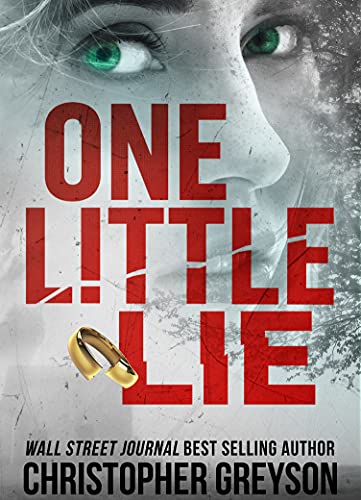
Christopher Greyson is the author of the Jack Stratton novels, which I like very much, and he was kind enough to provide a free review copy of One Little Lie, which is a departure for him. It’s a women’s thriller.
Now writing women’s thrillers is a shrewd business move. I haven’t seen the statistics, but judging from the titles I see, women’s thrillers are a growth market. Women, after all, are by far the largest reading demographic. And (here I judge by the scripts I see as a translator) women have an insatiable thirst for stories with strong female lead characters, who overcome danger on their own. No rescue by knights in shining armor allowed. A hunky male love interest is acceptable – even desirable – but he has to be taken out of play in some way so the woman can discover her own strength and triumph independently.
That’s the kind of story One Little Lie is.
Kate Gardner has been a doormat all her life. She gave up her career aspirations when she married Scott Gardner, scion of a wealthy family in a small town. Then he dumped her for his high school sweetheart, manipulating her into accepting minimal child support. She is working as a receptionist, a job she hates, and trying to keep up with caring for her two young children. But lately she’s been troubled by depression and memory problems, and the medications she’s been prescribed haven’t been helping. And now Scott wants full custody of the kids.
As a side gig, she got an assignment from a friend to write a review on a new, sophisticated flying drone that can be controlled from her mobile phone. One night at her son’s football game, she tries the drone out, but then gets distracted. When the battery runs down, the drone homes in on her and lands on her head. When people come to help her, they find the drone, with footage on it showing a man stalking her. When the police come, Kate is embarrassed to admit that she was controlling the drone herself. Everyone assumes it belongs to the stalker. Later, Kate’s best friend and her ex-husband both tell her not to admit the omission to the police. If they catch you in “one little lie,” they won’t believe you. This is hard for Kate, a basically honest person, especially because she’s attracted to Ryan, one of the detectives, who seems to return her interest.
From that point, Kate’s life descends into chaos. She loses her job, her best friend disappears, a slut-shaming campaign is launched against her, and she’s physically attacked in her home. All the while, memory lapses have her wondering if she’s losing her mind. Her wealthy mother-in-law, who claims to be on her side, gives her an ultimatum – she has to learn to stand up for herself. But if she fails, she’ll lose everything.
One Little Lie was an engaging read. I did have problems with some elements in the story, but I’m not in a position to know if these are standard tropes or weaknesses in this particular plot. A book of this kind calls necessarily for a final crisis where the woman is forced to discover her strength all on her own. But it seemed to me the resolution here was kind of contrived, depending too much on sheer coincidence.
Aside from that, it was an enjoyable read. Recommended, especially for female readers. Subtle Christian messages.
It’s 1857. Dexter James, an itinerant demonologist, comes to Titusville, Pennsylvania, where he’s sure there must be a lot of demon-possessed people in the backwash of the recent oil rush. He has trouble getting business at first, until he performs a miracle of healing (to his surprise) and becomes a huge success; then he crashes on his own hubris. Meanwhile, he falls in love with a local prostitute, who helps him find his true destiny.
That’s a brief, bare=bomes outline of Stephen Kanicki’s There Are No Saints, which could be classed as Christian fantasy, I suppose, or at any rate religious fantasy. There was a certain amount of creativity in the writing, and the characters showed some genuine depth and development. The ending of the book, I must admit, moved me.
However, I didn’t really like it. The writing style was not outstanding (a number of homophone errors), and the diction was purely 21st Century. No effort was made whatever to make the narrative read like one that could conceivably have been written in the 19th Century.
And speaking of the time setting, it was never explained why Dex had what seemed to be Viagara pills to distribute, or how he knew the 12 Steps of Alcoholics Anonymous almost a century before they were composed. I was looking for some kind of time travel plot element, but there was none.
And, as a doctrinaire Christian, I don’t accept the theology expressed in the book. It’s syncretist, saying that all religions are really the same: all about love. Which means Jesus Christ and His Cross were unnecessary, and it’s all good works.
So, in aggregate, I don’t personally recommend There Are No Saints. But you might find it amusing. Cautions for some foul language.
Having read the fourteenth book in Ian Rankin’s John Rebus series, I looked up the first one, published in 1987. It was fairly different overall. I’ll have to read a few more to see whether this one or the other is the anomaly.
In Knots and Crosses, DS John Rebus is pulled away from all of his current cases to join the growing team going after the separate kidnappings of two pre-teen girls. At his first conference, they announce it has become a murder investigation, and they have as many as zero leads. Rebus and a younger officer are assigned to comb the M.O. files for possible leads–the worst mental drudge. The police get nowhere until the murderer finally presses his point, that his main goal is Rebus himself.
Rankin has earned a lot of praise for his use of Edinburgh in these novels. Though Rebus is an officer at the fictional Great London Road police station, other details are well grounded. One of the main ideas you get from this book is that Edinburgh is good city, filled with stone walls and solid people. Kidnapping and murdering random girls couldn’t happen in this city. But Rebus and his fellow officers are dragged into the long shadows of sinful Scottish men.
Knots and Crosses delivers a fairly good original story for the series hero. In A Question of Blood, everyone knows Rebus doesn’t talk about his Army days, but in these pages all of that is spelled out. We also learn Rebus is a Christian, which means something unclear. Maybe he had a churched upbringing (though thinking of his father, I don’t know why they would attend services). He seems to hold to rudimentary Christian tenets and seek hope in a Good News Bible, but his sexual morality is complete mess and he avoids the church as if he has been wounded there. I wonder if we will see more of his faith in other books.
The main thing I disliked about this book is how the perspective jumps between many characters: a few cops, a couple victims, a newspaper man. His editor gets a couple paragraphs. The murderer gets a few lines. I think the ole universal third person may have been a better narrator.
The cracks and thunders made syllables in the depleted air, but they didn’t seem to be in Arabic. Hale guessed that they were of a language much older, the uncompromised speech of mountain conversing with mountain and lightning and cloud, seeming random only to creatures like himself whose withered verbs and nouns had grown apart from the things they described.
Wow.
To what shall I compare Tim Powers’s novel, Declare? Think of John LeCarre. And cross it with C.S. Lewis’s Space Trilogy, or… pardon my blushes… my own historical fantasy novels.
But really, it’s unlike anything you’ve ever read.
Andrew Hale is an English spy. He was born in Palestine and baptized in the Jordan River. He doesn’t know who his father was, though it’s rumored he was a fallen priest. He does know his mother was a failed nun. As a young boy he was introduced to a tall man named Jimmie Theodora, who swore him into a kind of secret organization – he didn’t understand what it was about. But eventually it led him to recruitment in British intelligence. And he began to glimpse a secret known to few and denied by all – that above the business of fighting the Germans and the Russians, there is a metaphysical war going on. Good vs. evil, principalities and powers of darkness in high places.
In occupied Paris in World War II, Andrew meets and falls in love with a Spanish Communist agent, Elena Ceneza-Bendiga, But their work will keep them apart, as Andrew carries out various assignments taking him to the deserts of Kuwait, to Turkey, Berlin and Moscow. And again and again he will come up against a man whose fate seems entwined with his – the charming, stuttering, utterly treacherous and amoral Kim Philby. The two men’s shared birthright will bring them together in epic confrontations on Mount Ararat and, finally, in Moscow.
This novel, as I mentioned last week, is very, very long. Be prepared to invest time in it. But it’s packed full of historical detail – Powers says in his afterword that all the dates and events (except for the invented supernatural activity) are scrupulously faithful to the documented record. It’s also packed with fascinating fantasy speculation.
The final impact of it all is hard to describe. Almost perception-altering. I highly recommend Declare.
Websites store cookies to enhance functionality and personalise your experience. You can manage your preferences, but blocking some cookies may impact site performance and services.
Essential cookies enable basic functions and are necessary for the proper function of the website.
Name
Description
Duration
Cookie Preferences
This cookie is used to store the user's cookie consent preferences.
30 days
These cookies are needed for adding comments on this website.
Name
Description
Duration
comment_author
Used to track the user across multiple sessions.
Session
comment_author_email
Used to track the user across multiple sessions.
Session
comment_author_url
Used to track the user across multiple sessions.
Session
These cookies are used for managing login functionality on this website.
Name
Description
Duration
wordpress_logged_in
Used to store logged-in users.
Persistent
wordpress_sec
Used to track the user across multiple sessions.
15 days
wordpress_test_cookie
Used to determine if cookies are enabled.
Session
Statistics cookies collect information anonymously. This information helps us understand how visitors use our website.
Google Analytics is a powerful tool that tracks and analyzes website traffic for informed marketing decisions.
Used to monitor number of Google Analytics server requests
10 minutes
__utmb
Used to distinguish new sessions and visits. This cookie is set when the GA.js javascript library is loaded and there is no existing __utmb cookie. The cookie is updated every time data is sent to the Google Analytics server.
30 minutes after last activity
__utmc
Used only with old Urchin versions of Google Analytics and not with GA.js. Was used to distinguish between new sessions and visits at the end of a session.
End of session (browser)
__utmz
Contains information about the traffic source or campaign that directed user to the website. The cookie is set when the GA.js javascript is loaded and updated when data is sent to the Google Anaytics server
6 months after last activity
__utmv
Contains custom information set by the web developer via the _setCustomVar method in Google Analytics. This cookie is updated every time new data is sent to the Google Analytics server.
2 years after last activity
__utmx
Used to determine whether a user is included in an A / B or Multivariate test.
18 months
_ga
ID used to identify users
2 years
_gali
Used by Google Analytics to determine which links on a page are being clicked
30 seconds
_ga_
ID used to identify users
2 years
_gid
ID used to identify users for 24 hours after last activity
24 hours
_gat
Used to monitor number of Google Analytics server requests when using Google Tag Manager
1 minute
_gac_
Contains information related to marketing campaigns of the user. These are shared with Google AdWords / Google Ads when the Google Ads and Google Analytics accounts are linked together.
90 days
Marketing cookies are used to follow visitors to websites. The intention is to show ads that are relevant and engaging to the individual user.
A video-sharing platform for users to upload, view, and share videos across various genres and topics.
Registers a unique ID on mobile devices to enable tracking based on geographical GPS location.
1 day
VISITOR_INFO1_LIVE
Tries to estimate the users' bandwidth on pages with integrated YouTube videos. Also used for marketing
179 days
PREF
This cookie stores your preferences and other information, in particular preferred language, how many search results you wish to be shown on your page, and whether or not you wish to have Google’s SafeSearch filter turned on.
10 years from set/ update
YSC
Registers a unique ID to keep statistics of what videos from YouTube the user has seen.
Session
DEVICE_INFO
Used to detect if the visitor has accepted the marketing category in the cookie banner. This cookie is necessary for GDPR-compliance of the website.
179 days
LOGIN_INFO
This cookie is used to play YouTube videos embedded on the website.