I have found a few casually interesting things in books over the years: old newspaper ads or a library card. Notes written in the margins have been the most engaging thing I’ve found. In fact, I have my mother’s Bible with many marginal notes. (She passed away two years ago this month.) One of these notes marks Isaiah 41:9-10 as my Dad’s verse.
Laurie Hartzel of the Star-Tribune collected reader submissions for strange things they have found in books, including a vintage postcard, a banana peel, and a diamond ring.
“Wistful” isn’t a word I use often (not in front of strangers, anyway), but I’m feeling a touch wistful now that “Atlantic Crossing” has finished its run on PBS Masterpiece. It’s the most famous thing I’ve ever had a hand in, so there’s a sense that my fifteen minutes are over now. Future generations of my family will say to their kids, “Yes, your great-grandfather and great-granduncle had a brother who never married. Weird guy. Religious. Grumpy all the time. Wrote some novels, and did some kind of translating of Norwegian movies and TV shows. Wrote subtitles or something.” [Voiceover: “But they were mistaken. He was a not a subtitle writer, but a screenplay translator. They are different things.”]
What follows is not a review of “Atlantic Crossing.” I cannot do a review. My legal obligations to the people I work for prevent me saying anything negative about the production in public (assuming I even have any criticisms to make). I want to talk about the things I appreciated in this remarkable and memorable production.
First of all, I think it was masterfully produced. The visuals were tremendous – taking advantage of the glorious Norwegian landscape in the segments filmed there, and beautifully recreating the US in the 1940s. There was a real epic quality to it all, especially in the first and last episodes.
I found all the actors’ performances top-notch. Sofia Helin, who played Märtha, is not actually the right physical type – she should be taller and slimmer. But she did an excellent job of portraying an essentially shy woman, trained to act as a public figure as a matter of duty, who is then forced to get her hands dirty in practical politics. The strain shows under the gracious facade.
The performance that impressed me most was Tobias Santelmann as Prince Olav. Frustrated in his military ambitions, he grows jealous of his wife’s relationship with the US president – although he virtually pushed her into the situation. At last he gains perspective when he realizes that many people have made greater sacrifices than he has, and he steps up into a wiser maturity and greater responsibility. There’s a movie called “The King’s Choice” (I reviewed it here), which is often compared with “Atlantic Crossing” in terms of historical accuracy. One thing I disliked about the movie (which is very good, overall) is that Olav doesn’t look very impressive in it. I think “Atlantic Crossing” gave him his due, though with a dark side.
The performance most Americans talk about, though, is Kyle MacLachlan’s as President Franklin Roosevelt. “Creepy” is one description I’ve seen, though I don’t think that’s quite fair. I think MacLachlan created a faceted, nuanced portrait of a pre-feminist American alpha male. He’s charming, easygoing in company, empathetic, and never in doubt that any woman he makes a pass at will take it as a compliment. It was a (publicly deniable) given, in those days, that powerful men deserved some sexual perks, and could be good guys in spite of it. Ted Kennedy and Bill Clinton were in the same tradition. Kudos to the producers for not papering this over, I say.
Oh yes, the script translation, though it takes an exquisite sensitivity to perceive it, was excellent.
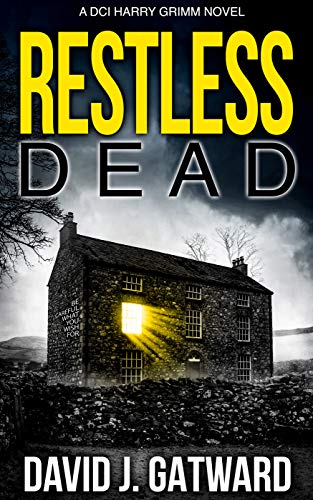
David J. Gatward’s Detective Chief Inspector Grimm series continues with Restless Dead. It’s a small mystery, the kind that couldn’t actually happen, in the same way, in an urban setting. But Harry Grimm, facially-scarred war veteran, is settling in in the relatively bucolic Wensleydale region, and in these parts they give the public more personal service than cops did back in Bristol.
Retired Col. James Fletcher is devastated by the death of his wife, killed in an auto accident while driving him home on his birthday, because he’d been drinking. Although his two daughters, his son-in-law, and his grandson have rallied around him, he’s profoundly depressed. Lately he’s started imagining he’s seeing his wife again around the estate (already rumored to be haunted); the family reports it to the police, who find no sign of an intruder. Col. Fletcher is not mollified, and things are about to get deadly.
Also, somebody is rustling sheep in Wensleydale, and the father of one of Grimm’s team members is a victim.
The Grimm series is semi-cozy and character-driven. I like it a lot (in spite of the injection of a “genuine” spiritualist). Restless Dead ends with a cliffhanger, but the major mystery was solved, and I look forward to the next book, coming in June.
Imagine, if you will, my bedroom. It is a palatial space, done in Wedgewood Blue in a Regency style, adorned with wholesome yet costly art, open and airy in ambience, with broad windows overlooking the ocean.
It’s nothing like that, of course. But you don’t think I’m going to describe my real bedroom, do you? You didn’t sign up for that kind of ashcan realism.
Anyway, my mornings in semi-retirement have acquired a sort of routine. I wake up way too early, as is the way of old people, and then try to get back to sleep. I can often achieve this (not always), but in between attempts, I check the email on my cell phone. You never know when translation work will show up, and they’re 7 hours ahead of us in Oslo.
This morning, I managed to get back to sleep around 7:30 a.m. I know this because that was the time when an email came in with a little job of work. Which I didn’t see until I woke up again, an hour later. The message was, “Can you do this small job? It’s not big but I need it in a couple hours.” Of which I’d already wasted one.
But I rolled out, postponed other things, and set about the task. Finished in plenty of time. Back to the usual Friday morning schedule then. Which involves washing clothes.
Shall I tell you about the new sheets I bought?
No, you’ve committed no sins to deserve that.
Maybe I should address the picture I posted above. Yes, why don’t I do that?
I posted that photo on Basefook precisely 3 years ago, whenViking Legacywas finally released, after many delays (if you want the paper version, I think this link works now). I’m still quite proud of it.
Just ordered a supply for events this summer. Did the same with West Oversea. I’m now invested in the prospect of a post-lockdown, semi-normal summer. When the paper version of The Year of the Warrior materializes, I’ll be all in.
Look at me, the avaricious capitalist risk-taker, living out my politics.
A strength of Erin Bartels’s 2019 debut novel We Hope for Better Things is its main story hook in the race riot in 1967 Detroit. A generational family drama that touches on the American Civil War, obvert and subtle hatred of colored people, and interracial relationships naturally feels like a Southern novel–at least it does to me. Telling a well-researched story from her neck of the woods, the complicated city of Detroit, Michigan, helps balance the typical narrative by showing how Yankees contributed to the slave systems of Southern states.
The story begins in modern day Detroit with an ambitious reporter, Elizabeth Balsam, meeting with a man who wants to ask a favor of her. She might be interested, if there’s a good story in it, but she’s in the middle of a potentially explosive investigation that is taking just about all of her emotional energy and creativity. When her investigation actually explodes in her face, she considers helping the man and maybe saving her career. The favor means looking up Nora Balsam, whom Elizabeth discovers is her great aunt living about 60 miles north in Lapeer, which is about 20 miles outside of Flint.
Before we get too far into Elizabeth’s interaction with Nora, the story turns back to Detroit 1963 and a younger Nora Balsam, who is looking for artwork to but at an exhibition. Instead she meets a good-looking photographer named William Rich and struggles to make sense of one of his photos on display, that of her father angrily reaching for the cameraman. Being as wealthy as she is, Nora hasn’t met many genuine people, that is eligible, young men, so she finds William’s bold interest in her appealing. You might call his interest reckless, because he is black and she’s white.
Once we understand a little more about Nora, we are pulled back to Lapeer 1861, where Mary and Nathaniel Balsam have begun to establish their farm. Nathaniel feels compelled to join the Union army to fight for the abolitionist ideas they have long discussed. That left Mary alone and pregnant with two housekeepers to manage everything. Of course, Nathaniel thought he would be home in several months, but three years later he had only returned once for a few days on furlough. His decisions in the field changed his family far more than his absence–he sent runaway slaves to Lapeer for safe harbor.
These three stories are skillfully woven together, holding the narrative tension well. I remember another novel set in Mississippi that tells three, interrelated stories at once, one of the three being comparatively dull. I was on the verge of skipping a section out of interest for the other story threads. We Hope for Better Things is engaging throughout. Questions raised in one thread begin to carry into the next.
With the publisher being Revell, you may think Bartels had to write in some explicit preaching or Xian exposition, but her faith comes through more subtly than that, in the faithfulness of the story arc.
In fact, in one sense, the Third Reich and its adventure in mass death was a conspiracy against irony. Perhaps that is why Basil hated it so much and fought it so hard.
First of all, I have to take back a criticism of this book that I made last night. I said I was reading a novella I’d read before, which had been simply re-titled. Now that I’ve completed Basil’s War, based on the novella Citadel, I see that it is in fact a full novel (though a short one for author Stephen Hunter). He took Citadel and added some new action (mostly at the end), and made the whole thing a lot more complex.
Basil St. Florian is a British SOE agent in World War II. Like the character in Beau Geste, he possesses almost no virtue save courage. He’s good at lying, stealing, killing, and seducing women. In ordinary civilian life, he’d probably end up in prison. But now, as a top field agent, he’s more likely to end up dead – and he isn’t greatly concerned about it.
In a secret war room under London, he gets briefed (by Alan Turing, among others) on his next mission (should he choose to accept it), which will involve making his way to Paris and into a museum library. There he is to photograph certain pages from a rare manuscript, which has been used as a “book code.” This code will identify a Russian agent in the Bletchley Park cryptography operation. There are reasons for this, but Basil’s job is to get to the book.
We follow Basil as he parachutes into France, steals false identity papers, bluffs his way through security checks, and generally stays one step ahead of the Germans – until he loses a step.
Basil is an interesting character to follow – he’s very good at his job, and more sympathetic than he probably ought to be, mostly because of his wit. The book is full of mordant observations on the nature of war and of warriors, plus the characters of the French and the Germans. (As well as intimate moments with Vivian Leigh.) The riddles within enigmas that unfold at the end are clever and surprising.
Stephen Hunter is a fine thriller writer, and I think most readers will enjoy Basil’s War. Cautions for mature material, but for a war story it’s pretty lighthearted.
My reading of late has been oddly frustrating. After a beautiful Syttende Mai (the Norwegian Constitution Day, on which I had a couple actual human interactions, both of them surprisingly pleasant) I’ve come up against a string of bum books.
First there was a novel from a series I hadn’t revisited in a while. I didn’t get far into it before I remembered why I’d stopped reading the books; I saw some ugly stuff coming and sent the whole thing into the virtual rubbish bin. Then I started a Christian novel that looked intriguing. I have an idea the story might well be worth reading, but the prose was so awful I gave up on that one, too.
Now I’m reading a new book by a favorite author, which turns out on closer inspection to be a novella. A novella I’ve already read. Re-released under a new title. I’m still reading, because it’s pretty good, but I’m a little bitter too.
I’m in the habit of watching old movies on Amazon Prime in the afternoons. Yesterday I saw “High Voltage,” which stars William Boyd (before he was Hopalong Cassidy) and Carole Lombard (in her first major movie role, before she added the “e” to her first name). It was a highly moral melodrama about bus passengers caught in a blizzard in the Sierra Nevadas, and ends with a repentant Boyd on his way to jail in St. Paul.
Today it was “The Naked Hills,” with David Wayne and Denver Pyle. This was a western with aspirations. Instead of the standard shoot-em-up, it’s a story about how greed destroys a man’s life. David Wayne, in a rare starring role, plays a man who grows obsessed with finding a fortune, in the 1849 Gold Rush and after. The message was commendable, but the story was one-dimensional, and the resolution anticlimactic.
What surprised me was the theme song. It’s a number called “The Four Seasons,” by Herschel Burke Gilbert and Bob Russell. I knew this song from before. I have blogged here previously about my fondness for the old “Yancy Derringer” TV series. During the series’ original run, it had its own title song, “The Ballad of Yancy Derringer.” But when it went into syndication, for some reason (probably having to do with copyrights) they changed it to an instrumental theme. And that theme was this same “The Four Seasons” melody. Only without the verses they use in the movie.
There are even lyrics, which somebody sings at the beginning. As best I remember, they go something like this:
We have four seasons, four seasons
To make our dreams come true.
God gives a man four seasons, that’s all that he can do.
I don’t know if that last “he” refers to God or the man.
Kind of depressing, actually. But I have an ear worm now.
And if you have to have an ear worm, it might as well be a song you like.
I read and reviewed the first three Inspector Harry Grimm novels previously, and liked them. Somehow the series fell off my radar. But I picked up the fourth book, Shooting Season, recently, and found it still worked for me.
Harry Grimm has a face that literally scares people – due to an IUD explosion during his service as a paratrooper. He was a detective in the city of Bristol, but was seconded up to rural Wensleydale in Yorkshire when the local inspector went on leave. That leave has been extended, and Harry is discovering he quite likes the place. He likes the fresh air, the scenery, and the people. His team (they have no actual police station, but operate out of the community center) is low-key but smart and professional, and they’ve taken to him.
Charlie Baker is a bestselling thriller writer, famously arrogant and hard to work with. Because his latest work is set in a shooting lodge in Yorkshire, his agent (and former lover) has set up a “shooting” (clay pigeons) weekend in the area. But at a kick-off bookstore reading, a fan stands up to accuse Charlie of using a ghost writer. What makes this even more awkward is that it happens to be true – Charlie’s “editor,” also visiting at the lodge, does in fact do most of the work. Also present are Charlie’s elderly accountant, his young female assistant, and a couple shabby-nobility hangers-on.
After the fiasco at the reading, Charlie gets more drunk than usual, and clashes with most of his “friends.” In the middle of the night he’s seen driving off, and the next day his body is found in a field near his crashed Porsche, his head literally blown off by a shotgun. At first it looks like suicide, but the mechanics of this shotgun make that impossible.
There’s no lack of plausible suspects, but everybody has an alibi. Inspector Grimm will need to do some heavy thinking on this one. But he’ll also need to think about his own greatest mystery – what to do about his criminal father, who killed his mother.
These books are pretty low-key, almost “cozy,” but with an edge. I like them a lot.
I’m a fan of Brett Battles’ novels about covert operations “cleaner” Jonathan Quinn, and the spin-off Night Man novels have been fun too. The Night Man is Nate, Quinn’s associate, who has taken up a sideline in his spare time – essentially being Batman. Along with his sort-of girlfriend Jar, an Asian woman on the Autism spectrum who does the computer stuff, he intervenes to help people who need help, but can’t be helped by the law. It’s nice, and his relationship with Jar is quite sweet. Nate is motivated to these actions by the voice of his ex-girlfriend, Lisa, who is dead. Nate doesn’t believe in ghosts, but the voice always seems to be right.
But I was a little disappointed with the latest Night Man book, Mercy. Because this one takes Nate and Jar out of their usual urban environments into American flyover country. And they don’t look good there – in my opinion – though I’m sure they see it differently.
The Cleaner team is on suspension right now, so Nate and Jar have more time for their vigilante activities. Unfortunately, those activities have begun to attract media interest, which they don’t want. So they decide to get a small Winnebago and take a road trip. Jar has never seen much of the US.
At the Grand Canyon, guided by Lisa’s voice, they hike along the edge of the Canyon and rescue a teenaged boy who is stuck on a ledge just below the brink. When the boy returns to his camper, he is cruelly punished by his father. Nate and Jar do not hesitate to make this guy their target, following the family to their home in Mercy, Colorado, planning to document his abuse and turn the evidence over to the authorities.
However, they soon discover that the man is involved in plenty of other shady activities. There’s a criminal conspiracy under way, and Nate and Jar are on it, whatever the danger.
The adventure in Mercy was up to Brett Battles’ usual high standards. What I didn’t like was Nate’s attitude. He looks at these small-town people and has nothing good to say about them. They’re too white, they use the wrong pronouns, they’re not worried enough about Covid masking. As a resident of the Midwest, I found all this condescending. Nobody in the town is depicted positively, except for the abused kids.
I won’t be boycotting Battles’ books, but I hope he sticks in the future to people he understands and can sympathize with.
From last year, a “distanced” celebration of 17 May, Norway’s Constitution Day. No doubt today’s celebrations were similar. The tall old man on the balcony is King Harald V, the little boy on the “Atlantic Crossing” miniseries.
“Ja, Vi Elsker,” the Norwegian national anthem, says this (roughly translated by me):
Yes, we love this land, as it rises, tree-covered and weather-beaten, over the water, with its thousand homes. Love it, love it, and think of our fathers and mothers, and the saga nights that descend with dreams upon the land.
Norwegians in houses and cottages, thank your great God. He will protect the land, however dark things may appear. All our fathers have fought for, our mothers have cried over, the Lord will quietly alter, so that we will have our rights.
Websites store cookies to enhance functionality and personalise your experience. You can manage your preferences, but blocking some cookies may impact site performance and services.
Essential cookies enable basic functions and are necessary for the proper function of the website.
Name
Description
Duration
Cookie Preferences
This cookie is used to store the user's cookie consent preferences.
30 days
These cookies are needed for adding comments on this website.
Name
Description
Duration
comment_author
Used to track the user across multiple sessions.
Session
comment_author_email
Used to track the user across multiple sessions.
Session
comment_author_url
Used to track the user across multiple sessions.
Session
These cookies are used for managing login functionality on this website.
Name
Description
Duration
wordpress_logged_in
Used to store logged-in users.
Persistent
wordpress_sec
Used to track the user across multiple sessions.
15 days
wordpress_test_cookie
Used to determine if cookies are enabled.
Session
Statistics cookies collect information anonymously. This information helps us understand how visitors use our website.
Google Analytics is a powerful tool that tracks and analyzes website traffic for informed marketing decisions.
Used to monitor number of Google Analytics server requests
10 minutes
__utmb
Used to distinguish new sessions and visits. This cookie is set when the GA.js javascript library is loaded and there is no existing __utmb cookie. The cookie is updated every time data is sent to the Google Analytics server.
30 minutes after last activity
__utmc
Used only with old Urchin versions of Google Analytics and not with GA.js. Was used to distinguish between new sessions and visits at the end of a session.
End of session (browser)
__utmz
Contains information about the traffic source or campaign that directed user to the website. The cookie is set when the GA.js javascript is loaded and updated when data is sent to the Google Anaytics server
6 months after last activity
__utmv
Contains custom information set by the web developer via the _setCustomVar method in Google Analytics. This cookie is updated every time new data is sent to the Google Analytics server.
2 years after last activity
__utmx
Used to determine whether a user is included in an A / B or Multivariate test.
18 months
_ga
ID used to identify users
2 years
_gali
Used by Google Analytics to determine which links on a page are being clicked
30 seconds
_ga_
ID used to identify users
2 years
_gid
ID used to identify users for 24 hours after last activity
24 hours
_gat
Used to monitor number of Google Analytics server requests when using Google Tag Manager
1 minute
_gac_
Contains information related to marketing campaigns of the user. These are shared with Google AdWords / Google Ads when the Google Ads and Google Analytics accounts are linked together.
90 days
Marketing cookies are used to follow visitors to websites. The intention is to show ads that are relevant and engaging to the individual user.
A video-sharing platform for users to upload, view, and share videos across various genres and topics.
Registers a unique ID on mobile devices to enable tracking based on geographical GPS location.
1 day
VISITOR_INFO1_LIVE
Tries to estimate the users' bandwidth on pages with integrated YouTube videos. Also used for marketing
179 days
PREF
This cookie stores your preferences and other information, in particular preferred language, how many search results you wish to be shown on your page, and whether or not you wish to have Google’s SafeSearch filter turned on.
10 years from set/ update
YSC
Registers a unique ID to keep statistics of what videos from YouTube the user has seen.
Session
DEVICE_INFO
Used to detect if the visitor has accepted the marketing category in the cookie banner. This cookie is necessary for GDPR-compliance of the website.
179 days
LOGIN_INFO
This cookie is used to play YouTube videos embedded on the website.