
Correctly handling the Word of God does not permit making the text say what we want. To understand the Bible accurately, we must discover (or “exegete”) the single, God-inspired meaning of every verse before us. The text of the Bible means what God inspired it to mean, not “what it means to me.”
When praying the Bible, our primary activity is prayer, not Bible intake. Bible reading is secondary in this process. Our focus is on God through prayer; our glance is at the Bible. And we turn Godward and pray about every matter that occurs to us as we read.
Don Whitney, “What’s the difference between interpreting the Bible and praying the Bible?”
Nat’l Review on D. Keith Mano’s ‘The Bridge’

“We of the Council, convened in full, have decided that man in good conscience can no longer permit this wanton destruction of our fellow creatures, whose right to exist is fully as great as ours,” the decree states. “It is therefore decreed that men, in spontaneous free will and contrition, voluntarily accede to the termination of their species.” The operative word is contrition. Guilt is a force eating people from inside. Citizens are too cowed, too stricken with guilt, to mount any organized resistance to the Council’s diktat. Although not all have chosen to give up on life, everything is in ruins and life expectancy for citizens is low indeed.
Our friend and instigator Dave Lull is well aware of my fondness for the late author D. Keith Mano. He sent me a link to this recent article from the National Review on one of Mano’s nearly forgotten but uncomfortably relevant novels, The Bridge.
Perhaps the scenario evoked in The Bridge is too general in nature to belong to Mano or to any one writer. But anybody who reads Cormac McCarthy’s 2006 novel The Road and Mano’s The Bridge, published 33 years earlier, will quickly see how much the later novel has in common with the earlier one.
I thought myself audacious (and feared I was prescient) when in my Epsom novels I postulated a near future in which “Extinctionism” was a popular movement. I in fact cherished a hope that I could manipulate Fate by exploiting its reluctance to ever prove me right. But we’ve seen Extinctionism begin to take hold in recent years, and one looks at imagined futures like those of The Road and The Bridge, today, with growing alarm.
The Bridge, writer Michael Washburn notes, is out of print but can be obtained online. It sounds intriguing, but – honestly – I’m afraid to read it. Also, look at the price on Amazon!
Musing on old movies
I’ve mentioned before that I’ve been streaming a lot of old B movies of late on Amazon Prime. The films range across several decades, but (for some reason) I have a special fondness for the ones from the 1930s – when talkies were new and nobody had yet figured out how to handle the technology. (A well-known example is the Marx Brothers’ The Cocoanuts, in which all documents are visibly sopping wet. That was because they hadn’t worked out how to filter the sound of crackling paper.)
Today my theme is acting styles. My view of the old silent movies is that they’re really a form of interpretive dance. Actors had to use broad, unnatural gestures and exaggerated facial expressions to convey their messages to the audience. These were skills that transferred pretty well from stage acting, where you have to play to the cheap seats. This meant that nobody was ready for the subtleties that sound demands.

The first film I watched was One Rainy Afternoon, a 1936 effort starring Francis Lederer and Ida Lupino. Lederer was a Czech actor who plays a Frenchman here – because everybody knows Americans can’t distinguish foreign accents (and they’re right). Irving Thalberg had plans to make Lederer a big star, but died before he could get the ball rolling. Instead Lederer got rich in California real estate.
Here he plays a young actor who’s having an affair with a married woman (this is an English version of an earlier French film). They go to a movie together, but enter separately. In the dark, Lederer sits next to the wrong girl – a very young and pretty Ida Lupino. When he kisses her, thinking it’s his paramour, she reacts in a big way. Soon there’s a riot, the press is called in, and Lederer is pilloried in the newspapers as “the Monster.” Guardians of public morality call for his prosecution, and he’s sentenced to a few days in jail. Lupino, regretful about all the fuss, secretly bails him out. You can probably predict the rest of the story based on that.
What stuck in my mind about this movie was the portrayal of the proto-MeToo women’s group that calls for Lederer’s blood. When their leader makes her denunciations, she strikes attitudes appropriate for a speech to a large arena, and uses a voice appropriate for the same arena with no sound amplification. It’s entirely artificial and embarrassing to watch. But at the time, this was cinematic convention. Margaret Dumont, in the Marx Bros. films, actually toned it down a little.
Also present is an actor named Hugh Herbert, who is mostly familiar to my generation from the many times he was caricatured in old animated cartoons. His shtick was acting flustered, patting his fingertips together and making “Woo-woo” noises. His form of comedy is preferable to the feminist oratory, but only by a little.

Moving along, I saw another movie which is generally better, though it was made earlier. I’ve reviewed “Sapper” McNeile’s Bulldog Drummond on this blog. This is the film version from 1929, based on a stage play. Hugh “Bulldog” Drummond is described in the books as big and not very handsome. Here he’s played by Ronald Colman, who is not particularly big and quite good looking. The character would be played by several actors over the years, but all would follow this precedent.
Bulldog Drummond is a young World War I veteran in London who chafes at peacetime boredom. He longs for adventure, and apparently has no sense of fear at all (you might put it down to PTSD nowadays). He advertises in the Times for dangerous work, and gets a note from Miss Phyllis Benton (played by a very pretty, very young Joan Bennett). She is concerned that her father has gotten involved with sinister characters. She is correct in this, so Drummond plunges in in his customary senseless style, pulling irritating practical jokes on the plotters, until he finally escapes certain death and thwarts a major criminal conspiracy.
Notable in this movie is a different kind of bad acting. The villains talk… slow. They strike dramatic attitudes and enunciate every word carefully through curled lips. This may account for Drummond’s improbable success against long odds – these oafs give him lots of time to act while they’re just talking. Once again, this is (I think) a carryover from silent films. What actors and directors still hadn’t figured out was that the challenge now was not to communicate thoughts, but to replicate reality (or rather the illusion of reality).
Also notable in Bulldog Drummond is his sidekick Algy, played by Claud Allister. Think of Bertie Wooster, without the massive intellect. All nose and teeth, with a monocle and a tendency to stand with is mouth gaping open, Allister is the archetype of the upper class twit. I actually found it painful to look at him sometimes. It was like staring at a freak in a sideshow.
Nevertheless, Bulldog Drummond left me with a positive feeling, while One Rainy Afternoon just felt embarrassing. Things (and people) have to be judged according to their times and contexts, not compared to our own ideals – which will, no doubt, look stupid to our descendants someday.
The triumphant return of George Wallace
I’m pretty sure people are tired of me pointing at current events and saying – in my querulous old man’s voice – “That’s something we saw when I was young, just all dressed up in different clothes!”
But darn it, it keeps happening.
I offer in evidence the following graphic. I’m sure you’ve already seen it. It was released (at taxpayer expense) by the Smithsonian’s National Museum of African-American History. It purports to explain important ways in which “whiteness” continues to inflict cultural violence on the black people in our midst.

“Whiteness,” according to this graphic, includes things like self-reliance. The nuclear family. “Objective, rational, linear thinking.” The primacy of the Western tradition. “Work before play.” Christianity as the norm. Respect for authority and property. “Delayed gratification.” European aesthetics. Christian holidays. English common law. Decision-making and majority rule.
When young people look at this list, I suppose they see an incisive analysis of cultural imperialism.
What I see is a throwback. I see Gov. George Wallace of Alabama (1963) shouting “Segregation now, segregation tomorrow, and segregation forever!”
You see, I’m old enough to remember the last years of Jim Crow. I can remember when you could turn on the TV and see (a few) people still seriously defending the principles of segregation.
I knew an older kid in school who went south to attend a segregated college. When she came back and we challenged her on it, she replied, “You people up here don’t understand. These folks aren’t the same as us.”
Which is precisely what the Smithsonian’s “Whiteness” graphic asserts. That these folks aren’t the same as us.
If you listened to the arguments for segregation they made in those days, you’d hear the apologists saying something like this: “We don’t hate the d*rkies. Some of ‘em are fine people. But you gotta understand. They’re different from white folks. They’ve got no sense of responsibility. They can’t get to work on time. They can’t manage money. They can’t think logically. They’re like children. That’s why we’ve got to give them their own separate neighborhoods and institutions. Because if they had to compete with the white man on even terms, they’d just die off.”
Which is precisely what the Smithsonian is saying. That black people and white people are essentially different. That there is no common ground of humanity. The only difference now is that the moral judgments on racial traits have switched polarization.
The end result of believing that color is the single most important fact about any individual has to be segregation.
If I wanted to be snide, I’d congratulate a certain political party on doing the longest strategic end run in history, achieving their old goal of racial segregation from the 1960s. George Wallace would be proud.
But I don’t really believe it’s strategic. I think it’s just the Gods of the Copybook Headings coming back, forcing those who don’t know any history to repeat it. Yet again.
‘The Murder Pit,’ by Mick Finlay
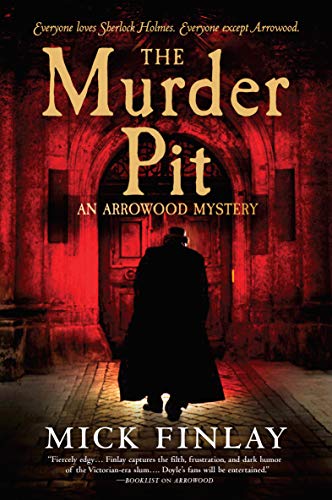
London in 1896, not the sophisticated, charming London of Sherlock Holmes, but the grungy, hardscrabble London of Holmes’s jealous rival, low-rent private investigator William Arrowood. Fat, heavy-drinking, gout-suffering Arrowood, who reads people’s faces and applies practical psychology to problems of crime. And who only seems to get noticed by the newspapers when he’s accused of some impropriety.
In The Murder Pit, second book in the series, Arrowood is hired by the Barclay family to make contact with their daughter Birdie. Birdie is mentally challenged, but is married to a son of a farming family in a village near London. For some reason her in-laws are preventing her from communicating with them, and they are worried about her.
It seems to be a truism in Arrowood’s life that all his clients lie to him. He knows the Barclays are concealing something. But it’s a job, and perhaps he can do some good. He and his assistant Barnett find the village economically depressed, and the farm people secretive, not hesitating to use violence to protect their privacy. Further investigation will reveal ties to a local insane asylum, and an important witness will disappear suspiciously. If Arrowood can unravel the mystery before the newspapers hound him out of business, he will be in a position to uncover a scandal at a very high level of society.
There are many good things to say about The Murder Pit. It will teach you much about the treatment of the mentally challenged in the 19th century, and of social conditions among the poor in the same period. My problem with this book (and the one before it) is that there’s not much fun here. I didn’t like the hero much, and there’s a sense of frustration and injustice throughout. Very likely it’s all true, too. But I don’t think I want to spend money on more of these stories.
Cautions for language and disturbing scenes.
Rewriting the Portrait, Coffee
Atlanta pastor John Onwuchekwa has a side angle in trying to start a coffee business in the city’s west end. They got off the ground just before the shutdown hit us.
“Initially our business plan and marketing were built off this idea of building community through pop-ups and in-person events,” founder and barista Aaron Fender said. But with those options shot for a few months, they considered other ideas.
“We started doing a lot of Instagram Live interviews with entrepreneurs, artists, and thinkers to build community. We started a coffee delivery service to your doorstep. We made a coffee club coffee subscription.”
Onwuchekwa explained the vision of Portrait Coffee to Atlanta Magazine. “One of the first things Frederick Douglass did when he finally learned how to read and write was [to write] a narrative of his life. It was a way for him to insert himself back into a history that was often too eager to forget the people who helped build it. As we think of coffee, we tend to feel like the industry as a whole is the exact same thing. We wanted to start a shop, trying to pour a new narrative of the picture that comes to mind when you think of specialty coffee.”
‘Arrowood,’ by Mick Finlay

“Your deductions are more like Sherlock Holmes than you think,” I said when we were walking again.
“No, Barnett. I decipher people. He deciphers secret codes and flower beds. That man and I are not alike, and frankly I’m getting tired of your jibes about him.”
William Arrowood, hero of Mick Finlay’s new series of Victorian mysteries, of which Arrowood is the first, lives in the same fictional world inhabited by Sherlock Holmes. But Arrowood deeply resents his more famous rival, envying him his high fees and elite clientele. Holmes deducts through reason, but Arrowood likes to point out that real people are not reasonable. He himself is a self-taught psychologist (though he doesn’t use that word). He observes people’s moods and infers motives. It’s not an exact science, though, and he often makes mistakes. Which can be tragic.
Unlike the ordered world of the Holmes stories, which the modern reader can easily imagine comfortable and relaxing, Arrowood lives in chaos on a lower level of society. He inhabits cramped rooms behind a pudding shop, wearing shoes that don’t fit because new ones would cost money. He pines for his wife, who has left him, clinging to a blind belief that she’ll come back someday. He is fat, bald, bespectacled, and ugly. Also an alcoholic. His assistant and chronicler Norman Barnett is a big bruiser who feels guilty about his past. His own wife died recently, and he hasn’t been able to bring himself to tell anyone.
Sherlock Holmes would not have taken the case brought to them by a young French woman, Miss Caroline Cousture. She is looking for her brother, who has disappeared. Arrowood agrees to search for him because he needs the money, though he’s sure Miss Cousture has lied about something. He grows more concerned when he discovers that the brother has been working at a brewery owned by Stanley Cream, a powerful criminal kingpin with whom he has tangled before – at great cost. And when his best witness is ruthlessly murdered before his eyes, the case gets intensely personal.
I’m of two minds about this book. It appears to be well-researched, but the world it recreates is ugly, filthy, cramped, and uncomfortable. And William Arrowood, though he has his positive characteristics, is not really a character you long to get to know better.
But I went ahead and bought the next book in the series. Arrowood is worth reading, if you don’t mind ugly realism. Cautions for disturbing situations. References to Christianity were not disrespectful.
‘That Old Dead Magic,’ by Robert Randisi
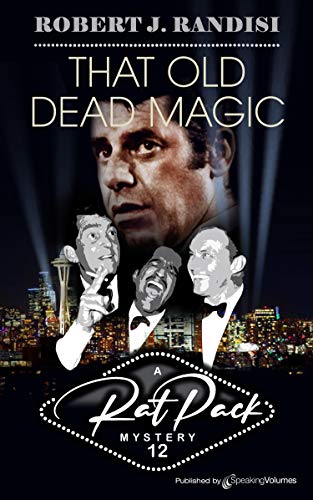
I’m old enough to remember the 1960s, when Frank Sinatra was the epitome of cool, the guy every heterosexual male wanted to be. Along with his buddies Dean Martin, Sammy Davis Jr., and a few others, commonly known as the Rat Pack, he held court in Las Vegas like a king. Journeyman author Robert Randisi is writing a series of mysteries based on that time and place. I figured I’d try one of them, That Old Dead Magic. Might be fun, I thought.
Alas, it wasn’t that much fun.
Eddie Gianelli, known as Eddie G. to his friends, is a fixer for the Sands Hotel, where the Rat Pack used to perform up until recently (1965). He solves problems, caters to big gamblers’ tastes, and runs interference for celebrities. Now the Rat Pack’s slot at the Sands is being filled by Sammy Davis Jr. and comedian Jerry Lewis, temporarily teamed up. Eddie G. has never cared much for Jerry Lewis’ shtick, so he doesn’t plan to see the show. But when Sammy asks him for his help in “keeping Jerry from killing somebody,” he goes to see them.
He finds Jerry Lewis the least funny person he’s ever met. Also one of the least personable. But he has a problem. Somebody, he says, is blackmailing him. He won’t say what it’s about, but he wants Eddie to make the payoff delivery, because he can’t trust his own temper.
At the same time, Eddie gets a request from his private eye friend, Danny Bardini. Danny is investigating the disappearance of several young women in town. He needs a pretty girl to act as bait. Eddie suggests a waitress he knows, and she’s happy to get the work. Except that when she disappears completely after a few days, he feels responsible.
In his capacity as Vegas fixer, Eddie has made lots of interesting friends. Not only the Rat Pack and other big stars, but the mobsters who actually own the town. His relations with the police are more ambivalent, especially with a particular corrupt detective. So when it comes down to direct action against white slavers, Eddie turns to his gangster friends rather than the law. It’s a little strange to read a story where mobsters are the white knights.
The plot of That Old Dead Magic was competent enough, but I found the book surprisingly barren. When you’re writing about old Vegas, people expect you to describe the glamor, along with some revelation of the essential tawdriness. But here the descriptions are very bare bones – Vegas is bright and colorful by night, but by day it’s worn out and shabby. That’s it. No poetry. The story had no texture for this reader – I got no sense of atmosphere. And the characters were barely described – this guy was tall, this guy was fat. That’s about it. The only characters I could picture were the famous ones I’d seen on TV.
That Old Dead Magic felt like the skeleton of a story to me. I found it rather disappointing.
Plantations Rebranding: Tea, Rum, and Plimoth
Several days ago, I wrote about Osayi Endolyn’s questions about products that brand themselves with the word plantation. She was specifically interested in Plantation Rum, an excellent French brand with a pineapple rum she loved. I heard her story on an episode of The Sporkful, and today I learned Plantation Rum would be rebranding to get away from the negative connotations of that word in American markets (also via The Sporkful).
Bigelow Tea has changed the name of it’s Plantation Mint to Perfectly Mint. It owns the Charleston Tea Plantation brand, which it has now rebranded at the Charleston Tea Garden.
Changing brand names looks like a step in the right direction, but I’m not sure about changing living history museums and state parks, like Plimoth Plantation changing to Plimoth Patuxet. This reminds me of a tweet I saw this week, saying we are asking for civil equality and they are just naming things Martin Luther King crabs.
Defining Racism as Anti-Racism
Samuel Sey is a Canadian writer who has recently taken up criticism of some of those who would speak for African-Americans today. One of those voices is Robin DiAngelo and her current bestselling book White Fragility. I’m not sure Sey and I would agree on the problems and solutions for American, if not human, racial tension and relief, but I am willing to agree that this is not the book to read about it.
In the book, DiAngelo says: “[white fragility] is rooted in the false but widespread belief that racial discrimination can only be intentional…the simplistic idea that racism is limited to individual intentional acts committed by unkind people is at the root of virtually all white defensiveness on this topic.”
That is a complete rejection of the biblical and logical definition for racism. Racism is biblically defined as a form of partiality or hatred against another person because of their skin colour. The Bible says: “show no partiality as you hold the faith in our Lord Jesus Christ, the Lord of glory…have you not then made distinctions among yourselves and become judges with evil thoughts? (James 2:1, 4)
Sey says the book is essentially racist in his definition of race and anti-racism. Have you read from this book or heard the author interviewed? What do you think?
If you want more context on Sey’s experience with police, he wrote about that last month.