We drank. Whatever it was, it had a gentle kick, like an eight-year-old girl soccer player.
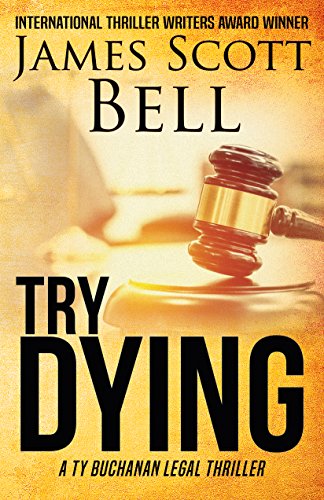
When I reviewed Try Dying, the first novel in James Scott Bell’s Ty Buchanan trilogy of legal thrillers, I said I found it a little pallid compared to his Mike Romeo books. That was a hasty judgment. This series, I now realize, is wonderful in its own way.
Ty Buchanan, as you may recall, was a high-powered lawyer with a big Los Angeles firm. His life got turned upside down when his fiancée was killed and he himself was arrested and charged with murder. He managed to prove his innocence and identify the real killers with the help of unlikely allies – a priest and a nun, from a nearby Catholic retreat center.
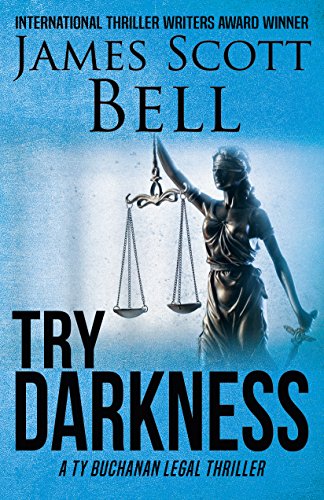
Try Darkness finds Ty living a strange, transitional new life, inhabiting a little trailer at the retreat center. He’s given up his old job, and for the time being is providing legal help to the poor, operating from a table at a coffee shop. Father Bob and Sister Mary Veritas are still his best friends – except that his feelings for Sister Mary are causing both of them considerable discomfort.
Father Bob brings Ty a potential client, a woman who’s living with her daughter, Kylie, at a transient hotel. The hotel makes it a practice to evict all tenants after 28 days, which prevents being reclassified as a residential hotel, making them subject to housing regulations. The practice is illegal, but the law is rarely enforced. Ty agrees to help her sue them.
But suddenly she’s found murdered, leaving little Kylie behind. Ty, leery of handing her over to Child Protective Services, takes her to the retreat center, where the nuns welcome her immediately (except for Sister Hildegarde, the unsympathetic mother superior, whom Ty, Father Bob and Sister Mary attempt to keep in the dark as much as possible).
Ty’s investigation – as you’d expect – will bring him up against powerful and dangerous people.
What was particularly fine about Try Darkness was that it had a lot of heart. Ty is working his way through grief, and his relations with Kylie – and with Sister Mary – are opening his mind and heart to a whole new way of life.
Highly recommended. The books should be read in order. No objectionable language.
King Eystein I of Norway, carving in the Bergen Museum. Photo credit: Nina Aldin Thune, Creative Commons LIcense.
I’ve been doing a little translation lately (I’ll tell you more about it later) which reminded me of one of my favorite passages from Snorri Sturlusson’s Heimskringla.
This story involves King Eystein I, far from the most renowned of Norway’s kings, but very possibly the most likeable.
He was part of a set, sharing a joint monarchy with his brother, Sigurd Magnusson. They were both the sons of King Magnus Bareleg, who never got the memo that the Viking Age was over, and died young and outnumbered in Ireland, declaring, “Kings were made for glory, not for long life.”
Eystein and Sigurd were very different men. Eystein, the older, was handsomer and friendlier, as well as more thoughtful. Sigurd was taller and stronger, and mercurial in his temperament. Some historians suspect, based on saga descriptions, that he may have suffered from bipolar disorder.
Sigurd was actually the first European king to go on a crusade, heading out in 1108 and returning in 1111. He fought in various places in the Mediterranean before helping King Baldwin of Jerusalem capture Sidon. He went home by way of Constantinople. Meanwhile, Eystein stayed home and watched the store.
One memorable scene in their saga has them together at one of Eystein’s estates in the Upplands. During the feasting they decide to amuse themselves by “mannjevning,” what we might call “ranking” today. A bragging competition.
Sigurd boasts about his prowess in war. He tells of his battles in the Holy Land, and all the honors he received from great princes.
This is how Eystein answers:
“I have heard that thou hast won many battles in foreign lands, but it might have been more useful for the land what I meantime did at home. North at Vagar I built booths for the fishing folks, so that poor people could get help, and earn their living. There I founded a priest’s garth and endowed the church. Before this the place was almost heathen. These men will remember that Eystein was King of Norway. The road from Trondheim went once over Dovre-fell, where people were lost in bad weather or had to sleep out of doors and suffer hardships. There I built a mountain inn and gave it an income; those people will know that Eystein has been King of Norway. At Agdenes there is a dangerous rocky coast and no harbour; and many ships were lost every year. There is now a harbour and a landing place for wintering ships, also a church. Afterwards I raised beacons on the high fells and this I hope will be useful for the country. I built at Bergen a king’s hall and the church of the Apostles, with an underground passage between the two. The kings that come after me will remember my name for that.
“I built St Michael’s Church and a monastery besides. I have also, my brother, shaped the laws so that the people can now obtain justice, and when the laws are kept the country will be better ruled. I have set a warping pole with iron rings in Sinholm sound. The Jämtland people are again under the Norse king’s rule, and this was brought about by blithe words and wise persuasion and not by force or fighting. Now these matters are of small importance, still I do not know, if the people in the land are not better served by them, than if thou hast killed black men in Serkland and sent them to hell…”
As good a “guns vs. butter” argument as I’ve ever read, I think.
But though that’s a memorable story, it’s not the best Eystein story. That comes earlier {and is not included in some translations). It represents one of those weird moments you occasionally experience in reading old books when time contracts and you encounter a historical character who seems like someone you might know, and would like to know, today.
There was an Icelandic poet in King Eystein’s court whose name was Ivor Ingemundson. Ivor was a witty conversationalist, and the king enjoyed his company. But a time came when Ivor’s mood changed. He grew quiet and sad, and the king noticed it.
The whole passage is quite long (in Monsen’s translation), but the essence of the story is that Eystein spoke to Ivor privately. Ivor was reluctant to talk at first, but the king asked a series of questions, finally working out through deduction that Ivor was lovesick. He had counted on marrying a particular girl back home, one he couldn’t help thinking about, but his father had arranged for his brother to marry the girl.
King Eystein then proposed a series of remedies – he offered to introduce him to suitable young women; he offered give him property; he offered money to enable him to travel. Ivor replied that none of those things appealed to him. So the king says this:
“I have suggested everything that comes to my mind. There is but one thing else that might help thee, although it is little compared to what I have offered thee. Every day when I am not taken up with important matters, thou shalt come to me and we will talk over this matter about the maid, for it often happens that sorrow shared is sorrow lessened, and every time I shall give thee something before thou goest away.”
The saga says that Ivor agreed to that. “He was thereby consoled in his sorrow and became glad again.”
Inspired by the mayor of New York City, who said the song “Imagine” was an inspirational song about treating each other better, writer Matthew Walther suggests that the unifying banner under which we can all gather could be disdain for this song.
Start with the word salad of Marxism, anarchism, and existentialism. Nowhere is there even the faintest hint of how any of the hypotheticals we are being asked to consider might be realized. Instead Lennon does the political equivalent of telling us that the real magic was inside us all along.
This terrible song offers “a vision of a reality in which ‘lol nothing matters’ is elevated to a first-order principle.”
I’ve always hated “Imagine.” It’s as silly a song as “Simply Having a Wonderful Christmastime.” It’s abyssmal. I can barely listen to Cohen’s “Hallelujah” and “Bewitched, bothered and bewildered” has to be about singing under the influence–does anyone like that one?
Let’s unite in our disdain for overly popular songs. What’s your pick? (via Prufrock)
He had a salt-and-pepper ponytail and L.A. eyes—trying to look cool and detached and hungry for money.
When you think about it, the thriller genre is almost ideal for Christian storytelling. A good thriller takes its hero and strips him of every comfort and illusion, forcing him to look at the plain truth unblinking.
Kind of like repentance.
James Scott Bell’s thriller, Try Dying, does a very good job of doing just that thing.
Ty Buchanan is a hotshot young L.A. lawyer. He works for a prestigious firm, owns a nice home, drives a nice car. He’s involved in a high-profile case, a lawsuit against a celebrity psychologist famous for helping people recover “repressed memories.” But best of all, he’s blissfully in love with schoolteacher Jacqueline Dwyer, to whom he’ll be married in a few days.
Then Jacqueline dies in a freak accident on the freeway.
After the funeral, he’s approached by a guy who looks homeless. He says he has information to sell him. That Jacqueline wasn’t killed in the accident. “They” killed her, he says.
When Ty presses him for more information. The man attacks him and runs off.
Ty can’t let this go. He starts hunting for the man, and trying to figure out why anyone would murder Jacqueline. Clues lead him to investigate a trendy self-help cult, one that has thugs on its payroll. But Ty won’t give up – even when he finds himself accused of murder and locked up.
This first novel in the Ty Buchanan series wasn’t as much fun as Bell’s Mike Romeo books, in my opinion, but I found it engaging and compelling. Prose, plotting, and characters were excellent. Ty’s existential crisis allows him to think about some of the the most important questions.
Keely Delmonico is a high-end call girl in Los Angeles. She does not have a heart of gold. She is, however, extremely intelligent. Enough to know that her present career has no future. She just doesn’t know what to do about that.
As James Scott Bell’s Last Call begins, one of Keely’s clients dies of a heart attack during a session. On instinct, she takes his cell phone away with her.
Her instinct is correct that the cell phone is valuable.
But she had no idea how valuable it is to certain people, and to what lengths they will go to reclaim it. Murder is just the beginning.
Keely runs to Las Vegas, to try to drop out of sight. But she’s underestimated the power of the people she’s crossed. And now she’s placed someone she cares about in mortal danger.
My reaction to Last Call was mixed. Author Bell did an excellent job ramping up the suspense. The tension was almost unbearable at times.
But plotting can be too tight. This story required some highly choreographed coincidences and deus ex machinae (is that the correct Latin plural?) to avert disaster. The plausibility suffered for this reader.
As with Bell’s other books, there is no obscene language.
A bookstore is the best place to be lost. There’s always a volume to grab, and inside there may be pleasures awaiting, wisdom to be gained, or at least something to make you mad. If you’re mad, you know you’re alive, which is a good thing to know from time to time.
I’d heard of James Scott Bell (he used to write the monthly fiction column for Writer’s Digest). I had an idea he was a Christian. I also had a vague idea I’d tried one of his books and didn’t care for it. But now I don’t think I did, because I’m suddenly a fan.
I’ll admit I was skeptical of Romeo’s Rules, the first volume in his Mike Romeo series, initially. I thought it a little ham-handed, working too hard to be amusing. But I kept reading. And the more I read, the better I liked the book. And the one that followed. And so on.
Mike Romeo (not his real name) is a genius. He was admitted to Yale at 14, but left at 15 due to a personal tragedy. Then he knocked around, learning the trade of private investigator, training his body, and becoming a champion cage fighter for a while. Now he’s drifted into Los Angeles, where he’s staying with his only friend, Ira, a wheelchair-bound former Mossad agent, now a rabbi. Mike has begun to think he’s stayed in one place too long. People are hunting him, and he needs to keep moving. But life keeps holding him here.
InRomeo’s Rules, Mike is out jogging one day when a woman approaches him, asking his help in looking for her children, who have disappeared. Then a nearby church blows up. Mike goes inside to make sure the kids aren’t there, and finds a dead body. This brings attention from the police, something Mike does not want. He gets sucked into the woman’s problems – she’s trying to get custody of her children from her powerful husband, who may have kidnapped them. In any case, they’ve gone missing.
In Romeo’s Way, Mike is hired to go to San Francisco as a mole in a political campaign, working for the opponent, whom he considers a rare decent candidate. San Francisco will be everything he expected (that is, just as bad as he expected), but he will meet an interesting woman who may or may not be on his side.
In Romeo’s Hammer, Mike finds a beautiful woman on the beach, naked and disoriented, and rushes her to a hospital. Then she disappears again, and her father appears to ask Mike to look for her. The trail will lead to radical environmentalists and a cult that’s even weirder than the usual California variety.
Finally, in Romeo’s Fight, Mike gets an offer that’s hard to refuse. A big fight promoter wants him to do a major cage match for him, for a lot of prize money. Mike knows he can beat his opponent, but he desires neither the fight nor the money. However, an old friend, another fighter, is arrested for murder and begs Mike to help clear him. That involves getting involved in the fight world again, only this one will be a fight for his life.
Once I developed a taste for the Mike Romeo stories it was like eating potato chips. I devoured them one after the other. Mike is a guy who’s forever citing philosophy and mythology to people, and they never get it. I can identify with that. He was almost the perfect male fantasy character for me. There were echoes of Travis McGee and Spenser here, but the ideas were conservative.
I enjoyed these books a lot, and recommend them highly. The Christian themes are only implicit, but the books are delightfully devoid of profanity. That’s hard to do well in a realistic story, but author Bell carries it off admirably.
Of man’s miraculous mistakes, this bears The palm, “That all men are about to live,” For ever on the brink of being born. All pay themselves the compliment to think They one day shall not drivel; and their pride On this reversion takes up ready praise, At least their own; their future selves applauds; How excellent that life they ne’er will lead! Time lodged in their own hands is folly’s vails; That lodged in Fate’s, to wisdom they consign; The thing they can’t but purpose they postpone. ‘T is not in folly not to scorn a fool; And scarce in human wisdom to do more. All promise is poor dilatory man, And that through every stage: when young, indeed, In full content we sometimes nobly rest, Unanxious for ourselves; and only wish, As duteous sons, our fathers were more wise. At thirty, man suspects himself a fool; Knows it at forty, and reforms his plan; At fifty, chides his infamous delay, Pushes his prudent purpose to resolve; In all the magnanimity of thought Resolves, and re-resolves; then dies the same.
And why? Because he thinks himself immortal. All men think all men mortal but themselves;
A few lines from the international bestseller, The Complaint: or, Night-Thoughts on Life, Death & Immortality. Night I. On life, death, and immortality, by Edward Young, published in nine parts 1742-45.
Michael Connelly is best known for his brilliant series of Harry Bosch police procedural novels. But he has other series. The most minor of these (only in terms of volume count) is his Jack McEvoy series. I have a personal fondness for Jack, because it was the first J.M. novel, The Poet, that introduced me to Connelly’s work.
Jack McEvoy is a journalist, occasionally a famous one. He broke a couple big serial killer stories, and parlayed them into bestselling books. But time moves on. There isn’t much work for journalists these days, and Jack’s books have settled back into publishers’ midlists; he can’t live on the royalties. So, as Fair Warning begins, he’s working as an online journalist, for a consumer web site called Fair Warning.
Jack gets a visit from the police. A woman with whom he once had a one-night stand has been murdered, and he’s briefly among the list of persons of interest. But she did a lot of dating, it turns out.
Still, Jack is curious and troubled by the murder. He does some research and discovers that this woman has one thing in common with several other recent female murder victims – she had contacted a popular DNA mapping site on the web, to make contact with relatives.
Jack’s beat isn’t homicide anymore, but he can’t let this go. He goes to the one person he knows who could really help make sense of this thing – Rachel Waller. Rachel used to be a top profiler for the FBI. Now – thanks to a mistake on Jack’s part – she’s doing research for an insurance company. Also, Rachel and Jack are in love, but Jack keeps messing up and spoiling their prospects. Still, she is intrigued by Jack’s theory and agrees to help him.
They will learn horrifying things, both about the potential for abuse in the field of genetic testing, and about the amoral world of Dark Web communities.
I enjoyed Fair Warning very much. It was nice to catch up with Jack and Rachel, and the story was satisfying. I was a little disappointed to see that a political message was inserted in a couple places, but it’s a message that’s perfectly natural for Jack as we know him.
Cautions for language and mature, sometimes troubling situations. Recommended.
This is not a book review, but – what shall I call it? – a book notice. You may be surprised to know that there’s a book out there about an aspect of Lutheran history in America, which mentions me.
The book is Fifty Thousand Evangelists, by Jonathan D. Anderson (whom I have met and assisted a little with a different project). I’m sure it will be a surprise to many, in view of the state of Lutheranism today, but there was a time – not so awfully long ago – when an estimated more than 65,000 young college-age Lutherans, mostly from mainline church bodies, went out to preach the inerrancy of Scripture and the importance of having a personal encounter with Jesus. At least at the beginning, and for a long time.
It was part of the wider Jesus Movement, and I was there. And so my picture and name, along with that of the group I sang with, is in Fifty Thousand Evangelists, on page 83.
I was motivated to buy the book, but I won’t be reviewing it. I’m pretty sure reading it would be painful for me. Subsequent events have poisoned all my memories of what was, in the experience, the happiest time of my life.
I’ve been working my way through Mark Dawson’s John Milton series of thrillers. As you may recall, I was a little disappointed with the first one, and liked the second better.
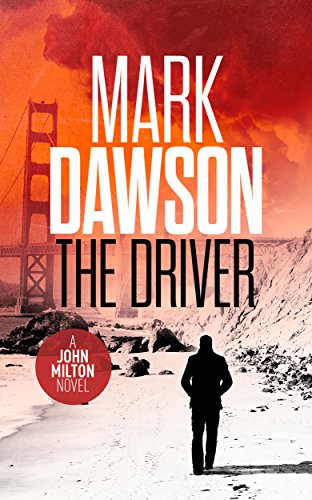
I began the third, The Driver, and have now officially dumped the series.
In The Driver, John Milton is now living in San Francisco, drawn into a search for a young prostitute who has disappeared.
I quit reading where I got to the part (I should have seen it coming, but I was optimistic) where he gets into American politics, which for him are pretty simple. On the Left, the good guys, on the Right, the bigots.
Author Dawson appears to have learned his American politics from CNN, where he apparently also learned about guns. Defectively in both cases.
I do not need John Milton in my reading life. He is barely distinguishable from a half dozen other thriller heroes available. And most of the other heroes’ creators have the sense not to insult half their prospective readership.
Websites store cookies to enhance functionality and personalise your experience. You can manage your preferences, but blocking some cookies may impact site performance and services.
Essential cookies enable basic functions and are necessary for the proper function of the website.
Name
Description
Duration
Cookie Preferences
This cookie is used to store the user's cookie consent preferences.
30 days
These cookies are needed for adding comments on this website.
Name
Description
Duration
comment_author
Used to track the user across multiple sessions.
Session
comment_author_email
Used to track the user across multiple sessions.
Session
comment_author_url
Used to track the user across multiple sessions.
Session
These cookies are used for managing login functionality on this website.
Name
Description
Duration
wordpress_logged_in
Used to store logged-in users.
Persistent
wordpress_sec
Used to track the user across multiple sessions.
15 days
wordpress_test_cookie
Used to determine if cookies are enabled.
Session
Statistics cookies collect information anonymously. This information helps us understand how visitors use our website.
Google Analytics is a powerful tool that tracks and analyzes website traffic for informed marketing decisions.
Used to monitor number of Google Analytics server requests
10 minutes
__utmb
Used to distinguish new sessions and visits. This cookie is set when the GA.js javascript library is loaded and there is no existing __utmb cookie. The cookie is updated every time data is sent to the Google Analytics server.
30 minutes after last activity
__utmc
Used only with old Urchin versions of Google Analytics and not with GA.js. Was used to distinguish between new sessions and visits at the end of a session.
End of session (browser)
__utmz
Contains information about the traffic source or campaign that directed user to the website. The cookie is set when the GA.js javascript is loaded and updated when data is sent to the Google Anaytics server
6 months after last activity
__utmv
Contains custom information set by the web developer via the _setCustomVar method in Google Analytics. This cookie is updated every time new data is sent to the Google Analytics server.
2 years after last activity
__utmx
Used to determine whether a user is included in an A / B or Multivariate test.
18 months
_ga
ID used to identify users
2 years
_gali
Used by Google Analytics to determine which links on a page are being clicked
30 seconds
_ga_
ID used to identify users
2 years
_gid
ID used to identify users for 24 hours after last activity
24 hours
_gat
Used to monitor number of Google Analytics server requests when using Google Tag Manager
1 minute
_gac_
Contains information related to marketing campaigns of the user. These are shared with Google AdWords / Google Ads when the Google Ads and Google Analytics accounts are linked together.
90 days
Marketing cookies are used to follow visitors to websites. The intention is to show ads that are relevant and engaging to the individual user.
A video-sharing platform for users to upload, view, and share videos across various genres and topics.
Registers a unique ID on mobile devices to enable tracking based on geographical GPS location.
1 day
VISITOR_INFO1_LIVE
Tries to estimate the users' bandwidth on pages with integrated YouTube videos. Also used for marketing
179 days
PREF
This cookie stores your preferences and other information, in particular preferred language, how many search results you wish to be shown on your page, and whether or not you wish to have Google’s SafeSearch filter turned on.
10 years from set/ update
YSC
Registers a unique ID to keep statistics of what videos from YouTube the user has seen.
Session
DEVICE_INFO
Used to detect if the visitor has accepted the marketing category in the cookie banner. This cookie is necessary for GDPR-compliance of the website.
179 days
LOGIN_INFO
This cookie is used to play YouTube videos embedded on the website.