
Ethical Editing Must Be Hard for Journalists

Photographer Steve McCurry, who is still admired by many photojournalists according to Gianmarco Maraviglia of Echo Photojournalism, has breached ethical lines by editing his photos to be more clutter-free. As the Associated Press puts it, “We do not alter or digitally manipulate the content of a photograph in any way.” To do so is at least to open themselves up to charges of altering the truth being shown in the photo.

Now McCurry calls himself a “visual storyteller.” He said, “Even though I felt that I could do what I wanted to my own pictures in an aesthetic and compositional sense, I now understand how confusing it must be for people who think I’m still a photojournalist.”

Yeah. Some of us still think Katie Couric is a journalist or perhaps in league with the journalist ilk, so we were surprised to learn that her people edited a documentary on guns, rights, and violence to show the Virginia Citizens Defense League dumbfounded when Couric asked them a basic question.

“If there are no background checks for gun purchasers,” she asked, “how do you prevent felons or terrorists from purchasing a gun?”

In the video, you hear that question and then see members of the group looking at each other or at the floor as if unable to give an answer, but in the audio, which you can hear in this article, the group dives right in. The first voice states that if you aren’t in jail, you should still have the right to purchase a gun, a point which others pick up on later when they say the government cannot predict a crime before in happens. There’s always a first time, and generally speaking we can’t foresee when that will be.

But if those answers are given in the documentary, they aren’t given as direct answers to Couric’s question to the Virginia group, and that has a few people upset.

“Katie Couric asked a key question during an interview of some members of our organization,” their president said. “She then intentionally removed their answers and spliced in nine seconds of some prior video of our members sitting quietly and not responding. Viewers are left with the misunderstanding that the members had no answer to her question.”

The director of documentary said he had just wanted to give the viewer space to think about the question.

‘Once Was Lost,’ by Matthew Iden

Once Was Lost

This is the latest Marty Singer novel, and it just came out. I grabbed it right away. I’m enjoying this series by Matthew Iden, and Once Was Lost doesn’t disappoint.

Marty Singer, ex-Washington DC cop and cancer survivor, gets asked for a favor by his adopted daughter, Amanda. She works at a women’s shelter, and a guy who’s been doing handyman work there needs serious help. He was a low-level gangster, but he decided to testify against his boss, who’s also his uncle. Then he was betrayed, and he barely got away alive with his son when his police protectors were murdered. Now he’s had enough of gangsters and cops. He wants to run away and disappear. Can Marty help him? Can he keep the father and son safe from both the crooks and a (possibly) corrupt US marshal?

Well, it’s not easy. And Marty doesn’t much like his new “client,” Tommy Donlan, who’s arrogant, whiny, and ungrateful. But his kid is nice, and Tommy’s genuinely devoted to him. So Marty, along with Amanda, his girlfriend, and a computer geek buddy, gets to work trying to disappear Tommy.

It works. And then there’s a twist, and he needs to find the guy he’s helped to vanish.

As always, author Iden writes a tight, gripping tale. A particular excellence of this book is his development of the character of Tommy. Tommy’s very off-putting, but Iden skillfully gives him just enough humanity to make us root for him. It’s interesting that a book called Once Was Lost includes a character named Grace. There’s grace in this story, but also many reversals and surprises. Amazing, you might say.

Cautions for language. Recommended.

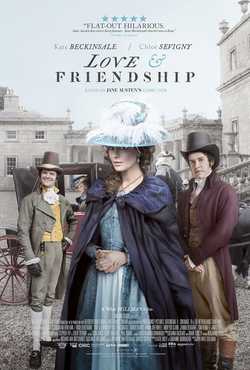
Film review: Whit Stillman’s ‘Love & Friendship’

Love & Friendship

I am fond of Jane Austen, though I’ve only read two of her novels. I’m a huge fan of Whit Stillman. So when I review his latest effort, Love & Friendship (which looks like it might be the big hit he’s deserved for so long) my perspective is that of viewing Austen-land from Stillman-land. This is probably fairly unusual.

People have noted the similarities between Stillman’s work and Austen’s books from the beginning. Metropolitan, his first movie, is self-consciously Austenian, a point paradoxically emphasized by the main character’s insistence that he’s never read Jane Austen because he prefers to read literary criticism of her. That’s an exquisitely Austenian comment on Austen.

And that’s what we also have in Love & Friendship, based on an Austen novella, Lady Susan. It’s meta-Austen. It tells its story, comments on the story, and laughs gently at its comments. It’s a lot of fun. It might be the perfect movie through which to introduce an intelligent consumer who’s not familiar with Austen’s work (I’m sure there are such people; I’m almost one of them) to her world.

Lady Susan (Kate Beckinsale), the main character, is “the most notorious flirt in England.” A young and beautiful widow, we meet her in a silent-movie preface (with subtitles) in which she is driven from the home of a relation, having broken hospitality by seducing the man of the house (she thinks this response shockingly unjust). She then goes to stay with other relations, where she attempts to win a handsome younger man as her own husband while scheming to marry her virtuous daughter off to the stupidest man in England, James Martin (Tom Bennett). Bennett’s scenes are the funniest in the movie – he’s Wodehousian in his affable ignorance. He’s certain there are Twelve Commandments (general ignorance of the Ten Commandments is a running joke in this movie – a comment, I assume, on our own times). Lady Susan is Donald Trumpian in her invincible self-regard and lack of concern for the feelings of others. She’d be unbearable if forces of cosmic justice, acting behind the scenes, didn’t conspire against her machinations – something she would deeply resent if she were aware of it.

I liked Love & Friendship a lot, and suspect I’ll like it more when I’ve seen it a few more times (which I’m sure I will). I was pleasantly surprised by the crowd at the showing I attended – much larger than I expected, and mostly gray-haired, people who I suspect don’t go out to the movies much anymore.

Highly recommended. Not for kids, because much of the humor is sexually sophisticated (though not smutty at all), and because the vocabulary hovers at a high altitude.

Fine Storytelling in Stoddard’s Evenmere

David Randall gives James Stoddard’s  Evenmere trilogy high praise, saying he ought to be famous for them by now. “Stoddard . . . makes a nifty apologia for the fantasy genre, as a necessary mediation that allows us to perceive the divine story through the protective articulation of another level of story.”

Stoddard’s books are good, simply as well-written fantasy. But their theological dimension lends them real depth. The High House is a representation of the universe, its architecture the Divine Architecture. Some parts of the allegory are straightforward: For example, the long, empty corridors between inhabited parts of Evenmere echo the distances of the stars. More subtle is the way meaning emerges from the fabric of Evenmere, in glimpses of the divine amid the prosaic:

The bare corridor continued only a brief time before ending at the base of a wide stair, which ascended to a gallery leading to the left, its end lost in the darkness. The steps were gray marble, and monks were carved upon the balusters, their mouths wide as if in song, their faces all turned toward the top of the stair. (High House)

Taking liberties with realism

Our friend Loren Eaton at I Saw Lightning Fall exegetes the ways the Daredevil series improves its storytelling by getting the real world wrong:

Here’s the interesting thing, though: While all these examples might falter on the ground of plausibility, they do yeoman’s work in developing both characters and plots, in advancing scenarios and revealing personal peculiarities. When Kingpin calls Vanessa on the carpet for concealed carry, viewers learn that she’s not some ingénue, but rather an empowered woman with her own ambitions: “We’ve been sitting here talking for hours, and you’re going to insult me like I have no idea what you really do? … I know you’re a dangerous man. That’s why I brought a gun to a dinner date.”

Read it all here.

‘Punctured,’ by Rex Kusler

Punctured

Rex Kusler shows promise as a mystery writer. Punctured is the first in his Las Vegas Mystery series.

The hero is Jim Snow, a former Las Vegas police detective who left the job to become a professional card player. But he’s had an unlucky streak recently and is thinking about other possibilities. Then he gets a call from his sister Karen, who also lives in Vegas. Her husband has been murdered, and she knows the police suspect her and her (male) neighbor.

Jim has never been all that close to Karen, but he agrees to help. With the assistance of a woman cop and a homeless man, he starts sorting through a tangle of motives and scenarios.

Author Kusler has the talent to be a good novelist, I believe. He writes a good sentence (most of the time), and knows how to stage a good scene. His problem is character development. His way of revealing his characters is to have them spill their entire life stories, with or without prompting, the minute they first appear. It stretches credibility the first time, and becomes funny when repeated again and again.

There are several books in this series now, and one hopes the author has improved his technique. I’d be inclined to try the next book, but there was one scene of fairly heavy-handed feminism that put me off. But Punctured isn’t a bad book, if you overlook the character development problem. Cautions for language, but it’s not terribly bad in that regard either.

‘Raven Black,’ by Ann Cleeves

Raven Black

I’ve been watching the latest series of the BBC dramatizations of Ann Cleeves’ Shetland mysteries, starring the character of Inspector Jimmy Perez. So I thought I’d check out the first novel in the series, Raven Black.

My verdict: I’m not sure.

First thing I noticed: The real Jimmy Perez in the books looks nothing like the guy who plays him on TV. In the book his appearance mirrors his exotic name (he’s a descendant of a sailor of the Spanish Armada, shipwrecked in Shetland). The guy on the show looks like he could be Norwegian. Or any kind of northern European.

Anyway, the story starts when a single mother living in the town of Lerwick discovers the body of a teenaged girl, strangled in the snow. Suspicion quickly falls on a man living nearby, a mentally retarded oldster who was once accused, but not convicted, of killing a little girl.

Inspector Perez is not convinced of the old man’s guilt. Eventually he learns that the girl was filming a documentary about life in the Shetlands, and a number of people didn’t like the direction her project seemed to be taking.

I’ve always been leery of women mystery writers, even (or especially) when they give us male protagonists. I didn’t dislike Raven Black, but I found it a little dull. In what seems to me the common fashion among female authors, the emphasis is more on relationships than action (even though the book is advertised as a thriller). I like relationships and personalities in my mysteries – in fact I insist on them – but I prefer the mix to be a little stronger on the danger side.

I may read more books in the series, or I may not. Not sure yet. I like the setting; it’s interesting to me for its own sake. Jimmy Perez, though, seems to me kind of a stick.

The Cross in Agents of S.H.I.E.L.D.

The third season of Agents of S.H.I.E.L.D. came to a close this month on an interesting Christological note. I’ve been a fan of the show since the beginning and never had the complaints I read from others that it was too slow, didn’t have enough super powers, and whatever else. It’s a good show, and it didn’t get canceled like Agent Carter did (which is another good show, great show even, and it stinks that it’s cancelled.) The most recent season of Agents of S.H.I.E.L.D. focuses on a vision one of the agents has of someone’s death, and central to that vision is a cross pendant.

I doubt I can keep from spoilers.

The season opens with the vision. A ship in space, the arc of the earth through the cockpit windshield, the cross pendant and necklace suspended in air, and a S.H.I.E.L.D. logo on a sleeve. No face or identifiers of who, if anyone, might be in that aircraft. We learn after a few shows that an Inhuman (a substitutionary word for “mutant” with its own extraterrestrial history) has the ability to foresee details of a death when he touches someone. This ability brings him into contact with Daisy Johnson (Chloe Bennet), the Inhuman agent of S.H.I.E.L.D. who is working on putting together an Inhuman tactical team, and when they touch each other, they see the vision of the cross on a ship in space.

“I’ve seen the future,” she tells her team, “and one of us is going to die.”  Continue reading The Cross in Agents of S.H.I.E.L.D.

Wanting to Be Smarter Than God

Sunrise

God in his grace also provides the solution: the God-man, the Word made flesh bore the sins of people of all nations in his body on the tree. We see him pinned there by our foolish pride. Our pride that thought it could build a tower bigger and better than God. That God that spoke us into existence with a word made his Word become flesh (Jn. 1:14) and that flesh was put to death on our behalf to save us from our wicked desire to be smarter than him.

Pastor Sean Nolan repents of his desire to be clever.