Weird week. Good, but weird. I am a dull man leading a dull life, but occasionally things pick up. They’re up right now.
Saturday I’ll be doing the first actual Viking event I’ve done in over a year – not strictly a Viking event, but a military history timeline thing at Dundas, Minnesota: Minnesota Military History Days. I’ll only be there Saturday. But it’s an event, and I’ll be setting up the tent, so I’m feeling the “tension.” (“Tent,” “tension,” get it? They actually do come from the same root.) Sunday is another event, but that’s not open to the public, so I won’t tease you with it.
(I probably won’t be posting anything Friday, because it takes me at least a day to do anything.)
And then translation work showed up. Fairly big project, fairly tight deadline. On top of that, it’s got a subject that really appeals to me (can’t tell you what). So I’m busy with that right now (should be working on it this minute, in fact).
And I got an invitation to be interviewed on a talk show a good friend does on a station in Des Moines (Truth 99.3). I can’t find a way to link to the recorded interview yet, except through Facebook. I’ll let you know if I find it (or, more likely, if somebody points it out to me, as one directs an elderly tourist to local points of interest).
Last night, I got a toothache. Went in to the dentist today on an emergency basis. He looked inside my maw and found nothing. He asked, “Have you been tense lately?”
For some of our readers, this will be the book you’ve been waiting for.
Ian Stuart Sharpe has produced an eccentric but highly amusing little book for the Viking fancier. Old Norse for Modern Times is not a language course or a dictionary, but a fun collection of modern phrases rendered into the language of the Vikings. The utility of this book will probably be limited, but it is a lot of fun, especially for reenactors, saga nerds, and Viking buffs.
Ever want to say, “I’ll make him an offer he can’t refuse” in Old Norse?
“Gøra mun ed hom boð slike, es hann getr eigi hafnat.”
Since Hamlet was in fact an old Viking (or pre-Viking) himself, he might actually have said, “Something is rotten in the state of Denmark:
“Eigi mun alt dælt I Danmǫrku.”
There’s also useful stuff for the contemporary berserker: “If I die in battle today, please delete my browser history.”
“Ef ek skylda falla i þessi orrustu, fyrirkom þú þá vefsǫgu minni.”
I must admit to some surprise in reading this book, in spite of all the knowledge I like to pretend I have. It generally takes more words to say stuff in Old Norse than in English – as a writer composing Viking dialogue, I’ve always thought of the Vikings as terse in speech. That’s probably just a function of English saga translations, it would appear.
A lot of us have pondered learning Old Norse at one time or another (I know I have, but I have trouble keeping track of just two languages). If you’re one of those people, Old Norse for Modern Times may serve as a good introduction.
Or you may want to read it just because it’s funny.
UPDATE: An enhanced version of my 2002 lecture at Mayville State University has been posted on YouTube. It includes the introduction by Prof. Dale Nelson, explaining how awesome I am. Or was.
Many long years ago, in 2002, I gave my very first lecture on the Vikings at Mayville State University in Mayville, ND. The invitation came thanks to my friend Dale Nelson, of the English Department. That culturally significant moment was recorded for posterity, and the video has just been posted at YouTube, as you see above.
The first time I saw this video, some time after the talk, I was impressed with how fat I looked. Now I’m impressed with how young I look.
I can’t guarantee I still stand behind all the opinions I express in this talk. One lives, translates, and learns.
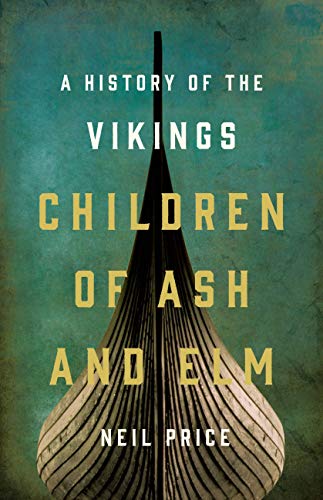
Having at last finished Neal Price’s very long – and enjoyable – survey, Children of Ash and Elm: A History of the Viking Age, I find my feelings definitely mixed. There is much in this book that I admire and value. I learned from it. But I found what seem to me certain debilitating flaws in it.
I might mention, first of all, that (although he does not cite Viking Legacy, the great book to which I am immortally linked as translator) author Price takes the same line on the historical validity of the sagas – that they are not straight history and cannot be treated as such, but that they do contain useful information for the historian who employs them with care:
Even the most sceptical of literary researchers, those who generally reject the Old Norse texts as viable sources (however remote) for the actual Viking Age, do not always go on to confront the question this viewpoint requires: why, in that case, would medieval Icelanders have created—over several centuries—the most remarkably detailed, comprehensive, and consistent corpus of historical fiction in the world?
Author Price is an accomplished archaeologist, who has spent decades studying the Viking Age. His research is extensive, and he writes with the authority of long familiarity. His purpose in this book is more than to tell the story of the Viking Age. It is to draw on his learning and experience to try to convey to the modern reader the essence of the Vikings – how they saw the world, how they felt. I think he succeeds to a commendable degree.
Most big books on any subject try to offer a new theory or insight, and Children of Ash and Elm does this through a couple (relatively) new ideas – that the Viking Age began earlier and lingered longer than is generally assumed, and that the two Viking enterprises, the “west Viking” and “east Viking” currents, were in fact one and the same, with no real separation.
Hidebound non-specialist that I am, I must admit I’m not convinced by these arguments. Inception and terminus dates are notoriously hard to nail down, but Price points especially to a mass ship grave containing Swedish skeletons, found in Estonia and dated around 750 AD (he always uses CE dating, of course). I don’t entirely buy this argument. It’s hard to identify a “Viking raid” on the basis of a single burial, however impressive.
As for the unity of east and west, I have long held, and continue to hold, that the location and power of Denmark is a central issue in understanding the Viking Age. The simple fact that passing into or out of the Baltic required paying tolls to the king of Denmark tended to send Norwegians west and Swedes east, just to avoid his domains. The compartments weren’t watertight, but I think they existed.
I noted what seemed to me a telling omission in the book’s account of Viking slaving activities. Price makes no secret (quite rightly) of the fact that the Vikings routinely took and trafficked in slaves, and profited greatly from the trade. He speaks movingly of the suffering of those in bondage. But he seems to minimize the role of the Muslim world in it. He does mention the Arab markets, but only more or less in passing. Reading this book, you’d think most Viking slaves ended up toiling on Scandinavian farms. In fact, the great majority were headed into the insatiable maw of the Islamic slave markets.
The book was also marred, for me, also by occasional genuflections toward political correctness. Here and there, author Price finds it necessary to apply concepts like “privilege,” “intersectionality,” and “gendering” to the Vikings. I don’t think this is useful or illuminating in historical context.
Nevertheless, I found Children of Ash and Elm fascinating and informational. It’s written (and well-written) with a clear passion for the subject and a practiced critical eye. I recommend it, with cautions.
Once, in the Russian urban centre of Novgorod, where the waterlogged soil preserves such things well, I breathed in the scent of fresh pine a thousand years old, the whole site just saturated in the fragrance from all the woodworking waste lying where the Viking-Age carpenters had left it.
Ever see one of those old comedy movies, set in the Middle Ages or sometime, in which the orchestra suddenly breaks into swing music and everybody starts jitterbugging? (I recently watched “A Knight’s Tale” for the first time, and they did the same sort of thing , with different pop music. I fear this will not age well.)
I had much the same feeling today as I was reading Neil Price’s generally excellent book, Children of Ash and Elm. In a chapter called “Border Crossings,” he takes a break from a mostly well-informed and insightful study of Viking Age history to impose 21st Century concepts on an alien culture.
There are clear suggestions of queer identities in the Viking Age (with a caveat for the retrospective application of contemporary vocabularies).
Give him points for self-awareness, anyway. Retrospective application is precisely what’s going on here. I speak from a position of prejudice, of course, but it saddened me to see a good study like this marred by what I consider (I could be wrong, of course) a transient intellectual fad.
In fact (except for the admittedly problematic Grave Bj. 581 in Birka, which I can’t explain, but neither can anyone else), he is able to demonstrate nothing about the Vikings themselves other than that they had an extremely “gendered” (his word), male-dominated culture, in which there is evidence of a certain amount of deviance. You could say the same about the Victorians. He admits it plainly at one point, saying, “There are no positive depictions of same-sex relationships in the textual sources.”
To put it in terms comprehensible to current academics, Price is “appropriating” Viking culture, forcing his own paradigm on them in a way that they would have found offensive.
After a couple weeks with Rodney Riesel’s light – and short – Dan Coast books, I have plunged (with some relief, actually) into a little more challenging material. I’m reading Children of Ash and Elm: A History of the Vikings, by Neil Price. It’s a long book, and it will take me a while to get to the point where I can review it. I’m finding it a good object to wrestle with – I like parts very much, and I disagree now and then. Here’s a nice passage from near the beginning:
When properly recited in appropriate surroundings, Viking-Age poetry can taste like cold iron on the tongue, its complex rhyme schemes building upon one another like layers of frost—treacherous but beautiful. We gain something old and true in this language, even if only understood in translation, and for that reason I have included a selection here.
Tolkien would have liked bit that very much. Even if you disagree with a historian, prose like this can make reading his book worth your time.
In one of several vignettes, Price imagines a younger son on the impoverished west coast of Norway, whose childhood sweetheart has a new brooch: a present from a boy who spent a successful summer raiding. What is young Orm or Gunnar going to do? Not only does he need money for the bride-price paid to her family, he needs a reputation: ‘The act of acquiring silver was as important as the silver itself.’ And if he went raiding he might in any case acquire a woman for free. DNA has shown that ‘a very large proportion – even the majority – of female settlers in Iceland were of Scottish or Irish heritage.’
Looks like the kind of book a man of my pretensions needs to read. It’s coming August 25th.
I have a new column up at The American Spectator Online today: Slaves to Intellectual Fashion: 1619. A little more fiery and dismissive than my usual stuff, I think. This particular initiative gets my goat in a personal way. I consider it slander against a country I love and am grateful for.
The weekend was good, thanks for asking. We had a couple Viking groups at Nisswa, Minnesota for a one-day Viking event on Saturday. I took a few pictures, but they weren’t very good. Having 2 groups together made it possible to have some relatively impressive battles, with (I guess) 15 to 20 guys all together. I did not participate in those. I sat in my pavilion in Viking splendor, dispensing wisdom and information to all comers. Also selling books.
It was nice, the weather was beatiful, and I stayed with some very gracious hosts in Brainerd. All in all, pretty rewarding. The scuttlebutt is that the event will happen again next year.
Websites store cookies to enhance functionality and personalise your experience. You can manage your preferences, but blocking some cookies may impact site performance and services.
Essential cookies enable basic functions and are necessary for the proper function of the website.
Name
Description
Duration
Cookie Preferences
This cookie is used to store the user's cookie consent preferences.
30 days
These cookies are needed for adding comments on this website.
Name
Description
Duration
comment_author
Used to track the user across multiple sessions.
Session
comment_author_email
Used to track the user across multiple sessions.
Session
comment_author_url
Used to track the user across multiple sessions.
Session
These cookies are used for managing login functionality on this website.
Name
Description
Duration
wordpress_logged_in
Used to store logged-in users.
Persistent
wordpress_sec
Used to track the user across multiple sessions.
15 days
wordpress_test_cookie
Used to determine if cookies are enabled.
Session
Statistics cookies collect information anonymously. This information helps us understand how visitors use our website.
Google Analytics is a powerful tool that tracks and analyzes website traffic for informed marketing decisions.
Used to monitor number of Google Analytics server requests
10 minutes
__utmb
Used to distinguish new sessions and visits. This cookie is set when the GA.js javascript library is loaded and there is no existing __utmb cookie. The cookie is updated every time data is sent to the Google Analytics server.
30 minutes after last activity
__utmc
Used only with old Urchin versions of Google Analytics and not with GA.js. Was used to distinguish between new sessions and visits at the end of a session.
End of session (browser)
__utmz
Contains information about the traffic source or campaign that directed user to the website. The cookie is set when the GA.js javascript is loaded and updated when data is sent to the Google Anaytics server
6 months after last activity
__utmv
Contains custom information set by the web developer via the _setCustomVar method in Google Analytics. This cookie is updated every time new data is sent to the Google Analytics server.
2 years after last activity
__utmx
Used to determine whether a user is included in an A / B or Multivariate test.
18 months
_ga
ID used to identify users
2 years
_gali
Used by Google Analytics to determine which links on a page are being clicked
30 seconds
_ga_
ID used to identify users
2 years
_gid
ID used to identify users for 24 hours after last activity
24 hours
_gat
Used to monitor number of Google Analytics server requests when using Google Tag Manager
1 minute
_gac_
Contains information related to marketing campaigns of the user. These are shared with Google AdWords / Google Ads when the Google Ads and Google Analytics accounts are linked together.
90 days
Marketing cookies are used to follow visitors to websites. The intention is to show ads that are relevant and engaging to the individual user.
A video-sharing platform for users to upload, view, and share videos across various genres and topics.
Registers a unique ID on mobile devices to enable tracking based on geographical GPS location.
1 day
VISITOR_INFO1_LIVE
Tries to estimate the users' bandwidth on pages with integrated YouTube videos. Also used for marketing
179 days
PREF
This cookie stores your preferences and other information, in particular preferred language, how many search results you wish to be shown on your page, and whether or not you wish to have Google’s SafeSearch filter turned on.
10 years from set/ update
YSC
Registers a unique ID to keep statistics of what videos from YouTube the user has seen.
Session
DEVICE_INFO
Used to detect if the visitor has accepted the marketing category in the cookie banner. This cookie is necessary for GDPR-compliance of the website.
179 days
LOGIN_INFO
This cookie is used to play YouTube videos embedded on the website.