All posts by Lars Walker

Memoir of decline: My strenuous weekend

Old Man In an Armchair, by Rembrandt, 1652.

I just received a postcard. It was mailed to me from Spring Grove, Minnesota (in the southeastern corner of the state) on May 17 last, and it arrived here in Robbinsdale today. That’s nearly three weeks to travel 161 miles. I could wax indignant about the way the mail service has deteriorated, harkening back to the gilded days of my youth when such a missive would have arrived the following day, or at most in two days.

But at this point, I just sympathize with the postal service. It must be feeling pretty much like I was feeling after this weekend.

Don’t get me wrong. It was a good weekend. Met a number of nice people, and sold a reasonable amount of my books.

But it was hard on me. This was one of those watershed moments in a man’s life (if it’s a man; sometimes it’s a woman but I know nothing about that. I only assume their experience is similar) when he’s forced to face the fact that he’s gotten bloody old. I drove home Sunday afternoon, left all my Viking junk in my car, and collapsed on the sofa. I spent Monday recovering; I accomplished nothing except for posting a book review. I had “run out of sand,” to employ a metaphor from my green years.

Having rested up now and thought it over, I realize the situation may not be as bad as I thought. This weekend was unusual in that it involved two consecutive Viking events on two consecutive days. That meant two setups and two teardowns, plus packing and unpacking my car. That’s a lot of barges toted and bales lifted. Thank God for the young people in our group – we’ve had a gratifying influx of promising youngsters recently, and they are generous in helping me lift and carry and strap things down. I couldn’t manage without them.

But I think I probably need to cut back a little. I’m considering selling my Viking tent. I can get by with a sun shade/awning, as I used to, which is a lot lighter. I said goodbye to steel combat a few years ago, and now I think I may need to say goodbye to the care and feeding of my tent. I stand before the crowd like Lou Gehrig in “Pride of the Yankees,” and say I’m the luckiest man on the face of the earth.

Lugging my Viking chest in and out of my house (it involves steps) is the single hardest part of managing my reenactment impedimenta, though. I think I’m going to experiment with just leaving the blasted thing in my car all summer. Heat may be an issue in the sunshine, but the only thing I can think of inside the chest that’s likely to melt is a little lump of beeswax in my leather sewing kit. And that’s in a plastic container, so I think it’ll be all right.

I’ll be thinking more about efficiency and downsizing. That’s part of the aging process generally. I must resign myself, I think, to being prized for my wisdom rather than my strong back.

Come to think of it, I was never much prized for my strong back. If I was considered wiser than I was strong, that was mostly because I wasn’t very strong.

What, you ask, were these two exhausting events? Saturday was the annual Nordic Music Fest in Burnsville, Minnesota. It’s held at Buck Hill, a commercial ski hill that’s been around forever, right next to the highway. In the non-snow months, they host other events, of which this was one. The day started rainy (not predicted by the weather man), then turned sunny and humid. The featured music was an ABBA cover band, and our young Vikings did a couple combat shows. I had several interesting conversations with people who came by my sales table, and I sold a fair number of books. It was comparable to last year.

Sunday was Danish Day at the Danish American Center in Minneapolis, something our group participates in every year. The weather was nice, though it was starting to spit rain by the time we tore the camp down. Attendance was better than it’s been in a while – I had to wait in line a long time to buy my food. (I got aebelskivers – a spherical Danish pancake served with strawberry jam and powdered sugar, a Danish hot dog, and layer cake.) My book sales were small, but they always are at Danish Day – I sold three books, which is actually good for that event. I don’t know why the Danes seem to be less interested in books than Norwegians – possibly it has to do with the fact that my books are Norway-oriented.

One of our new members has a pair of Norwegian Elk Hounds, named Odin and Freya, which he brought. They are astonishingly mellow and easygoing – I joked with the owner that the dog treats he fed them must be CBD gummies. (This breed is not usually known for its placidity. They’re strong dogs, and generally they like to romp.)

It was a good weekend.

But it seemed to me it was no country for old men. Or so I felt Sunday evening.

I didn’t take any pictures. Sorry.

‘One Way,’ by Tom Barber

Sam Archer, hero of One Way, is a New York City policeman, formerly a London policeman (it’s complicated). He’s on the counterterrorism squad, and in his last adventure (One Way is Book 5 in the series) he got injured badly enough to put him out of action for a while. It’s the last day before his much-anticipated return to work, and he’s relaxing on a park bench when he sees what he quickly identifies as a team of bodyguards moving a protected person. The protected person is a little girl, nine years old. Suddenly Sam spies a hit team attacking them, and he shouts a warning. Soon bullets are flying, one bodyguard (they’re federal marshals) is wounded, and Sam has no choice but to join the marshals in their escaping car. They end up taking cover in a 22-floor high rise building, whose ground floor is soon occupied by the attackers. The bad guys successfully cut off communications, and the little group of marshals, plus Sam and the protectee, are trying to find a safe hiding place – as the attackers begin hunting them down from room to room.

We’re operating generally on the Die Hard model here. Our intrepid hero, outgunned (joined here by a kick-butt female sidekick, for the sake of diversity), faces increasingly long odds, as their opponents turn out to be a lot better prepared than you’d expect – and to have surprising backup resources. Secrets are revealed, only to be topped by deeper, darker secrets. Betrayals are disclosed and further betrayals perpetrated. It all culminates in a rooftop showdown, with a bomb ticking in the basement.

For me, it was all a little much.

I’ve bellyached about the Cinematic Thriller Formula before. This formula dictates that the novel must work like a contemporary action movie – the drama has to ratchet up constantly (nothing wrong with that), and the limits of human physical endurance (as well as the laws of physics) can be generally ignored. Each narrow escape may be plausible in itself, but cumulatively they defy credulity. The strategy is to keep the audience so excited they don’t have time to engage their critical brains.

The problem with that is that novels are, by nature, a slower medium than movies. Most readers can, and do, pause for a break frequently. When we pause, some of us ponder – which conflicts with the author’s purpose.

Also, a movie usually doesn’t last much more than two hours. But a novel can take many hours to read. Being old and weak of heart, I dislike being kept in a state of fight or flight for ten hours straight. It wearies me, and I had a rough weekend.

For all that, I can’t deny that One Way did its job effectively. It was a little odd to read an American story written with English spelling and orthography – “kerb” for “curb,” for instance. But the author did a good job. His prose could use some pruning, but it worked.

Perfectly fine, if you like this sort of thing.

‘The Missing Man,’ by David Carter

Sometimes, especially in English crime fiction, your run across what I’m inclined to call a “Police Cozy.” It’s a story about cops, but low on the action and violence. That kind of story suits me very well.

Author David Carter is producing a series about Chester (England) detective Walter Darriteau. He works in a sex-balanced headquarters (they’re always sex-balanced these days, at least in fiction), and cooperates well with his colleagues. His partner, Karen, is an attractive blonde, but they both have outside romantic relationships. The Missing Man (one of the least charismatic book titles I’ve ever come across) is a novella featuring the regular characters.

A middle-aged woman calls the police and informs them, matter-of-factly, that she wants to confess to a murder. Nearly 25 years ago, she says, she killed her philandering husband. Now she wants to come clean.

Walter and Karen go to her home to interview her, and she tells them she didn’t actually commit the murder herself. She hired a couple criminals to do the job. She doesn’t in fact have any evidence of a crime. The perpetrators are dead, and even the purported burial site is under a concrete overpass (called a “flyover” in England), so it would be difficult to dig up. But her husband disappeared and hasn’t been heard from since, so she’s confident he’s dead.

Walter’s and Karen’s bizarre job is to try to ferret out any evidence or witnesses that might still be around after a quarter of a century. In time all will be revealed – and I have to admit it was a surprise.

The writing in The Missing Man was good. I enjoyed the story. Based on this short sample, the series appears worth checking out.

Personal appearance alert: Nordic Midsummer Festival

If you’re in the Twin Cities area, I’ll be present selling books, with the Vikings, at the Nordic Midsummer Fest at Buck Hill in Burnsville, on Saturday.

Information here.

‘Odin,’ by David Archer and Blake Banner

The voice on the other end was like dark chocolate that smoked and drank too much and didn’t give a d**n.

If you crossed Rex Stout’s Archie Goodwin with Ian Fleming’s James Bond, you’d pretty much get Alex Mason, hero of Odin, the first volume in a series by David Archer and Blake Banner.

Alex Mason is an agent for “Odin,” an officially nonexistent espionage agency operating for the US government. Its head is known as the Chief, but he’s sometimes called “Nero,” an obvious hat-tip to Nero Wolfe, of whom he is a near clone. He summons Alex to his office as Odin begins, telling him that he’s concerned about an agent he’s had in place in Manila, who has suddenly disappeared. That agent was part of a small, strategically placed cell of assets working against the Chinese. And now it seems they’ve been discovered.

In fact, as Alex arrives, Chinese agents are already moving against the cell. Quickly one is murdered, two go on the run together, and another is captured. Alex needs to find the two fleeing assets and get them to safety. As he begins that task, he is joined by a friendly – and gorgeous – female Mossad agent.

In terms of writing craftsmanship, I find no fault with Odin. The characters were sharp and interesting, and the dramatic tension escalated steadily. The prose was often delicious, with lines like, “He turned and strutted over on crisp little feet.”

The plotting impressed me very much. A plot development that looked like implausible coincidence turned out to be perfectly plausible, by neat authorial jujitsu. An apparent contradiction resolved itself, paying off in heightened suspense for the reader.

I was less happy with a moment of justification of adultery, but I’ve overlooked worse moral sins in a novel.

Bottom line – Odin was a superior thriller, crafted with high professionalism. It was a good time with a book, well worth the purchase price.

Writer’s journal: Character lists and pronunciations

King Olaf discovers a young man’s “treachery,” a scene I use in The Baldur Game: Illustration for Heimskringla by Christian Krogh.

First of all, I need to correct myself. I’m a little surprised nobody has rebuked me on the point already in comments. No doubt that’s because our readers are highly sensitive and polite people.

In a previous post, I called the list I’m working on right now, for my upcoming novel, The Baldur Game, an index of characters. It’s not an index. It’s just a list. Every index starts as a list, and the process reminded me of indexing. But to be an index, my list would have to specify pages on which the names are found, and doing that would be just making work for myself. Writing a deathless epic is plenty to do already, without such excess exertion.

The really hard part of the character list is the name pronunciations. I discussed that challenge earlier too. How many different ways are there to pronounce Saga Age names? You can use the pronunciations the top scholars use – the ones recreated on the basis of known linguistic laws concerning vowel shifts and the softening of consonants (there’s a name for that, but I can’t recall it. And it hardly seems worth the effort to look it up, even on the internet. Grimm’s Law enters into it, I know – and yes, it’s the same Grimms you’ve heard of, the ones who collected fairy tales). But nobody understands those scholarly pronunciations. I’m inclined to think, in my cattier moments, that the scholars themselves just use them to intimidate us.

Then you can use contemporary Icelandic pronunciation. But I’d have to master Icelandic pronunciation to do that, and it would sound strange to my readers, who are English speakers by and large.

And you can use contemporary Norwegian pronunciation. That’s more or less what I do, as the possessor of a middling facility with Norwegian. But you can only go so far with that too. I can do no more than suggest characteristic Scandinavian diphthongs that don’t exist in English. I fear my attempts won’t entirely please my Norwegian friends and family. My relatives in Rogaland, for instance, pronounce the name Einar something like “AY-nar,” but I make it “EYE-nar,” like Kirk Douglas does in the Vikings movie. Because I don’t want to challenge my American readers’ patience too much. Not when I’m expecting them to plow through my prose too.

The bottom line is that I’m unsatisfied with my pronunciations – and if I changed them I’m pretty sure I’d still be unsatisfied.

It looks like there’ll be a small delay in getting the book finally published. One collaborator, whose contribution can’t be omitted, is being delayed due to multiple obligations.

Still, I have a few things left to do. I need to make some more Photoshop additions to my map – locations mentioned in the book.

I could do another read-through, of course, but my instincts tell me no. I’ll give it one more reading before it’s published, but I think that should be the last step. There comes a point when you’re just rearranging the furniture in a manuscript, changing words and then changing them back. I suspect Frank Herbert was thinking as an author when he inserted an invented quotation in Dune that said (as I recall it): “Arakis teaches the maxim of the knife, cutting off that which is incomplete and saying, ‘Now it is complete because it ends here.’”

Any work of man can be “improved” indefinitely. At some point you’ve just got to let the baby be born already.

‘No Room for the Innocent,’ by Dan Wheatcroft

The “Leveller” trilogy rounds itself off in a satisfying way in Dan Wheatcroft’s No Room for the Innocent.

This series, as you may recall, involves intertwining plots centered on two main characters – Inspector Thurstan Baddeley of the Liverpool police and a man known as Nicks, who is a top-level assassin dispatched by a high-level, secret government organization to kill the worst criminals the police can’t touch. The two men know each other, and share a grudging respect, though Nicks is always one step ahead of investigators.

But now there’s a problem. Nicks’ handler, Don, has been murdered. Because Don is his only contact in the organization, he’s suddenly out in the cold and vulnerable. When he learns that his controllers have been less than altruistic in their operational aims, he can think of only one person to go to for help – Inspector Baddeley.

The writing in these books is adequate, with occasional grammatical lapses. But the author’s knowledge of police work (he’s a former cop himself) makes the settings and procedures authentic, and I liked the characters a lot.

I enjoyed this series, and recommend it, with only minor cautions for grown-up themes and violence. Conservative opinions are occasionally hinted at.

Memorial Day, Battle Hymn

Today is Memorial Day. It was raining here today, so I couldn’t fly my flag. I’d better lose no (more) time in posting my virtual commemoration of the holiday. The video above was (oddly), compiled by a Canadian, using footage from some of our more patriotic movies and TV series, the kind they don’t do anymore.

The Memorial Day tradition goes back (according to Wikipedia, to a proclamation by John A. Logan, Commander in Chief of the Grand Army of the Republic (the Civil War veterans’ organization), declaring May 30, 1868 to be a day for placing flags on the graves of fallen soldiers. Decoration Day, it was called. (That was what my grandmother used to call it. The official name was changed in 1971, some time after her death.) However, the Veterans’ Administration credits the idea to a woman named Mary Ann Williams.

The hymn tune, “Battle Hymn of the Republic” is obscure in its origins. It seems to have risen in the camp meeting culture of the American south, and possibly echoes a Negro spiritual. The tune was picked up by the 2nd Infantry Battalion, Massachusetts Militia (the “Tiger Battalion”). They used the coincidence of one of their members being named John Brown to make up a song that teased him, when he was late to report for duty (apparently a frequent occurrence). They joked that this was excusable on the grounds that he was dead – all the papers said that John Brown (the abolitionist) had been hanged. Other units picked the song up without the teasing, as the conviction grew in the ranks that they were carrying on John Brown’s work.

Julia Ward Howe, the abolitionist, felt the lyrics were not worthy of the cause, and sat down to write a nobler version, which was first published in 1862 in the Atlantic Monthly. It is a stirring song, and I remember thrilling as I sang it as a member of the Waldorf College Choir in 1969.

A few years back I discussed the hymn with a scholarly friend whose field is American religion. He pointed out to me – and I should have been aware of this, but emotion dulls the sight – that the theology here is in fact rather bad. A political/moral cause is elevated to the level of the work of salvation. The fighting of a war is compared to Christ’s sacrifice for our sins.

Howe was in fact a progressive, my friend pointed out. She had left Calvinism to embrace Unitarianism. In the manner of progressive Christians, she downplayed the atonement for sin and focused on the creation of a more just society. She and her compatriots were the forerunners of today’s social justice warriors.

There has never been a nobler cause in human history than the abolition of slavery. It’s a supreme triumph of Christian civilization – one for which Christian civilization gets insufficient credit. But it wasn’t the same thing as Christ’s redemption.

Having conceded that, I still have to say I’ll always love the Battle Hymn of the Republic. It’s not a true Christian hymn, but it’s a very good earthly sentiment. I’ll put it up against secular sentiments from anybody’s culture you care to name.

Writer’s journal: Nearing the finish line

King Olaf gives a sword to Sigvat the Skald. An incident I use in ‘The Baldur Game.’ Illustration for ‘Heimskgringla”: Christian Krogh.

Today was a good writing day. Yesterday was too, come to think of it. I finished up a side job on Monday, which opened up some time to exercise my muse beyond my routine two hours daily. And I was coming to the end of another draft of The Baldur Game.

This was the draft where I incorporated most (not all, but most) of the suggestions I got from my beta readers, one of whom is my co-blogger Phil. (Why are they called beta readers, anyway? Who are the alpha readers? No one ever explained that to me. And here I call myself an author.) I appreciate the comments and tweaks. They unquestionably improved the product and spared me numerous errors.

As one nears the finish line on a project, one often finds extra inner energy for the final sprint, which is what happened now. This is part of the final polish stage, and I feel things coming together. My next step, I think, is to construct my index of characters.

I like indexing. This was a surprise discovery for me. I recall looking at indexes in books I read as a kid, and thinking, “Somebody actually runs through these books and itemizes each item mentioned, and what page it’s found on. What an incredibly tedious task.”

But I took an indexing class in library school, and it turned out to be the most enjoyable class I had there. Indexing, it turned out, is perfect for my minor OCD nature. Approach it systematically, and when you’re finished you’ve got something neat and organized.

Character indexes are easier. I just go through the manuscript, note people’s names the first time they show up, and enter them in an alphabetized list, which is a breeze when you’re word processing. No need for page references. If you miss one the first time it appears, it’ll probably show up again. If not, he’s a pretty minor player, so who cares?

And once that task is done, there’s just the public domain map I plan to insert, to which I need to add some locations with Photoshop.

And then – I hope – one more quick read-through. And then I should be done, with only the cover to approve and the rigamarole of getting it published on Amazon left to do.

I do think this is a good book. In fact, I have an idea it’s a great book – but I also have an idea I’m biased on that score.

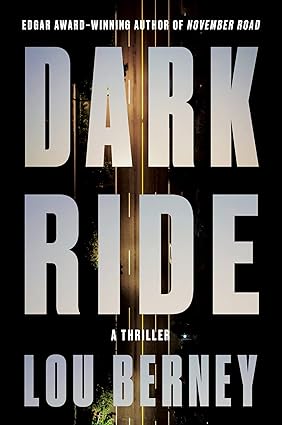
‘Dark Ride,’ by Lou Berney

My city is a midsized metropolitan area in the middle of the middle of the United States. It’s flat and sprawling and a lot like a lot of other places, with no distinguishing characteristics geographic or otherwise. If my city was a suspect in a crime, the eyewitnesses would have a tough time describing it. You could probably say the same thing about me.

Think of The Big Lebowski. But imagine it, not as a dark parody, but as a full-on, dead-serious 21st Century Noir novel. That’s more or less the ambience of Lou Berney’s Dark Ride.

I’ve reviewed a couple Lou Berney novels before, and I liked them very much. I haven’t read one in a while now because the publisher prices them high, but I got a deal on Dark Ride. And it’s very, very good.

Hardy “Hardly” Reed is a classic slacker. Long, shaggy hair, tee-shirts, board shorts, flip-flops. He holds a minimum wage job as a “frightener” at a horror-themed amusement park, and the rest of his time is spent playing video games and getting stoned with his slacker friends.

Until one particular day, when he’s at the Department of Motor Vehicles, getting an extension on a parking ticket. He notices a pair of small children sitting on a bench outside of an office. He’s puzzled by how quiet they are. They don’t laugh, they don’t play, they don’t talk. They just sit staring, like commuters on a bus. He approaches them to say hello, and then notices small, perfectly circular marks on their bodies. Someone has burned these children with cigarettes.

Something comes over Hardly then that he’s never experienced before. He discovers he cares. He tries to get help from a DMV worker, then from Child Protective Services. Nobody seems greatly concerned. The bureaucracy is snowed under with work. Hardly decides that if nobody else will help, he will. He can’t afford to hire a private detective, so he’ll learn to investigate on his own. Usually in his life, he’s given up on any task that seemed difficult or dangerous. But he can’t let go of this one.

Will Hardly, just this once in his life, be good enough?

I read Dark Ride almost in one sitting. It proved to be a grimmer story than I expected, but that only pulled me in. This is an excellent and original thriller. I recommend it. Cautions for language, sex, and drug use.