Your humble correspondent is at loose ends tonight. Haven’t finished reading my next book for reviewing. Tomorrow I’m driving up to Fargo, so I can speak to the Flere Lag Stevne (Several Society Gathering). It’s an assembly of bygdelags, which are organizations of descendants of immigrants from particular regions of Norway. They do genealogy and try to preserve traditions. Every lag holds a stevne annually, but some now pitch in and do their stevnes together. This group used to be the Tre (Three) Lag Stevne, but others have joined in this year, so now it’s the Flere Lag Stevne. And I’ll be giving a lecture on my trip to Norway last year to visit the Hafrsfjord Jubilee. It’s the third time I’ve lectured for them.
And, oh yes, I’ll be selling books.
Actually, I’ve just been hired as the editor of the magazine of the Valdres Samband – which is a lag, but not one of the lags at this particular stevne. But I expect I’ll be attending their stevne in the future. They’re the oldest lag in America. Being their editor won’t make me rich but it pays a little, and it’s work I believe I can do decently.
Above, a short video showcasing the work of the Norwegian painter Adolph Tidemand (1814-1876), who is famed for romanticizing the lives of Norwegian peasants. It seems a little sentimental to us today, but at the time it was a social breakthrough – poor people were acquiring some dignity in the eyes of the world. The Haugean movement, of which I wrote recently, had a lot to do with that.
Tidemand’s most famous painting is the one in this video where a man stands on a stool, preaching to a group in a house. It’s called “The Haugeans,” and the preacher seems to be Hauge himself.
You’ll note several paintings featuring young women in bunads (national folk costumes) with golden crowns. These are bridal crowns, a Norwegian tradition. Every bride got to be a queen for a day in Norway.
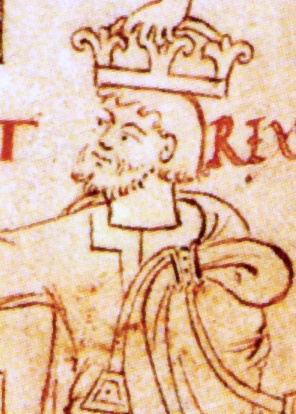
Image of Knut the Great from Liber Vitae, written in 1031, during Canute’s lifetime.
Had a pretty good weekend at the Antique Power Show at the Little Log House Pioneer Village, near Hastings, Minn. This is the third year my Viking group has been there – though nobody’s quite sure why we’re even around at a steam engine and tractor event. It amuses me that we have no apparent connection to the event theme, but people still like to see us there. The weather was cooler than we’ve been experiencing lately, and we were in the shade, so we didn’t suffer much from the sun smiting us by day nor the moon by night. And my book sales were good. But as always when I sit long hours on my Viking chest with no back support, I came home creaky. That’s the price you pay for staying alive into old age. By the way, it’s my 100th birthday today. Approximately. In round, subjective numbers. Close enough for freelance writing.
My work on The Baldur Game, the epic final volume of my Erling saga, continues apace. I’ve come to the part where Erling meets King Knut the Great of Denmark/England, and I figured I’d better bone up on that fellow’s life (did you know he was at least half Polish?). Having a weekend of Viking reenactment to fill, I pulled up my old Kindle version of Laurence M. Larson’s Canute the Great and the Rise of Danish Imperialism during the Viking Age. I’ve reviewed it here before, but it’s more interesting (in spite of its age) than the other Knut biography I own.
Knut (or Canute, as it’s spelled here) is a fascinating character in English history, despite the fact that his complete failure to provide an heir with survival skills doomed his accomplishments to be overshadowed by those of other kings. Still, he started out as a disfavored son of King Svein Forkbeard of Denmark (who conquered England first, then died, leaving Canute with all the weary work to do over again), knocked about as a pirate for a while, and finally fought his way up (Conan-like) to the throne of a great kingdom. His union of Denmark with England, Scotland, Norway and bits of what is now Poland could arguably be called the first British Empire.
Scholarship has advanced quite a lot since Larson wrote this book (1912), but in my opinion it’s sometimes advanced in the wrong direction. So I generally like Larson’s saga-friendly approach. It does skew the narrative a bit, I think, though, since the author spends a lot of time on Norway and St. Olaf, probably just because the sagas have described that business more completely than the English chroniclers recorded other aspects of Canute’s reign. As the drunk who hunted for his car keys under a street lamp said, “I lost them over there, but the light’s better here.”
My main complaint is the author’s uncritical acceptance of the traditional view that Olaf was somehow the “legitimate” king of Norway, and that his opponents (like Erling Skjalgsson) were rebels, bought by Canute’s treacherous “bribes.” In fact they were defenders of the land’s organic constitution, and Olaf was the usurper trying to overturn the ancient laws. And giving gifts to supporters was what overlords did in those days. Olaf did it himself, as I plan to point out in my book.
But other than that, I liked Canute the Great and the Rise of Danish Imperialism during the Viking Age, and found it useful. I recommend it. It’s out of copyright and cheap. Watch out for OCR typos.
Today is the anniversary of Johann Sebastian Bach‘s death in 1750, making it his day of commemoration in the Lutheran calendar (for Lutherans who tend a little higher church than I do). As good a reason as any to post some Bach music, as if I needed a reason. My intention was to find some footage of E. Power Biggs playing Bach on the organ, but there don’t seem to be any live performances on YouTube.
However, I found the clip above. It’s Air on the G String, performed on original period instruments by the Early Music Ensemble of a group called Voices of Music. If you go to their YouTube channel, you can contribute to their work if you like.
Somebody also said it was National Chocolate Day. I can get behind that too.
Tomorrow and Sunday, for those in the area, the Vikings and I will be at the Antique Power Show at the Little Log House Museum in Hastings, Minnesota.
On the beach at Southend, England, a ragtag group of young “guerilla filmmakers” is shooting a movie, one they hope will lead to their big break. Their “star,” a washed-up, alcoholic TV actor, appears to be dozing by the pier. But he’s not dozing – he’s dead. It looks as if he fell asleep there the night before and froze to death. But the crime scene investigator notices suspicious signs. This brings in the police team – Inspector Joe Hogarth and his younger subordinates, Detectives Palmer and Simmons. Then, when Hogarth’s oldest, greatest enemy appears, a villain who’s now a member of Parliament (Tory, of course), Hogarth’s back is well and truly put up—for better or worse. So begins The Poison Path, by Solomon Carter.
I’ve read one Inspector Hogarth book before. I found it well-written but rather dreary; the hero is solitary, depressed, and has a drinking problem. This is a later book, and he seems to be doing a little better – there’s some subdued flirtation with his female subordinate, Palmer. Still, he remains driven, lonely, and obsessed. He’d fit in well in a Scandinavian Noir story, I think. One interesting and unusual element was that our hero is not always right, like so many fictional detectives. In fact, he’s wrong quite a lot of the time. Mostly, he lets his feelings run away with him.
So, all in all, The Poison Path wasn’t bad. Not my favorite kind of story, but I’ve got no real complaints.
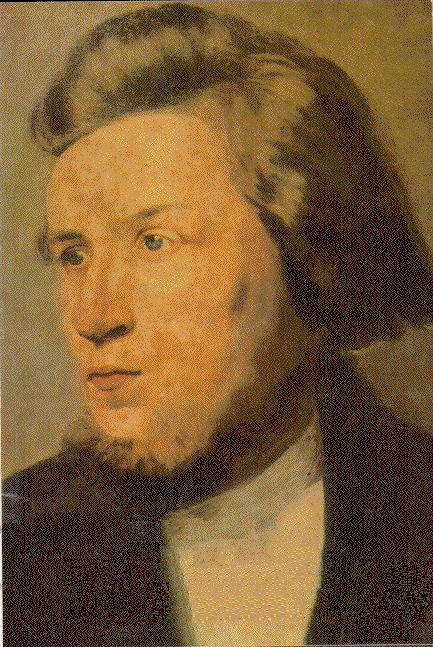
Portrait discovered in Copenhagen,, believed to be Hans Nielsen Hauge.
I wrote a fairly long meditation on Pietist Christianity and legalist Christianity yesterday. And I think I failed to actually say one of the things I meant to say.
Which is ironic, because that was one of the very weaknesses I meant to criticize (gently) in my hero, the Norwegian lay preacher Hans Nielsen Hauge. Some years back I began work on translating his works, a project another linguist has since taken over. Mostly to my relief. Because Hauge is exceedingly hard to translate. I’ve heard of one scholar who started the same project years back and simply gave up in frustration. “He’s untranslatable!” that person said.
I think that’s an exaggeration, but I sympathize. Hauge is very hard to translate. The man was in no way a systematic thinker. He was an enthusiast. He poured his words out onto the page, it appears, just as they came to him. Sometimes he goes on for pages without a period or a paragraph break. I imagine Hauge as being very much like a certain pastor I once worked for. He hired me precisely for my writing skills. Because he found it almost impossible to actually get to the point. He communicated all right in person, because he could supplement his words with facial expressions and gestures. But when writing he just lost his way.
After many years, I think I finally figured out Hauge’s point. It’s a point he never states in so many words, but once you’ve figured it out, it illuminates all the rest of his verbiage. And it explains some of the puzzling – or even apparently unorthodox – things he seems to say.
That central point, I think – and I mentioned this part last night – was that he believed that a true believer – someone who was genuinely “awakened,” as he put it, would find the Christian life easy. They would be filled with the same joy and love he felt. We all know how love lightens burdens. When I was in love, long ago, I would have done many things far outside my comfort zone – and sometimes I actually did those things – just to please her. Just to be close to her. Love made hard tasks light.
This is a beautiful vision, and I believe it’s true in the Christian life to some extent.
But it’s not equally true for everybody. And it’s not always permanently true . I have good reason to believe that Hauge himself, during his ten-year imprisonment, when he was denied books and visits from his friends for long periods, eventually learned that the Way could be hard. He never lost his faith, but he learned that even true believers can struggle.
Some of us aren’t like Hauge. Our experience with God may be lower-key, less emotional. We have a smaller tank of emotional fuel to burn (those of us who are introverts feel this especially). We’re more like John Haugvaldstad, who needed rules and lists to keep himself on the straight path. I believe he took it to an extreme, but for some people this pattern seems prudent. Books like Jordan Petersen’s 12 Rules for Life fill a need for them (us).
Among us Lutherans there’s an old tension – sometimes fiery verbal warfare – between the Pietists and the “Confessionals.” The Lutheran Church, Missouri Synod is the largest and best-known Confessional church body in the US. Going back to the days of immigration, the Pietists and the Confessionalists anathematized one another. The Pietists (like Georg Sverdrup, subject of the journal I edit) condemned the Missouri Synod as cold, formalistic, Catholic-adjacent, and spiritually dead. Confessionalism, Sverdrup wrote, provided a “sleeping pillow” on which members of dead congregations could slumber while their pastors tried futilely to do all the work of the church on their own.
The doctrine-centered Missourians, on the other hand, condemned the Haugean Pietists as unstable, emotional enthusiasts. If synods and pastors didn’t keep a close eye on the laity, checking their every statement for orthodoxy and basically barring them from any kind of spiritual ministry, then everybody would just go crazy. Subjectivism would take over. You’d have churches abandoning traditional sexual morality, and syncretizing with other religions, and reciting something like, oh, “the Sparkle Creed.”
Which, sadly, is just what happened. Missouri Synod theologians rarely hesitate in making the charge that all the aberrations we see today in The Very Big Lutheran Church Body That Shall Remain Nameless (as I call it) spring from the subjectivism inherent in Pietism.
I have to admit their prophecies came true.
But I still think Hauge and Sverdrup had a point.
The heart of my own theology, for many years, has been the Incarnation. The Word became Flesh. Somehow, through the power of God, body and mind came into harmony. Justice and Mercy kissed. The absolute and the subjective cooperated perfectly in the one perfect Man.
That’s what I want to see reflected in the church, and in myself.
Bust of John Haugvaldstad outside the Mission School in Stavanger.
My mind was so uplifted to God that I had no consciousness, nor can I express what occurred in my soul. For I was outside myself, and as soon as I had come to my senses again, I understood that I had not been serving the beloved God who was good above all things, and that I now thought nothing in this world worthy of esteem. That my soul experienced something supernatural, divine, and blessed, that it was a glory that no tongue can express. I remember it to this day as clearly as if it had been a few days ago, though 20 years have now passed since God’s love visited me so overwhelmingly. Nor can anyone dispute this with me: for I know that everything good in my spirit followed from that moment, especially the sincere, burning love for God and my neighbor, that I had a wholly altered attitude and a sorrow over all sins, a passionate desire that people should share with me in that same grace, a particular desire to read the holy Scriptures… (Hans Nielsen Hauge’s memoirs, trans. by me)
I hope this little essay won’t be too provincial to interest our readers. I’m writing, as I do so often, about the Lutheran “sect” in which I was raised, the Haugeans. I came to some realizations about the Haugeans this past weekend, based on reading I’d been doing and some conversations I had with other members of the Georg Sverdrup Society. The wider implications, I think, touch all Christians.
The Haugean movement, especially as it developed among Norwegian-Americans in this country, was probably best known for its legalism. We were the kind of people who (by and large) did not drink or smoke, did not play cards, did not attend the theater or dance. There were great revivals among the Haugeans in America, especially in the 1890s and the 1920s. After that, the rains never seemed to come again. My own observation, based on what I know of people who grew up in my church in the 1920s, was that the young people were embittered and driven away by all the rules. Being “awakened” seemed to mean (to those young people) a commitment to following the rules. Forever.
Based on some recent reading, I think the fault for this probably lies, not with Hans Nielsen Hauge himself but with another man, John Haugvaldstad (1770-1850). I suppose I bear some familial guilt for this development, since Haugvaldstad was a neighbor to my Hodnefjeld ancestors on Mosterøy Island (before he moved to Stavanger), and they were close friends and supporters of his.
Look at the excerpt from Hauge’s memoirs above. That’s not the testimony of a rule-bound soul. It’s the testimony of a man in love. I think Hauge ought to be imagined as a man with a big smile on his face. All his work, all his rugged foot-journeys, his long days and hard work, even his imprisonments, were experienced with joy, because he’d fallen in love with Jesus. For Hauge, the Christian life was fun. That was how the movement began.
But when Hauge went to prison, John Haugvaldstad arose as leader of the movement – at least in Stavanger, an important Haugean center. And Haugvaldstad was a very different soul from Hauge. Haugvaldstad struggled with temptation. At last he decided that the only way to handle temptation effectively was to avoid all questionable activities (“if it’s doubtful, it’s dirty”). Debauchery and fights happened at parties, so avoid parties, dancing and drinking. In fact, avoid all music other than hymns. Don’t play cards. (Smoking was acceptable in some circles; it depended.) Don’t attend the theater. Don’t read worldly literature. And on and on.
It was Haugvaldstad who made the Haugeans teetotalers. Hauge himself was always opposed to drunkenness, but he sometimes seems to have served brandy at social gatherings and he served beer to his household at Christmas. In a famous conversation, he said to John Haugvaldstad, “Ditt Væsen er taget, ikke givet!” Which means, “Your temperament is taken [upon yourself], not given [by God]!”
But Hauge went to prison, and he died young, and Haugvaldstad prospered as a businessman in Stavanger. He was highly regarded (he’s considered one of the founding fathers of modern Stavanger), and not without reason. He was a very good man, a man with great concern for the poor. He did much good for his neighbors, and for Christian missions. The esteem in which he was held led many people to make him their role model. The “temperament” of Haugvaldstad became the Haugean norm.
Today, in our situation, I would very much like to see the spirit of Hauge return. I think we could use it.
The Burnside books by David Chill comprise a PI series I’d never heard of. Yet in many ways Bull Rush was exactly what I look for in a detective book.
Burnside (like Spenser he goes by his surname) is a private eye in Los Angeles. An old acquaintance comes to his office to ask him to look for his missing adult son. The young man was once a hot pro football prospect (Burnside himself is a former college player and sports culture permeates the story), but now he works for a slightly shady real estate operation. The young man has had trouble with drugs in the past, so it’s likely he’s passed out somewhere.
Burnside isn’t entirely happy with the job – the father was never someone he liked a whole lot. On top of that, Burnside knows he got the referral from another mutual “friend,” a crooked sports agent who’s always playing the angles. But it’s a legitimate job, and he isn’t in a position to turn it down.
Then, in the course of his search, Burnside stumbles on a murder victim. Now he’ll have to deal with the police. And soon, with politicians and the very wealthy.
What pleased me best about Bull Rush was its traditional qualities. Burnside doesn’t have an ideological agenda. He doesn’t have a kick-butt female partner. He’s not involved in deconstructing or normalizing anything. He’s just doing a human job among human beings. The main way he differs from your classic Golden Age gumshoe is in having a wife and a young son. Oh yes, and a psychotherapist he sees regularly.
The writing in Bull Rush was clean and professional, without either pyrotechnics or illiteracies. The characters were believable, the dialogue sharp. This is honest, meat-and-potatoes detective fiction. I recommend it highly.
Duty is based on something more profound than hope, on faith that what is too wrong to endure will be made right, rectified by a system of justice that underlies all of nature, far beneath the subatomic level, a system that may right a wrong in a day or through the passage of time or outside of time. The schedule isn’t ours to protest or endorse. His duty is to act with all the skill and wisdom he possesses, not with hope but with conviction.
Rejoice! We have a new Dean Koontz book. He just keeps rolling them out – always good, sometimes exceptional. After Death is somewhat reminiscent of Koontz’ recent series of novellas about a character called Nameless. But it handles similar concepts in a different way.
Michael Mace was dead, and is alive again. It wasn’t a miracle in the religious sense, but it still may change the world. Michael was head of security at Beautification Research, a company that was ostensibly a cosmetics business but actually did top-secret genetic and nanotech research. When an accidental leak kills everyone in the building, Michael dies with all the rest. But then he wakes up. And now he’s changed. He has new powers that give him mental access to all the information on the internet. No firewall can stop him.
The first item on his agenda is to help a single mother named Nina Dozier and her son John. Michael’s best friend and co-worker Shelby was very fond of them, and probably would have courted her if he’d lived. They’re in danger from John’s natural father, a gang lord who’s decided it’s time to claim his son and make him his successor. Nina will have to be taught a lesson too, for dissing him.
But there’s a larger danger than that. It comes from the Internal Security Agency, the corrupt law enforcement body that supports the corrupt bureaucracy now running the country. Their chief agent is a psychopath named Duran Calaphas, an efficient killer but increasingly delusional. He takes Michael’s appearance as a personal sign for him, giving him a worthy foe he must destroy in order to achieve his grandiose personal destiny. Without loyalty to anyone or anything but himself, Calaphas will stop at nothing, destroy anything, to kill Michael Mace. And his companions.
Koontz hits every note precisely, manipulates the reader with the deft hand of a master. It’s beautiful to behold. Especially delightful (for me) was one amazing plot twist unlike anything I’d ever read before (it involves storytelling). A delightful moment.
My only quibble (spoiler alert) was that I thought the ending might have been too good to be true. But that’s no great failing in a book. No failing at all, actually. We’re allowed a happy ending from time to time.
Above, an interview — a few years old — with author James Scott Bell. Among the topics touched on are whether writers are born or made, and if a series character can have a character arc.
He mentions his blog, Kill Zone, which I wasn’t aware of. You can find it here.
Allan Bloom warned us in The Closing of the American Mind that relativists are incipient authoritarians. If right and wrong aren’t universal but are merely personal or social constructs, there’s no criterion for judging one person’s case against another’s. The decision can only go to the party with the most power. Not on any kind of principle, but because nature abhors a vacuum, just as gravity abhors unsupported coyotes.
Websites store cookies to enhance functionality and personalise your experience. You can manage your preferences, but blocking some cookies may impact site performance and services.
Essential cookies enable basic functions and are necessary for the proper function of the website.
Name
Description
Duration
Cookie Preferences
This cookie is used to store the user's cookie consent preferences.
30 days
These cookies are needed for adding comments on this website.
Name
Description
Duration
comment_author
Used to track the user across multiple sessions.
Session
comment_author_email
Used to track the user across multiple sessions.
Session
comment_author_url
Used to track the user across multiple sessions.
Session
These cookies are used for managing login functionality on this website.
Name
Description
Duration
wordpress_logged_in
Used to store logged-in users.
Persistent
wordpress_sec
Used to track the user across multiple sessions.
15 days
wordpress_test_cookie
Used to determine if cookies are enabled.
Session
Statistics cookies collect information anonymously. This information helps us understand how visitors use our website.
Google Analytics is a powerful tool that tracks and analyzes website traffic for informed marketing decisions.
Used to monitor number of Google Analytics server requests
10 minutes
__utmb
Used to distinguish new sessions and visits. This cookie is set when the GA.js javascript library is loaded and there is no existing __utmb cookie. The cookie is updated every time data is sent to the Google Analytics server.
30 minutes after last activity
__utmc
Used only with old Urchin versions of Google Analytics and not with GA.js. Was used to distinguish between new sessions and visits at the end of a session.
End of session (browser)
__utmz
Contains information about the traffic source or campaign that directed user to the website. The cookie is set when the GA.js javascript is loaded and updated when data is sent to the Google Anaytics server
6 months after last activity
__utmv
Contains custom information set by the web developer via the _setCustomVar method in Google Analytics. This cookie is updated every time new data is sent to the Google Analytics server.
2 years after last activity
__utmx
Used to determine whether a user is included in an A / B or Multivariate test.
18 months
_ga
ID used to identify users
2 years
_gali
Used by Google Analytics to determine which links on a page are being clicked
30 seconds
_ga_
ID used to identify users
2 years
_gid
ID used to identify users for 24 hours after last activity
24 hours
_gat
Used to monitor number of Google Analytics server requests when using Google Tag Manager
1 minute
_gac_
Contains information related to marketing campaigns of the user. These are shared with Google AdWords / Google Ads when the Google Ads and Google Analytics accounts are linked together.
90 days
Marketing cookies are used to follow visitors to websites. The intention is to show ads that are relevant and engaging to the individual user.
A video-sharing platform for users to upload, view, and share videos across various genres and topics.
Registers a unique ID on mobile devices to enable tracking based on geographical GPS location.
1 day
VISITOR_INFO1_LIVE
Tries to estimate the users' bandwidth on pages with integrated YouTube videos. Also used for marketing
179 days
PREF
This cookie stores your preferences and other information, in particular preferred language, how many search results you wish to be shown on your page, and whether or not you wish to have Google’s SafeSearch filter turned on.
10 years from set/ update
YSC
Registers a unique ID to keep statistics of what videos from YouTube the user has seen.
Session
DEVICE_INFO
Used to detect if the visitor has accepted the marketing category in the cookie banner. This cookie is necessary for GDPR-compliance of the website.
179 days
LOGIN_INFO
This cookie is used to play YouTube videos embedded on the website.