Sometimes I hate a book enough to read it all through just so I can tell you in detail how bad it was. That was the case with Impression, by Ray Clark. I’ve read worse novels, but few combined inept writing with such personal offense to myself.
Detective Inspector Stewart Gardener and his partner Sean Riley are the heroes of this police procedural, part of a series set in Leeds in North Yorkshire. When a local prostitute is found dead in her kitchen, stabbed to death with a bayonet, and then a local businessman is found choked to death with sealing wax (!) in a butcher shop doorway, their investigation begins. That investigation, to this reader, seemed a remarkably ham-handed one. A local online journalist comes to them with a theory that these murders are recreations of historical murders in the area. They laugh him off, with tragic results. Also, when a couple whose daughter was recently kidnapped show up on their radar, they treat the two with surprising insensitivity – largely because the husband is a born-again Christian, and so (in their eyes) contemptible.
This hatred for born-again Christians comes up again and again in the book. Author Clark wants to make sure we’re in no doubt how he feels on the subject. “Real practicing Christians,” DI Gardener states authoritatively, “see the born-again converts as part-timers—people who are not really taking the Lord and the good book seriously.” Further on, Riley says that the fact that a man is a born-again Christian “tells me that he is hiding from something in his past.” That’s an odd way, in an English book, of dismissing John Wesley, John Newton, and William Booth, among so many others.
But my complaints aren’t only theological. The author is lazy. His characters never come to life, and most of them are hard to keep straight. He misuses the term “begging the question,” and is prone to misplacing modifiers and misusing words, as in the line, “Despite being still in the throes of summer, [a character] was dressed in a camel hair coat and trilby….”
One major plot point involves a child, decades ago, playing constantly with a Polaroid instant camera. However, we’re also told that the child’s family was very poor. Apparently the author has no idea what Polaroid film used to cost.
Finally, the climax was melodramatic and implausible.
Last week, an independent bookstore in Chicago splashed up attention for many Twitter users with a tweet complaining about a customer who wanted to rent rather than buy some expensive books. Rebecca George, a co-owner of Volumes Bookcafe in Chicago’s Wicker Park, wrote in Jan 9 tweet: “Turns out one of our biggest sales last month was for the person to stage their home for the holidays and now they want to return them all. Please don’t do this to a small business, people. That one sale was a third of our rent.”
The books were eye-catching art and cook book, no doubt published to show off the reader’s good taste. The most modest book in the set was entitled Authenticity: The Vain Attempt at Finding the Real You. (I’m sorry. I made that up.)
The tweet has been seen almost seven million times and picked up by news outlets, making January a very good month for sales by good-hearted book-buyers showing their sympathy.
What else is online?
Reading Good Books: An essential freedom that builds character more than we know. “American kids, more than ever, are stratified into those who read—those who have regular access to books—and those who don’t. I’m not talking here about basic literacy, but being open to the human good that is the enjoyment of literature.”
Kristin Lavransdatter at 100.Sigrid Undset wrote a “medieval romance in the twentieth century (published between 1920 and 1922), [and] she somehow reverses a thousand years of morbidity, bringing a long dead genre back to life. . . . Kristin Lavransdatter is really just a love story—but one of the most savagely honest love stories ever written.”
Mystery: All About Agatha is a podcast that has read all of Agatha Christie’s novels, discussed them, and ranked them against each other. I look forward to looking up All Hallow’s Eve to see if they place it within the worst five.
Writing: Backstory brings characters to life, making them appear as real people, except when it floods the reader with irrelevant details. So it’s a very good, except when it isn’t.
Terry Teachout: The New York art critic died last year on Jan. 13. Patrick Kurp calls that fact “comparably difficult to believe. It’s like saying France no longer exists. Seldom in my experience was so prominent and successful a writer so generous with his success.”
Another free book by an author I’m not familiar with. I think this is the fourth in the string. I’ve disliked each book less than the last, and The Blood Line by Solomon Carter was the best so far. Not stellar, but not bad.
Aging Detective Inspector Joe Hogarth of Southend in Essex, England, is summoned to a very nasty crime scene with his two female colleagues. The deceased has been dead several days, and decomposition is well under way. The dead man was known as a forger, specializing in false passports and other IDs. The method of the murder is interesting – first the man was given a powerful “speedball” injection of cocaine and heroin, and then he was stabbed to death before the drugs could kill him. Why would anyone take the trouble to do all that?
Before long another local criminal, a human trafficker, is found murdered exactly the same way. This is obviously personal for the killer, but who could that person be? The field of possible suspects is wide; the problem is finding the person with the right kind of hate.
Joe Hogarth is a sort of a sad sack – middle-aged, never married, lonely but scared of commitment. Instead of taking risks in dating, he medicates himself with alcohol. Meanwhile, an old enemy of his has been released from prison. All unknown to Hogarth, this psychopath has come to town and is laying plans to repay him for all the time he spent behind bars.
I thought The Blood Line was well-written. Joe Hogarth is a good character, and not politically correct; I was interested in him. My only real objection, though, is a big one – the story is kind of dreary. Hogarth has a dreary life, and little hope is in view. Maybe things will get better in the next books in the series.
I’ve been reading a lot of free books made available through various Kindle promotions lately. As you may have noticed, I wasn’t entirely happy with the last couple I reviewed. Was J. C. Fields’ The Cold Trail more satisfying?
Well, yes. But not entirely.
This book is part of a series, and there were the usual problems with character relationships that had to be explained, but that wasn’t handled too badly. The story begins with the disappearance, a few years back, of three female volleyball players from a college in Missouri. A few years later, our hero, Sean Kruger, a professor at another Missouri college, is able to rescue a different volleyball player. Kruger is a former FBI agent, and he worked on the earlier abductions. The similarities prompt him to get his hacker friend to do some checking in the records, and he believes he can discern the work of a serial killer. Because of this he makes up his mind to go back to his old job at the FBI, which assigns him to the case.
Eventually he and his team are able learn that one thing connects a number of disappearances of female athletes over recent years. In each case, a particular software company was installing a system in the college at the time. And the man overseeing the installation was the son of the company’s owner, computer mogul Robert Burns, who recently retired as a senator. The son in question was Robert Jr., “Bobby,” and he has just been elected to his father’s old seat. Is it possible a US senator is a serial killer?
Of course it’s possible, and much money has been spent on covering up Bobby’s “indiscretions.” But it goes far deeper than that. We’re talking about the Russian mafia and international human trafficking.
The story worked pretty well. The characters were interesting, and they interacted well. The dialogue was good. The book could have used a proofreader – I found misplaced modifiers and word confusion (like “vanilla folder”). But as a narrative, it wasn’t bad. I caught what looked to me like one plot weakness, but that happens.
My reservations were mostly political and paranoid.
The evil senator is, of course, a conservative Republican. And he is owned, part and parcel, by Vladimir Putin and the Russians, who are using him to destabilize the US economy.
It occurred to me that Robert Burns might be a stand-in for Donald Trump in a left-wing fantasy.
Also, we got to watch the FBI at work investigating a senator, and they cut legal corners from time to time. Nothing sinister about the squeaky-clean FBI illegally surveilling a Republican, right?
Also, the bureaucrats in this book never worry about wokeness. There’s no concern over microaggressions, and nobody talks about their preferred pronouns. I did not believe this was true to contemporary life in the federal government.
All in all, The Cold Trail left me with chilly feet.
Writing a story (of any length, but novels are hardest in this respect) presents many challenges, and it’s a surprise any of us ever gets it tolerably right (I’m not saying I get it right myself; that’s for others to determine). You’ve got to cobble together an interesting plot, and then you’ve got to cat-herd your characters into doing the (sometimes outrageous) stuff they need to do in order to keep common sense from breaking out. A story implies unusual activity, and unusual activity usually means forcing characters to do extreme stuff. This can be done well or badly. I felt it was done rather badly in Lewis M. Penry’s One Other, second in his DS Jerome Roberts police procedural series.
Dr. Ben Carr is one-half of a medical practice in the London suburb of Shefford. He’s a family man and football (soccer) coach. Apparently popular with his neighbors – so why did someone stab him to death in his home?
Detective Sergeant Jerome Roberts, along with his superior DI Richard Martin, starts questioning neighbors and friends, and a darker picture of him emerges. Dr. Carr seems to have had his share of enemies – there’s his business partner (whom he’s been blackmailing), and the families of female students he’s been sleeping with. There’s the football mom who threatened him publicly for not putting her son into a game. There’s his own brother, too.
As police pressure increases, the suspects respond violently, turning on one another, and even on themselves. The whole thing erupts in a series of homicides.
And that’s my problem with this book. This isn’t supposed to be grand opera or Shakespearean tragedy. It’s a story about ordinary middle class citizens in a suburb. No doubt they’re all sinners like the rest of us, but (it seems to me) the author overestimates the capacity of the average person for deadly force. Killing another human is the first and most stubborn taboo. It takes serious fear, trauma, or specialized training to get past that taboo. Communities don’t just break out in murder like an epidemic of chickenpox.
One Other fell down, for this reader, in the psychology department. I simply didn’t believe the story.
The inner office was, however, empty when Joss entered. It was only after he had banged cheerfully on the desk with a paperweight, at the same time shouting a jovial “Bring out your dead,” that Mr. Duff came in from the little balcony outside the window, where he had been attempting to alleviate his dyspepsia by deep breathing.
“Aha, J. B.,” said Joss sunnily. “Good morrow.”
“Oh, you’re there are you?” said Mr. Duff, making no attempt to emulate his junior’s effervescence.
The managing director of Duff and Trotter was a large man who, after an athletic youth, had allowed himself to put on weight. In his college days he had been a hammer thrower of some repute, and he was looking as if he wished he had a hammer now and could throw it at Joss….
“You’re late!” he boomed.
“Not really,” said Joss.
“What the devil do you mean, not really?”
“A man like me always seems to be later than he is. That is because people sit yearning for him….”
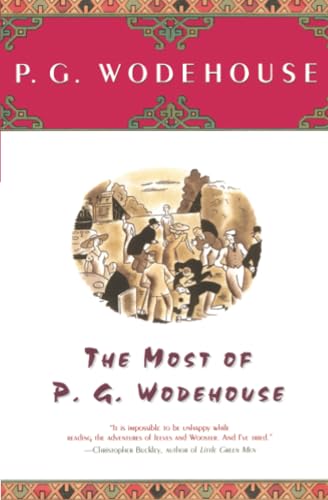
The first book of P. G. Wodehouse I ever bought was the collection The Most of P. G. Wodehouse, published by Simon & Schuster back in the ‘70s, which included the novel Quick Service as a sort of extra (it remains the most reasonably priced way to get this book, so that’s the link I’m using). Thus, Quick Service was the first Wodehouse novel I ever read. I enjoyed it immensely then, and did again on re-reading. Especially because its main character is surprisingly different from most of your Wodehouse heroes.
The plot of the story is extremely tight and complex, but cutting back to the essentials, we start at Claines Hall in Sussex, which now belongs to Mrs. Howard Steptoe, an American millionairess, and her husband. Also in residence is her poor relation, Sally Fairmile, who serves as a sort of secretary. Sally has just gotten engaged to young Lord Holbeton, another guest at the manor. The problem is that under the terms of his father’s will, Lord Holbeton can’t touch his inheritance yet without the approval of his trustee, Mr. J. B. Duff of Duff and Trotter’s exclusive grocery store in London. Sally suggests that she go talk to Mr. Duff, and see if she can’t charm him.
But when she arrives at Duff’s office, she finds not him but our hero, Joss Weatherby, an artist who works in the advertising department. Joss immediately falls in love with her. When she’s gone, Duff reappears, having learned, through eavesdropping, that Joss painted a portrait of a Mrs. Chavender, which now hangs at Claines Hall (where Mrs. Chavender just happens to be a current guest). Duff was once engaged to Mrs. Chavender, he says, and it occurs to him that her face, with its haughty sneer, would make a wonderful poster for the store. He then fires Joss, but Joss heads off to Claines Hall, to take a job as Mr. Steptoe’s valet (a job that Sally mentioned is open). His plan is to steal the portrait, get his job back, and marry Sally.
There may be other heroes like Joss Weatherby in other Wodehouse stories (my memory sometimes fails, and there are a lot of stories), but such an energetic, bright, confident type isn’t the Master’s usual fare. Uncle Fred and Uncle Galahad were probably something like this in their youths. “Aplomb” is the word that best suits Joss. It makes no difference whether he’s discovered swilling his boss’s sherry, breaking into a French window, or perched on a chair, cutting a painting from its frame, he is never dismayed. His self-confidence only ebbs in those moments when he contemplates his unworthiness of the woman he loves. And then only briefly. Joss Weatherby is a great tonic for the depressive reader.
Quick Service is a tremendous story, and everyone should read it.
I opened my eyes again. Ridiculous. The truth—as the last half hour had demonstrated beyond doubt—was that the war was lost. And yet here I was, so trapped in the habit of writing, that I was already trying to find the words to explain to someone who would never read them why no one would ever read them.
Dale Nelson reviewed this book in the Bulletin of the New York C. S. Lewis Society, comparing it to That Hideous Strength. I bought it on the strength of that. Coyote Fork is a very different book from THS, but a fascinating parallel read.
Robert Lovelace is an English journalist who used to make his living as a travel writer. But that livelihood is gone, destroyed by social media. His last, desperate bid for writing work is an assignment to go to Silicon Valley and report on the roll-out of TOLSTOY, the latest brain-child of social media mogul Evan Bone (whom Robert blames for the loss of his job). TOLSTOY is supposed to represent a whole new level of Artificial Intelligence, one in which computers will be creating their own stories. Robert can only take so much of this, and rushes outside at last for fresh air.
In the parking lot, he sees Anne Grainger, his ex-girlfriend, who’s supposed to be in England. She’s another victim of Bone’s empire – after rediscovering her Christian faith in mid-life, she was cancelled for her thought crimes in a thoroughgoing way by Global Village, Evan Bone’s social media empire. She fled into hiding, her reputation ruined.
Back in his hotel room, Robert gets the news – Anne is dead. She killed herself, and she was nowhere near California at the time.
The vision, or visitation, of Anne leaves Robert with a single resolve. He’s going to discover the secretive Evan Bone’s true story, and tell it to the world. Give him a dose of his own medicine. Destroy the destroyer. His quest will take him to Coyote Fork, the abandoned site of a 1970s hippie commune, where it turns out Evan grew up. There’s a standard popular narrative about Coyote Fork, and then there’s the true story, which only a few people dare to tell.
Along the way, Robert will be joined in his quest by Ruth Halassian, a scholar who shares his passion – and might share his future. But the real secret of Coyote Fork lies with the local Indians, and they don’t tell their story to just anyone.
Coyote Fork is really not very similar to That Hideous Strength, except in certain themes related to the abuse of science and technology. Robert is a little like Mark Studdock in some ways. But this story is much simpler (which will relieve many readers). Where THS is explicitly Christian, Coyote Fork is more ambivalent – not anti-Christian is the best I can say on that. Where Christianity comes up, it fares pretty well, but the real truth in this story (to the extent that there is a truth) seems to be hidden among the pre-Christian Indians. The final resolution seemed ambivalent at first, but became clear once I’d thought about it.
All that said, Coyote Fork is expertly written, fascinating, and disturbing. I recommend it. Cautions for adult stuff and rough language.
And mixed with this was the sense that she had been maneuvered into a false position. It ought to have been she who was saying these things to the Christians. Hers ought to have been the vivid, perilous world brought against their gray formalized one; hers the quick, vital movements and theirs the stained-glass attitudes. That was the antithesis she was used to. This time, in a sudden flash of purple and crimson, she remembered what stained glass was really like.
The time has come to review C. S. Lewis’ That Hideous Strength, and how am I to do that? I think a scholar could devote his whole career to this one. It’s packed full of good stuff. All that stuff doesn’t always work together as you might wish, but even the “failings” look different once you’ve grasped the grand design. Or (perhaps better put) designs.
The setup, in case you’ve never read the book, is that this is the third novel about Prof. Elwin Ransom of Cambridge University, who traveled, first to Mars, and then to Venus, in the previous novels, Out of the Silent Planet and Perelandra. There he found the universe and its inhabitants to be very different from what he expected – more on the lines of medieval cosmology than anything imagined by H. G. Wells.
But in this third book, Ransom himself doesn’t appear until well along in the story. We first meet Jane Studdock, educated young wife of a fellow at Bracton College of the (fictional) University of Edgestowe. Jane has been having troubling dreams of a disembodied head, connected by tubes to some kind of mechanism. She confides her fears to “Mother” Dimble, wife of an older faculty member, which leads her gradually into the orbit of an eccentric community of Christians who live in the nearby village of St. Anne’s.
Meanwhile, her husband Mark is excited to be gaining entrée into the “inner ring” at Bracton – the young, “dynamic” men who know the important people and are poised to sweep the old traditions away. But soon he gets a chance to join an even more exclusive ring – the men of the National Institute for Coordinated Experiments (N.I.C.E.), which is acquiring the college property. Mark’s new duties, should he agree to take the post with N.I.C.E., are a little vague, but they clearly involve ethical compromises. And he cannot guess N.I.C.E.’s true goal – the extinction of all life on earth.
If you’ve read Perelandra, you’ll recall how the narrator, as he approaches Ransom’s cottage at the beginning, has to struggle against a “barrier” – a spiritual blockade of sorts. Readers approaching That Hideous Strength have to pass a barrier too. Ironically, this barrier exists because the author did such a good job of realizing his narrative goals.
The problem with the first half of That Hideous Strength is that the passages set at Belbury (the headquarters of N.I.C.E.) are highly effective in portraying the worst aspects of bureaucracy, as Lewis had come to know (and loathe) it. His hatreds of petty ambition, of envy, of snobbery, of fuzzy thinking, of officiousness, of chronological snobbery and moral relativism spring into sight here – not in vivid, but in muted, colors. The satire is biting. But it makes for rather dreary reading. It’s like a breath of country air when we switch to the scenes at St. Anne’s, where the breeze is fresh and there are friendly people (and animals).
Somebody said (it might have been Dale Nelson; it might have been in the comments here) that That Hideous Strength is Lewis’ catch-all book, the book where he threw in everything he wanted to say all at once. Perhaps it would have worked better artistically if he’d practiced more restraint. But it wouldn’t be what it is – a book you could study all your life.
What themes are we dealing with here? The Abolition of Man. The whole nightmare of Belbury is a vision of a new world order based on subjective values – in which all the things that make our lives worth living are dismissed as chemical accidents, reducing humanity itself to raw material for working experiments on. The “humanitarian” theory of punishment, in which the prisoner’s rights are swept away on the pretext of “treating” him. The lure of the “inner ring,” where a man sells his soul by stages for rewards of diminishing happiness. The values of hierarchy and subordination, including in marriage. The mythopoeic fantasies of Tolkien, which Lewis weds to King Arthur and the Matter of Britain. The “spiritual thriller” genre written so well by Lewis’ friend Charles Williams.
There’s something strangely familiar about Belbury to the modern reader, although the parallel isn’t apparent at first. The great goal of the N.I.C.E. is to utterly wipe out organic life, leaving only Mind (ostensibly human, but in fact diabolical). That seems like the opposite of the dominant movement of our own world, a Nature worship that seems poised to embrace human extinction.
But it seems to me the two things aren’t that far apart. Both the Greta Thunberg cult and N.I.C.E. are hostile to human procreation. Today’s progressives, though “sex-positive” in theory, in fact despise any human sexual activity that could produce natural offspring (like the inhabitants of the moon described in this book, “their real children they fabricate by vile arts in a secret place.”).
I could go on and on. That Hideous Strength occupies a very special place in my heart. Every time I read it, it moves me and teaches me. It brings me to tears. I recommend it highly, but I warn you it requires a little work.
“You do realize that by limiting yourself thus you are depriving your family of comfort and riches?”
“Oh, you third-reachers!” laughed Siloán. “You have so much that your hearts have become small. You can live very well with very little. Sometimes, it is better this way.”
It isn’t immediately apparent that Nicholas Kotar’s The Song of the Sirin is not typical English-oriented fantasy. Somewhere after the hunt of the white stag, the interaction with the otherworldly wolf, and everything the Pilgrim says, I began to think I didn’t know the terms the writer used. Not knowing anything about Russian folklore, I had no knowledge base to foresee the possibilities in a name or type.
The kingdom of Vasyllia is in decline with an elderly monarch, called the Dar. Three castes of people stir up plenty of political tension, having little more to do than look out for themselves. The young man Voran and his teenaged sister Lebía are orphans of a wealthy family, but their opportunities are limited by the suspicious circumstances of their parents’ deaths; their father, Otchigen, may have betrayed the king to save himself when the people in a distant embassy were slaughtered.
Voran draws more suspicion to himself when he brings a Pilgrim into the city and professes to believe everything he says. The old stories about the divine Covenant and mythical beasts like sirin (an eagle with feathers like gems and the head and torso of a woman) were just a nice cultural basis. There was no living water dripping from a weeping tree. No Raven monster seeking that water along with the destruction of all mankind.
But, of course, the old stories are true, and Voran will be accused by the ignorant and deceived by wily spirits before he begins a long trial of endurance to set the kingdom right again.
Some dark moments in the story are handled carefully, which I appreciate. My main quibble with the writing is the sentences that push toward colorful language where sparse prose would fit the scene better.
The Song of the Sirinis book one of the five-book Raven Son series. While it ends satisfactorily, there’s still a lot of ongoing conflict. I don’t know what to expect in book two, which I picked up with the first one.
“I feel sorry for her.” “Well, she’s much, much too young to die. We’ll come back as ghosts later and apologize to her.”
The 2004 anime series Paranoia Agent, by Satoshi Kon, is a good example of a story that can’t be told with words alone. It’s essentially a visual story. As such, viewers are led to believe things that may not be true and explanations are not always spoken.
The thirteen-episode series begins like a crime story. The young designer Tsukiko Sagi is under pressure to create a new character for toys and shows that’s just as cute and bound to be more famous than her current creation, Maromi, a pink, floppy eared dog. Walking home at night, Tsukiko begins to feel the shadows turn over on her. She runs, stumbles, and then a young boy in a baseball cap and inline street skates zips up out of nowhere and strikes her with a bent metal bat. At least, that’s what we see.
In the next few episodes, news of this “li’l slugger,” reportedly an elementary school-aged boy, is everywhere. The public and the two detectives looking into it are shocked something like this could happen. Several more people, who are being driven to the end of the wits by various dark circumstances, fall victim to this mysterious kid. A boy who fits the description perfectly is apprehended by the traffic cop he strikes with his bat. This kid tells the detectives he is a righteous warrior who can see the glow of a demon, who wants to overthrow the city, on select people has a skates up behind them. He strikes them with his bat, a spiritual sword in disguise, to wound the demon. He must continue to hunt this thing down until it can no longer hide.
Is this kid the source of the crime spree? No, because he dies in police custody and the officers believe they see the li’l slugger skating away through the halls.
Then the story shifts in tone. We get an episode of women sharing ridiculous rumors about li’l slugger assaults and murders. Another one is of an animation studio working on a Maromi cartoon and the li’l slugger cracking their skulls one by one. Another one is a comical tale of three people with Maromi backpacks who try to work out their death pact (the primary wrench in the works is that a little girl wants to kill herself too).
All of this works together to deliver a principle spelled out in the final episodes, one that doesn’t explain everything we see because we believe too much of what we see is real (within the story). That principle is the latest rave is killing us all. It’s even twisting our perceptions. The Next Hot Thing everyone must have creates fear and sucks our life away. We don’t need it, if it demands so much of us. Consider a quiet life that fulfills some useful service that puts food on your table, respects yourself and your family, and doesn’t feed the machine.
I’m not recommending watching this show. Half of it is dark and ugly, and the whole may be too trippy for most people. I’m sure someone could make a decent list of truths or propositions found in the show, but I think those would be minor principles to the main one I’ve given here.
Websites store cookies to enhance functionality and personalise your experience. You can manage your preferences, but blocking some cookies may impact site performance and services.
Essential cookies enable basic functions and are necessary for the proper function of the website.
Name
Description
Duration
Cookie Preferences
This cookie is used to store the user's cookie consent preferences.
30 days
These cookies are needed for adding comments on this website.
Name
Description
Duration
comment_author
Used to track the user across multiple sessions.
Session
comment_author_email
Used to track the user across multiple sessions.
Session
comment_author_url
Used to track the user across multiple sessions.
Session
These cookies are used for managing login functionality on this website.
Name
Description
Duration
wordpress_logged_in
Used to store logged-in users.
Persistent
wordpress_sec
Used to track the user across multiple sessions.
15 days
wordpress_test_cookie
Used to determine if cookies are enabled.
Session
Statistics cookies collect information anonymously. This information helps us understand how visitors use our website.
Google Analytics is a powerful tool that tracks and analyzes website traffic for informed marketing decisions.
Used to monitor number of Google Analytics server requests
10 minutes
__utmb
Used to distinguish new sessions and visits. This cookie is set when the GA.js javascript library is loaded and there is no existing __utmb cookie. The cookie is updated every time data is sent to the Google Analytics server.
30 minutes after last activity
__utmc
Used only with old Urchin versions of Google Analytics and not with GA.js. Was used to distinguish between new sessions and visits at the end of a session.
End of session (browser)
__utmz
Contains information about the traffic source or campaign that directed user to the website. The cookie is set when the GA.js javascript is loaded and updated when data is sent to the Google Anaytics server
6 months after last activity
__utmv
Contains custom information set by the web developer via the _setCustomVar method in Google Analytics. This cookie is updated every time new data is sent to the Google Analytics server.
2 years after last activity
__utmx
Used to determine whether a user is included in an A / B or Multivariate test.
18 months
_ga
ID used to identify users
2 years
_gali
Used by Google Analytics to determine which links on a page are being clicked
30 seconds
_ga_
ID used to identify users
2 years
_gid
ID used to identify users for 24 hours after last activity
24 hours
_gat
Used to monitor number of Google Analytics server requests when using Google Tag Manager
1 minute
_gac_
Contains information related to marketing campaigns of the user. These are shared with Google AdWords / Google Ads when the Google Ads and Google Analytics accounts are linked together.
90 days
Marketing cookies are used to follow visitors to websites. The intention is to show ads that are relevant and engaging to the individual user.
A video-sharing platform for users to upload, view, and share videos across various genres and topics.
Registers a unique ID on mobile devices to enable tracking based on geographical GPS location.
1 day
VISITOR_INFO1_LIVE
Tries to estimate the users' bandwidth on pages with integrated YouTube videos. Also used for marketing
179 days
PREF
This cookie stores your preferences and other information, in particular preferred language, how many search results you wish to be shown on your page, and whether or not you wish to have Google’s SafeSearch filter turned on.
10 years from set/ update
YSC
Registers a unique ID to keep statistics of what videos from YouTube the user has seen.
Session
DEVICE_INFO
Used to detect if the visitor has accepted the marketing category in the cookie banner. This cookie is necessary for GDPR-compliance of the website.
179 days
LOGIN_INFO
This cookie is used to play YouTube videos embedded on the website.