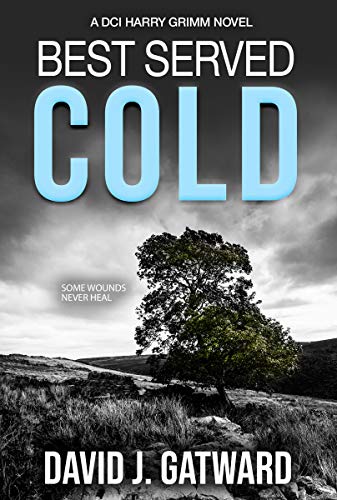
Book Two in David J. Gatward’s Harry Grimm series is Best Served Cold, a story which (as I’m sure you’ve guessed, because you’re smart) is about revenge.
Harry Grimm, scar-faced former police detective from Bristol, is settling in (at least tentatively) in his “temporary” secondment in Wensleydale, Yorkshire. It’s beautiful country, where the people are genuine and honest, the air is fresh, and Harry – in spite of himself – is beginning to enjoy himself. Except for the inexplicable local mania for eating fruitcake with cheese.
When a foul-natured and unpopular local farmer is found crushed under the wheels of one of his own wagons, it looks like an accident at first. But investigators quickly realize that the set-up is impossible. This was murder, and of a cruel sort. Not long after, another farmer – one of the first victim’s few friends – is found drowned to death in a slurry pit. Eagle feathers are discovered in the mouths of each.
The fact that nobody misses the victims much doesn’t mean the police can relax. There has to be some incident in the past that accounts for such terrible revenge. Harry hunts through the records and talks to old schoolmates of the victims, gradually piecing together the story of a horrible cruelty long forgotten by most.
I am enjoying these books for their setting, characters, and mood. I have to admit, though, that I figured out whodunnit before I was supposed to. Fairly obvious, I thought. Maybe I’m just really smart, but I think author Gatward needs to work on his plotting.
Kristofer and Gry Molvaer Hivju. Photo credit: NRK
I have some dislocated thoughts I’m going to try to coordinate in this post tonight. Just subjective responses to a couple recent entertainment experiences. They may or may not mean anything to you.
The picture above is of Kristofer Hivju, a Norwegian actor who’s attained high visibility since appearing in the Game Of Thrones miniseries. Beside him is his wife, Gry Molvær Hivju, who is a documentary film maker. They constitute, as you’ll note, a striking couple.
I heard about a documentary series they made together, and watched it recently on the Norwegian NRK network feed, using a VPN. I don’t know if it will ever be offered outside Norway. The series is called simply “Olav,” and it relates a personal quest to find the historical truth about Norway’s patron saint, Olav (or Olaf. Best known, of course, as a character in my novel, The Elder King) Haraldsson. We learn that Kristofer first learned of Olav as a boy, when his father, also an actor, played Olav in the annual Olav play presented (most years) near Trondheim, Norway. He tells us that Olav has been his hero all his life – the Viking who became a Christian king, and converted his country.
I’m not sure how seriously to take the dramatic arc of the series. Hivju may be playing a role as he presents himself as a lot like a little boy, shivering with excitement to go where his hero went and see all the evidence of his life. His disappointment is palpable as he travels to England, France, and Russia and finds – generally – that evidence for Olav’s life (outside the Icelandic sagas) is pretty sparse. Judging by the evidence, Olav was a fairly minor player on the European scene until after his death, when Norwegian churchmen and chieftains promoted him and his saga for political reasons. (I note that no mention whatever is made of the work of Prof. Torgrim Titlestad, whose book, Viking Legacy, I translated. They even report that a Norwegian translation of the Icelandic Flatøybok has recently been released, but they don’t mention its publisher, Saga Bok, Prof. Titlestad’s publishing house, or even let us see a copy).
The final resolution of the whole thing (and I’d have bet my house that this would be the case) is that they conclude that history and faith are different things, and each is important in its own realm. I reject that principle in terms of the central affirmations of Christianity, though I don’t doubt that many false stories have been told of saints and holy men over the years. I wondered about Hivju’s own faith, which he never really explains. Does his faith include Olav’s God, or only Olav as a hero? None of my business, I suppose.
Around the same time, I was reading a couple books by Blake Banner, whose Cobra series of thrillers I’ve enjoyed very much. So I picked up a couple from his Dead Cold Case series, which I’d started and given up on for some reason. Reading again, I remembered why. I’ve never encountered a more God-bothered series of books, and in a bad way. In each of these books (as far as I could tell) the author felt it necessary to insert a few Awful Christians. Judgmental, repressed, joyless, hypocritical, and often criminal. His knowledge of Christianity seems to come primarily from a bad experience of Roman Catholicism – when he describes an American Methodist Church, he assumes that they cross themselves when they enter the church, call their services masses, and reject sexual pleasure as sin. I feel sorry for whatever bad experience the author must have had, but I couldn’t take much of it.
We live among the ruins of shattered faith today. Those who believe, generally believe in a subjective way that has little to do with the real world. Those who don’t believe seem furious at God for not existing. We who hold onto Christianity have lots of work to do. It may be illegal work, before long. But that’s how Christianity started, after all.
‘It’s a secondment. Think of it like an exchange programme if you want. We’re sending you there in exchange for, well, for you not being here, if I’m honest.’
A new English police series with a fairly original hero. I’m up for that.
Harry Grimm, the hero of Grimm Up North, looks kind of like Frankenstein’s monster, due to scarring from an IUD explosion during his service as a paratrooper. Now he’s a detective in Bristol. He’s pretty good at it too (his face actually helps), but his superiors don’t like him, partly because of his hostile attitude, and most particularly because he never lets up on his personal search for the man who killed his mother and destroyed his family – his own father.
So his boss sends him off on a “temporary” secondment to Wensleydale in Yorkshire, an area made famous by All Creatures Great and Small. It’s a whole other world – clean air, friendly people, tiny towns, an agricultural economic base. Not much crime, to be honest, and certainly very little serious crime.
Except that the very day Harry shows up, a young girl goes missing. And not long after, a murdered body is found beside a lake.
It would be ridiculous to blame this sudden crime wave on Harry, but that doesn’t stop his Yorkshire superior from doing just that. His learning curve will be steep, but in the end he’ll unmask the killer and save a couple lives.
Grimm Up North was an enjoyable fish-out-of-water mystery. The writing was good and the characters were amusing. Cautions for the usual.
Think of the big Woody Allen/Soon Yi Previn scandal, where a famous man marries his stepdaughter. Now, instead of Woody Allen, imagine the guy is a legendary macho writer, a cross between Jack Kerouac and Ernest Hemingway. And imagine the wife he abandoned was a famous feminist.
That’s the extreme situation David Handler sets up in The Girl Who Ran Off With Daddy, yet another Stewart Hoag mystery. Needless to say, this one involves some pretty cringe-inducing situations – though I think it’s fair for me to tell you the worst parts do get mitigated in the end.
When Hoagy was a young writer, Thor Gibbs was his mentor and inspiration. So when Thor asks him to ghost-write his stepdaughter/girlfriend’s autobiography, giving her side of the story, he doesn’t feel he can say no – creepy though it feels. Hoagy is mostly retired now, living in Connecticut with his ex-wife/current partner, Merilee, and their baby daughter Tracy. His life is fairly idyllic, and he’s not really over the moon about having their farm invaded by an aging Peter Pan with a death wish on a motorcycle, and his seductive 18-year-old lover. Thor Gibbs hates normal living, and none of that is in prospect – until murder occurs.
There’s lots of stuff going on beneath the surface in The Girl Who Ran Off With Daddy, and some of it’s actually pretty positive. Especially a subplot involving Hoagy’s father. So if you can get through the initial creeps, you may be glad you read it.
Cautions for language and immature subject matter.
Matthew’s Gospel has the account of the Magi’s visit, and it never occurred to me to wonder why “all the chief priests and scribes of the people” didn’t go with them to Bethlehem. Did they write them off as pagans on a goose hunt?
we see God for who he is: the Savior of all nations for all time. The same God who perfectly orchestrated Israel’s history so that he was born of the line of David created a specific heavenly object so that he could draw these wise-men to himself: the source of all true Wisdom. We see a Savior who loved the world so much that he chose to become one of us for all of us: Jews and Gentiles alike. No circumstance can deny the will of God. There is no distance that God cannot bridge: if he has already restored the bridge between man and God, how much more will he bridge our earthly gulfs of loneliness, guilt, fear, and doubt?
If man is simply good by nature and governed by social or natural laws, then someone somewhere could raise up utopia for the perpetual happiness of all who lived there. Dostoevsky said that if such a place could be constructed, let several years pass and “people would suddenly see that they had no more life left, that they had no freedom of spirit, no will, no personality. . . . they would see that their human image had disappeared . . . that their lives had been taken away for the sake of bread, for ‘stones turned into bread.'”
A passage in Notes from Underground looks forward to modern dystopian novels, works like Yevgeny Zamyatin’s We (1920–21) or Aldous Huxley’s Brave New World (1932), where heroes rebel against guaranteed happiness. They want their lives to be their own. Put man in utopia, the underground man observes, and he will devise “destruction and chaos,” do something perverse, and, if given the chance, return to the world of suffering. In short, “the whole work of man seems really to consist in nothing but proving to himself continually that he is a man and not an organ stop. It may be at the cost of his skin; but he has proved it.”
Any politician who believes the right policies or governing body can right all wrongs does not understand the people he claims to serve nor, perhaps, himself. We must be free, even to our ruin. (via Prufrock News)
Once again, even in the violent whirlwind of my life, I was reminded there was still goodness in the world. Strangers willing to help the injured, the helpless, and the innocent. There’d been times in my life when I’d been all three. Even innocent.
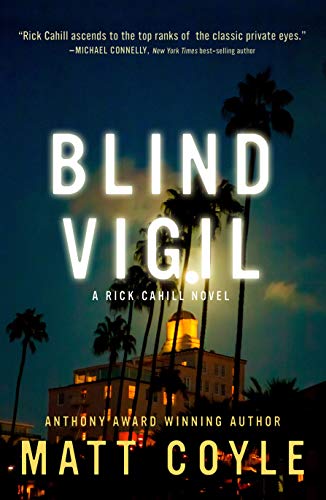
There’s a new installment in Matt Coyle’s hard-boiled Rick Cahill series. I’ve reviewed the previous books about this San Diego private eye, a former cop suspected of his wife’s murder. In previous books he has cleared the memory of his father, unjustly suspended from the police force for corruption, and identified his wife’s real killer. My main complaint with the earlier books was that some were excessively dark, but light has broken in increasingly as the series went on – even now in Blind Vigil, when – ironically – the hero has gone blind, due to a bullet wound at the end of the last book.
It’s been nine months since then, and Rick is well along in his recovery, assisted by his girlfriend Leah and his Black Lab, Midnight. He believes his sight is starting to return, but his doctor thinks it’s only a common illusion, similar to phantom limb syndrome in amputees. But Rick is well enough now to feel the need of some activity.
That need is answered by his former PI partner, Moira MacFarlane, who wants his help with a case. She’s been hired by Rick’s estranged best friend, Turk Muldoon, to surveille his girlfriend, whom he suspects of cheating on him. She’d like Rick to sit in as she meets with Turk, to see if he can tell from his voice whether he’s withholding information. After that, she persuades Rick to keep her company as she watches the girlfriend’s apartment. Next thing they know, the girlfriend has been murdered, and Turk has been arrested. Moira thinks Turk is guilty and washes her hands of him, leaving Rick to investigate the case on his own, without eyesight, backup, or a license.
The idea of the blind detective has been tried before, and I never really bought it. I always felt the author had to stack the deck to provide the specialized circumstances in which a blind detective could triumph. I liked this story better than those others. I thought author Coyle did a pretty good job of keeping the tension high without straining the reader’s credibility too much (at least not more than other detective stories, where heroes routinely survive by the skin of their teeth). What I liked best was that Blind Vigil continues the series’ ongoing story arc, in which an embittered, lonely man gradually reintegrates with humanity.
Cautions for what you’d expect. Recommended, like the whole series.
I did believe that. Of course, you must remember that TV and movie people almost always mistake their business friends for real friends. This is partly because they want to believe that everyone they deal with truly loves them. And partly because they have no real friends.
David Handler, author of the Stewart Hoag mysteries, spent some time as a TV sitcom writer. He mines that vein of experience for background material for his mystery, The Man Who Cancelled Himself, in which we once again follow “Hoagy” Hoag, celebrity memoir ghost writer, and his scene-stealing basset hound, Lulu.
The first few Stewart Hoag books seemed to be heavily disguised portraits of actual characters, but as they go on, the author is spreading his net wider. The main character here, Lyle Hednut, is a lot like John Belushi, with some Rosanne Barr and Pee Wee Herman thrown in. He started in improv comedy, and worked his way up to having his own sitcom, playing “Uncle Chubby,” a sort of degenerate Mr. Rogers. The show was leading the ratings until Lyle got arrested under embarrassing circumstances in an adult theater. Now there’s pressure to cancel the show, and the network wants Hoagie to write a book that will give Lyle’s side of things. In order to fit in, he’s added to the series writing staff.
One of the first things Hoagy learns is that Lyle Hudnut is only marginally human. Big, overdramatic, Gargantuan, mercurial, he is a genuine narcissist with manic mood swings, who jumps from woman to woman and terrorizes his co-workers. He tells Hoagy a horrific story of childhood abuse, but Hoagy begins to suspect he’s left important points out. And when someone begins to sabotage the production, real danger presents itself.
This was one of my favorite books in this series, mainly because author Handler does something I never expected – he offers us a pair of characters, husband and wife, who are ordinary middle-class elderly Americans. They are neither well-educated nor stylish. Nevertheless, they are handled with genuine empathy and respect. The character of Hoagy Hoag generally presents himself as something of a snob, a latter-day Lord Peter or Philo Vance. But this was a nice scene. As a middle American, I appreciated it.
There was also an important development in Hoagy’s own life in this story. I was mostly in favor of it, but I thought our hero had been rather badly used. You can judge for yourself.
Pretty good stuff. Cautions for language and some gross mature content.
It’s been a hard year overall, though not entirely because of Covid. I know one person who died of the virus and many others who had it and recovered without incident. For months, our church has offered two services to allow people to spread out and livestreams one of them for the third of the congregation who won’t return until doctors give them a green light. (For only a few more days, you can watch the recording of our Christmas concert. I’m becoming increasingly dissatisfied with my singing voice, but the rest of the choir and the instrumentalists are great.)
Tennessee has surged in new cases, but it still feels removed from us, at least by a step. I’ve worried about my aunt, who says she lives around many people who have tested positive, but she hasn’t picked it up. My wife and I have been exposed to it technically; two of my daughters could easily have been as well, but we’ve not had reason to pursue tests for it. Like I said, it feels a bit removed from us.
More immediate has been the tornado damage to one of our suburbs. The video above was taken on Tuesday this week and shows the edge of an area that tornados ripped up in April. Large houses were flattened, some smaller ones too, and others were skipped as tornadoes do. The trees tell most of the story. You won’t see the many houses behind me, completely destroyed, or my high school, that had built up since my days there but now has been scraped to the ground. Every building was compromised in the storm.
We had been in lock down for a few weeks when this happened. All of that was shelved when we turned out to clean up streets, help neighbors recover, and share food. I helped a church team build several storage sheds on our parking lot, which other members of the church and community used. (I plan to put up a smaller one in my backyard this year.)
New routines have come since then; normal has taken a hiatus.
I’ve heard many sermons on living a quiet, respectable life of prayer and service based on this passage: “I urge that supplications, prayers, intercessions, and thanksgivings be made for all people, for kings and all who are in high positions, that we may lead a peaceful and quiet life, godly and dignified in every way. This is good, and it is pleasing in the sight of God our Savior, who desires all people to be saved and to come to the knowledge of the truth” (1 Tim 2:1-4 ESV).
Sometimes I wonder if the quite life is evangelical enough. I wonder if we live in noisy times and need bold witnesses to confront materialistic, entertainment-driven people who take their values from today’s famous who are only justifying actions they haven’t thought through. But I also think it’s peaceful, quiet people who clean up storm-damaged neighborhoods, who look after widows and shut-ins, and who take the time to pray for everyone they can think of. They aren’t people looking to make a name for themselves.
Will we continue to nurture the quiet life in 2021 or distract ourselves from it?
What shall we say about the year that is passing? If you’re reading this, you and I are survivors. Our Lord bids us live in hope. Sufficient unto the year is the evil thereof.
Blessings to you and your family, from the highly trained professionals at Brandywine Books.
Websites store cookies to enhance functionality and personalise your experience. You can manage your preferences, but blocking some cookies may impact site performance and services.
Essential cookies enable basic functions and are necessary for the proper function of the website.
Name
Description
Duration
Cookie Preferences
This cookie is used to store the user's cookie consent preferences.
30 days
These cookies are needed for adding comments on this website.
Name
Description
Duration
comment_author
Used to track the user across multiple sessions.
Session
comment_author_email
Used to track the user across multiple sessions.
Session
comment_author_url
Used to track the user across multiple sessions.
Session
These cookies are used for managing login functionality on this website.
Name
Description
Duration
wordpress_logged_in
Used to store logged-in users.
Persistent
wordpress_sec
Used to track the user across multiple sessions.
15 days
wordpress_test_cookie
Used to determine if cookies are enabled.
Session
Statistics cookies collect information anonymously. This information helps us understand how visitors use our website.
Google Analytics is a powerful tool that tracks and analyzes website traffic for informed marketing decisions.
Used to monitor number of Google Analytics server requests
10 minutes
__utmb
Used to distinguish new sessions and visits. This cookie is set when the GA.js javascript library is loaded and there is no existing __utmb cookie. The cookie is updated every time data is sent to the Google Analytics server.
30 minutes after last activity
__utmc
Used only with old Urchin versions of Google Analytics and not with GA.js. Was used to distinguish between new sessions and visits at the end of a session.
End of session (browser)
__utmz
Contains information about the traffic source or campaign that directed user to the website. The cookie is set when the GA.js javascript is loaded and updated when data is sent to the Google Anaytics server
6 months after last activity
__utmv
Contains custom information set by the web developer via the _setCustomVar method in Google Analytics. This cookie is updated every time new data is sent to the Google Analytics server.
2 years after last activity
__utmx
Used to determine whether a user is included in an A / B or Multivariate test.
18 months
_ga
ID used to identify users
2 years
_gali
Used by Google Analytics to determine which links on a page are being clicked
30 seconds
_ga_
ID used to identify users
2 years
_gid
ID used to identify users for 24 hours after last activity
24 hours
_gat
Used to monitor number of Google Analytics server requests when using Google Tag Manager
1 minute
_gac_
Contains information related to marketing campaigns of the user. These are shared with Google AdWords / Google Ads when the Google Ads and Google Analytics accounts are linked together.
90 days
Marketing cookies are used to follow visitors to websites. The intention is to show ads that are relevant and engaging to the individual user.
A video-sharing platform for users to upload, view, and share videos across various genres and topics.
Registers a unique ID on mobile devices to enable tracking based on geographical GPS location.
1 day
VISITOR_INFO1_LIVE
Tries to estimate the users' bandwidth on pages with integrated YouTube videos. Also used for marketing
179 days
PREF
This cookie stores your preferences and other information, in particular preferred language, how many search results you wish to be shown on your page, and whether or not you wish to have Google’s SafeSearch filter turned on.
10 years from set/ update
YSC
Registers a unique ID to keep statistics of what videos from YouTube the user has seen.
Session
DEVICE_INFO
Used to detect if the visitor has accepted the marketing category in the cookie banner. This cookie is necessary for GDPR-compliance of the website.
179 days
LOGIN_INFO
This cookie is used to play YouTube videos embedded on the website.