Links of interest. To me, anyway

Arbol Navidad

Photo credit: Jorge Barrios.

The picture above is intended to induce holiday cheer, and possibly petit-mal seizures. Also because I haven’t gotten my own tree up yet.

Under the tree, a few links, just for you.

At First Things, Joe Carter points us to an interesting article from First Principles, on the true worth of the Puritans and Puritanism.

At City Journal, Andrew Klavan has a short story. Not Christmasy.

Mike Gray at The American Culture links to a Telegraph report on a debate on religion, between Tony Blair and Christopher Hitchens.

And Standpoint has an excellent (what else?) review of a new book about Chesterton, with an appreciation, by the inestimable Paul Johnson. I forget who pointed me to it.

Figment Invites Teens to Write More

Figment.com is a new site for teenagers who want to find new writing and write it themselves. The NY Times has a write-up on it. Want to write some great work for the cellular age? This may be your starting point. Just don’t get cocky.

What is Sin?

In a letter to John Wesley in June 1735, his mother Susanna Wesley wrote these words:

The beauty, pleasures, and ease of the body strangely charm us; the wealth and honours of the world allure us; and all, under the management of a subtle malicious adversary, give a prodigious force to present things; and if the animal life once get the ascendant of our reason, it is the greatest folly imaginable, because he seeks it where has not designed he shall ever find it. But this is the case of the generality of men; they live as mere animals, wholly given up to the interests and pleasures of the body; and all the use of their understanding is to make provision for the flesh to fulfil the lusts thereof, without the least regard to future happiness or misery.

I take à Kempis to have been an honest weak man, with more zeal than knowledge, by his condemning all mirth or pleasure as sinful or useless, in opposition to so many plain and direct texts of Scripture. Would you judge of the lawfulness or unlawfulness of pleasure; of the innocence or malignity of actions? Take this rule: whatever weakens your reason, impairs the tenderness of your conscience, obscures your sense of God, or takes off the relish of spiritual things; in short, whatever increases the strength and authority of your body over your mind, that thing is sin to you, however innocent it may be in itself.

(from Susanna Wesley by Eliza Clarke LONDON: W. H. ALLEN & CO., 1886)

Weather note, plus dialectic

If it has to happen, I guess this is the night for it. As much as eight inches of snow is expected tonight. There’s no pressure to fire up the snowblower before morning, when delivery is complete. So I can relax tonight, and I have my work planned for me tomorrow.

So far it’s been a pretty textbook winter here. Cold and snow have arrived right on schedule. I was going to make a joke about Global Warming promoters saying, “It’s quiet. Too quiet.” But they’re having crazy weather in Europe, so that doesn’t work.

But has there ever been a year when the weather wasn’t crazy someplace in the world?

Below, my simple, three-step template for social change in the modern world. Our cast of characters consist of a Liberal and a Conservative.


Step One:


Liberal: Let’s do this! It’ll be great!

Conservative: I don’t know. Seems like that might change everything.

Liberal: Nah, don’t worry about it. Nothing important will change. You won’t notice a thing.

Step Two:

Conservative: Everything has changed. You said it wouldn’t.

Liberal: Why are you afraid of change?

Step Three:

Conservative: Everything has changed, and it’s all gotten worse.

Liberal: You’re a bigot.

No irony deficiency in my life

I made a mistake today. I did a web search for an old friend.

Sometimes it’s better not to know.

This was a guy who, once upon a time, was (to quote Proverbs) “closer than a brother” to me. A guy I shared long road trips with, prayed with, shared confidences with, and sat up late with over pizza, talking about Jesus and how to win the world for Him.

I haven’t been in contact with him in years. We were drifting apart even then. I knew he was a pastor. I now learned that he’s been, for some time, an aggressive advocate, within the Very Large Lutheran Church Body Which Shall Remain Nameless, of what’s called “gay issues.”

My thoughts went back, inevitably, to an evening long ago, when I’d had dinner with him and his wife. The subject of homosexuality came up and I (on the basis of some very superficial recent reading) said that I thought I could make an argument for evangelical Christians supporting the homosexual movement.

“They seem to be just fighting for the right to be different from everybody else,” I said. “I think maybe we ought to support that. We can’t be confident that America will always be a Christian country. Someday we may be the ones who are different. We need to make sure that there’s a right not to conform in this country.”

My friend and his wife disagreed, spiritedly. I don’t clearly remember what they said, but I have the idea they pointed out that homosexual activists showed no particular inclination to respect the rights of those who disagreed with them. They pointed, I think, to the shameful treatment received by Anita Bryant, who paid with her career for daring to oppose their agenda.

In hindsight, I think it’s clear that they were right and I was wrong. I did not cling to that point of view much longer.

But, in one of those ironies that seem to me so common in life, today I’ve taken their side, and they’ve taken what was mine at the time (and gone far beyond it).

And I have to wonder, was that conversation the beginning, for them, of their movement to feelings-based ethics and zeitgeist-uber-alles theology? Or a significant step on the way?

I honestly can’t recall any argument I’ve ever won, in my whole life.

Is it possible the only one I did win was one in which I was completely wrong?

The weight of heroism


Wild Bill Hickok

I’m reading a novel right now, by a very good author, which is taking me forever to get through. (I won’t say what novel—maybe I’ll review it at the end of the line.) It’s a pleasant story with an interesting narrator. But it’s so… languid. It starts with a murder, but then the plot takes the hero (and the villain) to an entirely different location, and the villain proceeds to do nothing very sinister for a considerable time. The hero is wearing himself out trying to catch the villain at something, but there seems to be nothing to catch. Thus the book lacks that sense of urgency that drives the reader to keep turning pages, and pick the book up anxiously whenever there’s a free moment.

It’s slow.

My analysis of the problem is this—the author has failed, thus far, to raise the stakes. In order to keep your audience’s attention, you need to keep the villain busy doing bad stuff. And that stuff must be devastating and costly. People who matter to the reader, and to the hero, need to be placed in imminent, horrifying danger (unless it’s the hero himself who’s in peril). The good characters’ awful pain and fear are the very elements that transfix the reader.

I think there are very few authors who don’t have a problem raising the stakes like this (I know I do). Most of us are nice people. We don’t enjoy inflicting pain. Raising the stakes is emotionally hard.

This relates to life too. I’ve written more than I have a moral right to about heroism. I believe in the necessity of heroism. I believe that faith and heroism are closely related (all heroism isn’t faith, but all true faith is heroism).

It’s easy to forget that heroism has a high cost. Continue reading The weight of heroism

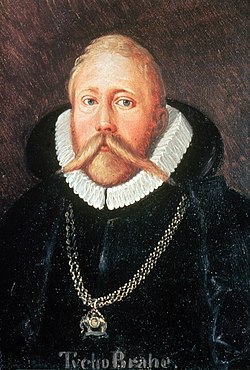
Who killed Tycho?

By way of Instapundit, I found this interesting article from the New York Times by John Tierney, about a mystery concerning the death in 1601 of the astronomer Tycho Brahe. Analysis of Tycho’s hair after his grave was opened indicates mercury poisoning as the possible cause of death.

“Who’s Tycho Brahe?” you ask. What do they teach them in these schools?

Most people’s choice for an astronomer with a dramatic life would be Galileo, because of all his disputes with the Church. But in terms of sheer drama and bombast, the life of Tycho Brahe of Denmark has Galileo’s beat by light years. He fought duels! He had a fake nose! He kept a pet dwarf and a moose! Continue reading Who killed Tycho?

Slate's HACK/30

Slate’s War Room has a list of thirty opinion makers and commentators they’re calling their Hack 30. “We’re listing the worst columnists and cable news commentators America has to offer. Think of this as our all-star team — of the most predictable, dishonest and just plain stupid pundits in the media.” I plan to read through it, unsure how irritated I’ll feel by the end, not that I want to carry the water for anyone, but a list like this could easily be the work of one cynical curmudgeon against many.
Related to this, Patrol Magazine has a list of “Ten Worst Christian Media Hacks,” which appears to have angered the Internet gods because their site has been down ever since they put the second part of the article on it. (links defunct)

Book Reviews, Creative Culture