“Ukrainian Alleluia” by Craig Courtney, performed by the Wellington College Chorale
Composer Craig Courtney wrote this piece in 2007 as a testimony to the enduring faith of Ukrainian Christians and our eternal hope.
3Once more they cried out,
“Hallelujah! The smoke from her goes up forever and ever.”
4 And the twenty-four elders and the four living creatures fell down and worshiped God who was seated on the throne, saying, “Amen. Hallelujah!” 5 And from the throne came a voice saying,
“Praise our God, all you his servants, you who fear him, small and great.”
6 Then I heard what seemed to be the voice of a great multitude, like the roar of many waters and like the sound of mighty peals of thunder, crying out,
“Hallelujah! For the Lord our God the Almighty reigns. 7 Let us rejoice and exult and give him the glory, for the marriage of the Lamb has come, and his Bride has made herself ready; 8 it was granted her to clothe herself with fine linen, bright and pure”—
for the fine linen is the righteous deeds of the saints. (Rev 19:3-8 ESV)
War has a glory to it. We marvel at Ukrainian President Volodymyr Zelenskyy for refusing to fear Russian invaders. The mayor of Kyiv, Vitali Klitschko, has shown similar valor. They have inspired thousands of people from other countries to join their fight, including a man known as the deadliest sniper in the world. This is the fight that’s been handed to them, and they are brave or cocky enough to not shirk it.
For many Russians, the opposite is true. Their leaders are cruel bullies who tell them it is sweet and fitting to die for the fatherland, which is the meaning of the Latin words above. Wilfred Owen’s poem on this idea has stuck with me since my college days. War is an ugly thing many are called to do; the elites who will direct other people in other places so that they will not suffer call it sweet and fitting.
Peace: I was unable to find a published announcement of an event I heard about on the radio, that radio stations around the world were playing Beethoven’s Symphony 9 or at least the last movement, “Ode to Joy,” as a bid for peace in Ukraine. On Wednesday, twenty members of the Kyiv’s orchestra played it in the city square.
Russia: Peter Hitchens says he has been fond of Russia, of the heart he believed he saw in Russian people. “What if this could now be put right, if once again the sweet, low houses of Moscow could be populated by gentle, literate, moral people,” he once thought. He sees no chance for that now. (via Books, Inq)
Photo: John H. Garth Memorial Library, Hannibal, Missouri. 2003. John Margolies Roadside America photograph archive (1972-2008), Library of Congress, Prints and Photographs Division.
And the translation work keeps coming in. If I were tired of it, I would not tell you. Because I have an international trip this summer to support. Plus inflation to cover. Also, it’s nice to be needed, when you’re me.
It’s cold, cold, and I have to go somewhere tonight. But tomorrow’s supposed to be warmer, and Sunday warmer still. Maybe this will be the turning point – just as Daylight Savings Time falls, clattering like a muffler off an old car. Maybe spring is coming. Or milder weather, with some consistency, at least.
The song above is an old Faeroese ring dance song, translated into Norwegian. I heard it first from a Norwegian folk group, but their version doesn’t seem to be on YouTube. However, this one isn’t bad, and they illustrated it with footage swiped from the 1958 film, “The Vikings,” starring Kirk Douglas. For its time, that movie made commendable gestures in the direction of trying to be kind of authentic. In some ways. Sort of.
It’s still better than the History Channel series, now metastasized to Netflix, they tell me.
The song is about King Olaf Trygvesson (whom you may remember from The Year of the Warrior), and how he built and launched his great ship, Ormen Lange (the Long Serpent). The chorus goes:
The dance is loud in the hall, when we dance in the ring!
Gladly ride the men of Norway to the Thing of Hildar (a kenning for battle).
Speaking in general terms, hard-boiled mysteries written before the turn of the millennium tend to be a good bet for me. A little more modern than the classics (which I also like), but before the explosion of Wokeness that has fatally infected so much recent literature. Jack Lynch’s Bragg books are a good example.
So I tried out W. Glenn Duncan’s Fatal Sisters, part of his Rafferty series. The intention seems to have been to produce something reminiscent of Robert B. Parker’s Spenser novels.
Sadly, it didn’t quite work for me. But read on. You might like it better.
Rafferty is a private eye in Dallas. Like Nick Charles and Spenser, he has a steady girlfriend (though because of the time of writing, the author didn’t feel it necessary to make the girlfriend a two-fisted martial artist. And that’s always nice). Rafferty operates alone, but has a dangerous friend called “Cowboy” who backs him up when things get hairy.
In Fatal Sisters (I haven’t figured out yet what the title means. Probably missed a clue), Rafferty gets a call from Patty Akkister, a fairly ordinary young wife. She says her husband Sherm is missing. But it’s all hush-hush, because, she says, Sherm is actually a spy, off on one of his secret assignments. He’s been gone so long, though…
Rafferty has run into situations like this before. Clearly, old Sherm is having an affair, and using the spy story to explain his absences. Rafferty takes the case, in the hope of catching Sherm and talking him into going back to Patty.
Unfortunately, Rafferty’s wrong. Sherm’s no spy, but he is involved in some very dangerous business. And before he’s done, Rafferty will find himself dodging bullets and protecting people – including Patty – from serious mayhem and murder.
I’m not entirely sure why Fatal Sisters didn’t work for me. Rafferty was an okay character, though he never really came alive in my mind. He’s a wisecracking PI, which is a great tradition, but it seemed to me his dialogue never quite hit the target. The book was interesting enough, in a “something to read while waiting for a plane” sort of way. And there was a pretty good surprise at the climax.
On the language side, the profanity quotient was much lower than we get in our decade. So it had that going for it.
Busy, busy today. Busy like a maur, which is Norwegian for “ant.” Working on a project I won’t describe to you, of course, except to say that it’s more difficult than the usual fare. I’m dealing with some dialect here. I do surprisingly well with dialects (having figured out the “trick” of it some time back. You need to imagine the sounds of the words). But it still takes longer than the usual stuff. And involves harder thought.
It’s just as well I had inside work to do. It was cold outside. Clear, but cold, though it wouldn’t have seemed so bad a month ago. Yesterday was partly cloudy, and the temperature soared into the 40s, which feels pretty good in March. Exchanged a few words with one of the neighbors, who complained about his aches and pains due to moving snow. The warm day had been ushered in by a heavy snowfall. We have now, according to the neighbor, exceeded the average snowfall for the year. It’s been a yo-yo year, we agreed. The temps have gone up and down, and every time they passed the freezing point (either way, it seemed), we got another dump of snow.
My usual favorite radio talk show didn’t grab me today, so I slipped in my DVD of “Wisting” (a Norwegian production, you may recall, which I worked on a bit). I wanted to listen to some spoken Norwegian. When I go there this summer, I’d like to be able to understand people. I can speak TO them – haltingly, but understandably. But I can’t understand them when they talk. The words, so comprehensible on paper, blur together and mean nothing to me. It’s frustrating. Here I am a genuine Norwegian translator, with credits, and I can’t understand the spoken language.
One of my great fears is that someone will someday expose me for the imposter I am.
I guess I’m not the only person who feels that way.
Marine Archaeologist Mensun Bound led a team on a search of Antartica’s Weddell Sea to find the famous vessel of explorer Ernest Shackleton, who lost the ship in 1915.
“Endurance, a 144-foot, three-masted wooden ship, holds a revered place in polar history because it spawned one of the greatest survival stories in the annals of exploration. Its location, nearly 10,000 feet down in waters that are among the iciest on Earth, placed it among the most celebrated shipwrecks that had not been found.”
What they found was “in a brilliant state of preservation,” Bound said.
I like the late Jack Lynch’s Pete Bragg series of hard-boileds, starring Pete Bragg, better and better. Yesterday is Dead was right up my alley.
Pete Bragg, you may recall, is a private eye in the San Francisco area. But his origins are in Seattle, where he grew up and was a newspaper man for a while. He doesn’t have a lot of fond memories, though. Somehow, he says, nothing ever worked out for him there.
So it’s been a while since he’s been in touch with his best old friend up there, Benny Bartlett. Benny is freelance journalist, and a really nice guy. He works on human interest and feature stories. Woodward and Bernstein he’s not.
So why is somebody threatening him over the phone? There have been a couple strange incidents, too, which may have been attacks. But Benny’s not sure. The police aren’t impressed. But Benny’s worried about his family. Would Pete come up and look into things?
Of course Pete will. About the time he shows up in town, the danger to Benny becomes undeniable. But even more disconcerting is that Pete runs into his ex-wife, Lorna. Their relationship was complicated, and when she left him, it hurt. Now she seems interested again. Can Pete take another chance on her? Or should he be faithful to his California girlfriend?
Yesterday is Dead is classic hard-boiled, even down to Pete getting taken for a ride and given a professional beating. My only real complaint is a lingering one with this series – Pete’s judgment and ethics in dealing with women are pretty bad (and they’ve got to be bad when I can tell). But I guess that’s part of his character.
The shooting stopped not out of mercy or rationality, but out of ammo depletion. Each automatic and semiautomatic weapon came up dry at almost the same second. Anyone whose eardrums had not been shattered by the ruckus would have heard an anvil chorus of clicks, snaps, slams, curses, and chunks as, momentarily drained of IQ, the troopers decided that if they pulled real hard the guns would start shooting again.
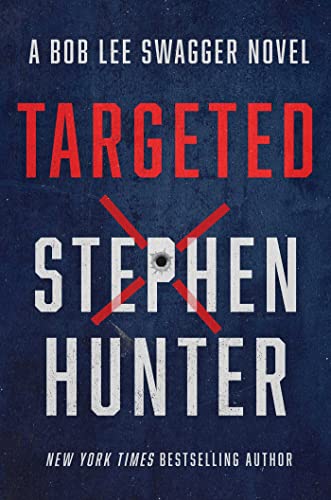
I always wonder (with anticipation) what stunt Stephen Hunter will pull to squeeze one more story out of the Bob Lee Swagger franchise. When you’re writing an action character who ages in real time, and you’ve gotten him up to his mid-seventies, generating drama turns into a real challenge. Generating plausible drama would seem nearly impossible.
And yet Hunter pulls it off again in Targeted. I won’t say the story is quite plausible, but it’s carried off with such style and verve that it works, in the grand tradition.
In our last story, old Bob Lee saved the country from a major terrorist plot with a near-impossible rifle shot. In the grand tradition of American politics, the reward he earns is a congressional investigation, led by a predatory old congresswoman who may, or may not, be based on a living person. Oh, we have nothing but respect for you personally, the investigators say (they are lying), but we need to seriously consider the procedures and protocols that led to your action. Were anyone’s civil rights violated? Did systemic racism inform the operation in any way?
Just when things look very bad for the old sniper, the whole thing gets turned upside down by the arrival by a group of mysterious convicts who take everybody hostage. Bob, plastic-cuffed to a wheelchair, is in a poor position to save the day, but a surprising ally will appear.
Lots of action, a good dollop of political satire, and one of the most dependable action heroes out there. I got a kick out of Targeted, and recommend it highly.
Here’s a 13th century hymn from well outside my church circles. It’s a traditional Catholic and Orthodox hymn for Lent, which began last Wednesday. I believe it’s attributed to the Franciscan Jacopone da Todi, which he wrote in Latin. The performance above is in Ukrainian with English and Ukrainian subtitles.
Ukraine is still under siege. NATO allies are sending ammunition, weapons, and food to Ukraine, but they will not close Ukrainian airspace to Russian aircraft. That would mean acknowledging World War III. I understand the hesitation, but I don’t understand, given everything Putin has said and done, how this isn’t a world war already.
Putin will not stop until Ukraine falls, and Ukraine must not fall. The only way out of this apart from NATO taking an active role in the conflict is either Ukrainian surrender or an uprising of the Russian people. The latter may happen anyway.
Mindy Belz has this piece on the Christianity of Ukrainians and how Putin is seen as a Christian despite his brutal oppression of them.
In related research, the Cato Institute has released its fourth annual Arms Sales Risk Index. “Selling weapons to governments that treat their citizens poorly increases the power of the state at the expense of its citizens, allowing them to respond to unrest and political challenges with violence.”
But I don’t want to talk about this here. What else do we have?
Word games: Based on under 200,000 tweets of game results, U.S. players rank 18th in the world of Wordle. Sweden, Finland, and Denmark are the top three. Among U.S. players, those in St. Paul, Minn. are #1.
Have you played Wordle? It’s fun, and you don’t have to stay with only one version of it. There’s Dordle, a two-up Wordle, and Quordle, a four-up version. Worldle is a geography version that tells you how far away in what direction is the correct answer. Heardle revives Name That Tune with six guess for sixteen seconds of music. I’ve enjoyed both Wordle and Quordle for a few weeks now.
Photo: Merced Theater, marquee detail, Merced, California. 1987. John Margolies Roadside America photograph archive (1972-2008), Library of Congress, Prints and Photographs Division.
Websites store cookies to enhance functionality and personalise your experience. You can manage your preferences, but blocking some cookies may impact site performance and services.
Essential cookies enable basic functions and are necessary for the proper function of the website.
Name
Description
Duration
Cookie Preferences
This cookie is used to store the user's cookie consent preferences.
30 days
These cookies are needed for adding comments on this website.
Name
Description
Duration
comment_author
Used to track the user across multiple sessions.
Session
comment_author_email
Used to track the user across multiple sessions.
Session
comment_author_url
Used to track the user across multiple sessions.
Session
These cookies are used for managing login functionality on this website.
Name
Description
Duration
wordpress_logged_in
Used to store logged-in users.
Persistent
wordpress_sec
Used to track the user across multiple sessions.
15 days
wordpress_test_cookie
Used to determine if cookies are enabled.
Session
Statistics cookies collect information anonymously. This information helps us understand how visitors use our website.
Google Analytics is a powerful tool that tracks and analyzes website traffic for informed marketing decisions.
Used to monitor number of Google Analytics server requests
10 minutes
__utmb
Used to distinguish new sessions and visits. This cookie is set when the GA.js javascript library is loaded and there is no existing __utmb cookie. The cookie is updated every time data is sent to the Google Analytics server.
30 minutes after last activity
__utmc
Used only with old Urchin versions of Google Analytics and not with GA.js. Was used to distinguish between new sessions and visits at the end of a session.
End of session (browser)
__utmz
Contains information about the traffic source or campaign that directed user to the website. The cookie is set when the GA.js javascript is loaded and updated when data is sent to the Google Anaytics server
6 months after last activity
__utmv
Contains custom information set by the web developer via the _setCustomVar method in Google Analytics. This cookie is updated every time new data is sent to the Google Analytics server.
2 years after last activity
__utmx
Used to determine whether a user is included in an A / B or Multivariate test.
18 months
_ga
ID used to identify users
2 years
_gali
Used by Google Analytics to determine which links on a page are being clicked
30 seconds
_ga_
ID used to identify users
2 years
_gid
ID used to identify users for 24 hours after last activity
24 hours
_gat
Used to monitor number of Google Analytics server requests when using Google Tag Manager
1 minute
_gac_
Contains information related to marketing campaigns of the user. These are shared with Google AdWords / Google Ads when the Google Ads and Google Analytics accounts are linked together.
90 days
Marketing cookies are used to follow visitors to websites. The intention is to show ads that are relevant and engaging to the individual user.
A video-sharing platform for users to upload, view, and share videos across various genres and topics.
Registers a unique ID on mobile devices to enable tracking based on geographical GPS location.
1 day
VISITOR_INFO1_LIVE
Tries to estimate the users' bandwidth on pages with integrated YouTube videos. Also used for marketing
179 days
PREF
This cookie stores your preferences and other information, in particular preferred language, how many search results you wish to be shown on your page, and whether or not you wish to have Google’s SafeSearch filter turned on.
10 years from set/ update
YSC
Registers a unique ID to keep statistics of what videos from YouTube the user has seen.
Session
DEVICE_INFO
Used to detect if the visitor has accepted the marketing category in the cookie banner. This cookie is necessary for GDPR-compliance of the website.
179 days
LOGIN_INFO
This cookie is used to play YouTube videos embedded on the website.