On Memorial Day, we remember.
‘The Mansions of the Lord’
On Memorial Day, we remember.

On Memorial Day, we remember.

Look at these guys. How old do you think they are? They enlisted them pretty young in those days, and a lot of boys lied about their ages to get in. Now they’re Civil War soldiers, an occupation Bruce Catton described as “more dangerous than anything we know about today.” No small chance of getting shot, and the risk of dying of accident or disease was twice as high.
These are the images that make us pause. Which is good. These guys paid the price so we could have the freedom to call America a racist, Nazi hell hole today.
We ought to ponder these images.
But it’s wrong, I think, to stop there. That’s what I dislike about the Vietnam War memorial in Washington. No disrespect meant – I know it’s a profoundly meaningful place for many people. But it’s the first war memorial in America that ever just said – “Men died, and these are their names.” Nothing about the aspirations they fought for. Nothing about the cause.
That’s understandable, of course. By the time the monument was built, America had decided there was no cause.
That, I think, is the greatest dishonor.
Maybe –very likely – I know nothing. I never went to war – avoided the draft for Vietnam. But I don’t believe the Narrative we’ve seen in every war movie made since Vietnam (with a couple exceptions, like We Were Soldiers), that all soldiers fight unwillingly, and take drugs and commit atrocities to dull the pain. A lot of guys reenlisted for Vietnam. I choose to believe that a lot of them did it, at least in part, because they believed in the war. Believed they were fighting to prevent the horrors that did in fact come to pass, after America abandoned its South Vietnamese allies.
One of my college textbooks stated baldly that old men start wars so that the young men will be killed, and then those old men can take the young women.
Somebody actually thought that was worth putting in a book.
Young men don’t cling to life like old men do. Young men race fast cars, and climb sheer mountain walls, and blow stuff up while drinking, because they want to face death, to show it what they’ve got. War disillusions them quickly, I have no doubt. But those young men in that picture had something more than youth. They had pride. They were warriors.
I think we should remember that when we think of them. They were not mere victims.

What a weird reading experience this one was.
Rodney Riesel’s novel The Maine Events begins with our hero, bestselling mystery writer Allen Crane, arriving in York Beach, Maine. Blocked in his creativity since the loss of his wife 3 years ago, he’s hoping a couple weeks at a motel by the beach will help him find his creativity again. With him comes his faithful mutt, Frankie.
On the first day, at a restaurant, he stumbles in on a couple guys fighting in the men’s room. He intervenes, and the bigger guy suddenly collapses with a mild heart attack. However, the next day the guy himself shows up at Allen’s room to assure him there’s no hard feelings.
In fact, everybody seems to be nice in York Beach. There’s the pretty waitress who goes out with Allen, the friendly family staying next door, the elderly couple from Oklahoma, and the gay guy who makes a pass at him (but whom Allen befriends anyway, just to show how openminded he is). For about half the book, nothing much really happens, though the character interactions are pleasant enough. Then a couple young boys disappear, and Allen starts putting clues together.
And at the end of a relatively implausible final action scene, the author comes in out of left field and turns the story in a whole different direction than it had been going up to then.
I did not like the ending. I do not recommend this book.
Also, the author has trouble with his characters. There’s a difference between giving your characters quirks and just throwing in weird behavior that makes no sense. That sin is committed now and then in this book. The writing isn’t actually bad – not great, but passable – but the author is capricious.

A lone Geatish widow   a death-wail
braided for Beowulf.   Bound hard,
she sang sorrowfully   of how she in full
dreaded the dark days   that soon would come,
a flock of the slain,   the fear of the folk,
thralldom and shame….
Andrew P. Boynton is a friend of mine on Facebook, so I may be prejudiced, but I was greatly impressed by his recently released Beowulf: A New Translation and Commentary.
Boynton, unlike some modern translators who’ve opted for rhymed verse or prose, has taken up the challenge of recreating Old English alliterative poetry (very similar to Norse). Lee Hollander took the same approach to Eddic poems. This is difficult to do in modern English, which lacks the flexibility of diction the old languages possess. One way to increase your options is to employ obscure words (something Hollander did too). However, these words are explained here in the copious notes. Tolkien fans (and Tolkien’s influence is a constant presence) will welcome the word “mathom,” though Boynton uses it to mean “treasure,” which is not quite how Tolkien used it.
I found Boynton’s Beowulf vigorous and enjoyable, though sometimes difficult to follow (the notes help). Seasoned fans of the poem will find it very satisfying. The Commentary seems to me (as an amateur) very good; the best modern scholarship is referenced, and Tolkien is there in abundance.
I will make this one recommendation – the paper version is probably better for most readers. I got the ebook, and this particular work is awkward to use in that format. It’s set up for facing pages – the translation on one side, the original Old English text on the other. That means the pages are tied to one another, so you can’t adjust typeface size as in an ordinary Kindle book. The print was quite small for me, so I had some trouble reading.
Otherwise, I recommend Beowulf: A New Translation and Commentary.
This interview with astronomer Sperello di Serego Alighieri, a descendant of Dante Alighieri, gets into interesting territory.
Half the time it seems to me that things like string theory are attempts to get around the implications of the universe’s having a beginning, because string theorists don’t want it to.
The thing with those kinds of theories – you can call them theories, but it’s more speculative philosophy than science.
Because it is in principle untestable.
Yeah, it is not testable. It’s the same thing as multiverse theory, maybe there are many universes, OK, we can talk about it, but so what? It’s not testable. But even then, in a multiverse scenario, it is entirely possible to ask whether someone can have created all these universes. I don’t think that it is possible for science to say that God does not exist. But also the other way: religion should not close down inquiry into how the universe developed; this is up to scientists.
Then they get into Galileo and how Jesuits reformed the Chinese calendar.
I have found a few casually interesting things in books over the years: old newspaper ads or a library card. Notes written in the margins have been the most engaging thing I’ve found. In fact, I have my mother’s Bible with many marginal notes. (She passed away two years ago this month.) One of these notes marks Isaiah 41:9-10 as my Dad’s verse.
Laurie Hartzel of the Star-Tribune collected reader submissions for strange things they have found in books, including a vintage postcard, a banana peel, and a diamond ring.

“Wistful” isn’t a word I use often (not in front of strangers, anyway), but I’m feeling a touch wistful now that “Atlantic Crossing” has finished its run on PBS Masterpiece. It’s the most famous thing I’ve ever had a hand in, so there’s a sense that my fifteen minutes are over now. Future generations of my family will say to their kids, “Yes, your great-grandfather and great-granduncle had a brother who never married. Weird guy. Religious. Grumpy all the time. Wrote some novels, and did some kind of translating of Norwegian movies and TV shows. Wrote subtitles or something.” [Voiceover: “But they were mistaken. He was a not a subtitle writer, but a screenplay translator. They are different things.”]
What follows is not a review of “Atlantic Crossing.” I cannot do a review. My legal obligations to the people I work for prevent me saying anything negative about the production in public (assuming I even have any criticisms to make). I want to talk about the things I appreciated in this remarkable and memorable production.
First of all, I think it was masterfully produced. The visuals were tremendous – taking advantage of the glorious Norwegian landscape in the segments filmed there, and beautifully recreating the US in the 1940s. There was a real epic quality to it all, especially in the first and last episodes.
I found all the actors’ performances top-notch. Sofia Helin, who played Märtha, is not actually the right physical type – she should be taller and slimmer. But she did an excellent job of portraying an essentially shy woman, trained to act as a public figure as a matter of duty, who is then forced to get her hands dirty in practical politics. The strain shows under the gracious facade.
The performance that impressed me most was Tobias Santelmann as Prince Olav. Frustrated in his military ambitions, he grows jealous of his wife’s relationship with the US president – although he virtually pushed her into the situation. At last he gains perspective when he realizes that many people have made greater sacrifices than he has, and he steps up into a wiser maturity and greater responsibility. There’s a movie called “The King’s Choice” (I reviewed it here), which is often compared with “Atlantic Crossing” in terms of historical accuracy. One thing I disliked about the movie (which is very good, overall) is that Olav doesn’t look very impressive in it. I think “Atlantic Crossing” gave him his due, though with a dark side.
The performance most Americans talk about, though, is Kyle MacLachlan’s as President Franklin Roosevelt. “Creepy” is one description I’ve seen, though I don’t think that’s quite fair. I think MacLachlan created a faceted, nuanced portrait of a pre-feminist American alpha male. He’s charming, easygoing in company, empathetic, and never in doubt that any woman he makes a pass at will take it as a compliment. It was a (publicly deniable) given, in those days, that powerful men deserved some sexual perks, and could be good guys in spite of it. Ted Kennedy and Bill Clinton were in the same tradition. Kudos to the producers for not papering this over, I say.
Oh yes, the script translation, though it takes an exquisite sensitivity to perceive it, was excellent.
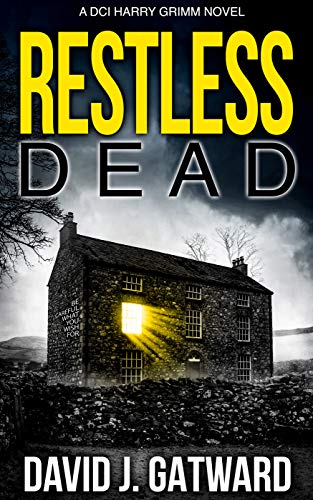
David J. Gatward’s Detective Chief Inspector Grimm series continues with Restless Dead. It’s a small mystery, the kind that couldn’t actually happen, in the same way, in an urban setting. But Harry Grimm, facially-scarred war veteran, is settling in in the relatively bucolic Wensleydale region, and in these parts they give the public more personal service than cops did back in Bristol.
Retired Col. James Fletcher is devastated by the death of his wife, killed in an auto accident while driving him home on his birthday, because he’d been drinking. Although his two daughters, his son-in-law, and his grandson have rallied around him, he’s profoundly depressed. Lately he’s started imagining he’s seeing his wife again around the estate (already rumored to be haunted); the family reports it to the police, who find no sign of an intruder. Col. Fletcher is not mollified, and things are about to get deadly.
Also, somebody is rustling sheep in Wensleydale, and the father of one of Grimm’s team members is a victim.
The Grimm series is semi-cozy and character-driven. I like it a lot (in spite of the injection of a “genuine” spiritualist). Restless Dead ends with a cliffhanger, but the major mystery was solved, and I look forward to the next book, coming in June.

Imagine, if you will, my bedroom. It is a palatial space, done in Wedgewood Blue in a Regency style, adorned with wholesome yet costly art, open and airy in ambience, with broad windows overlooking the ocean.
It’s nothing like that, of course. But you don’t think I’m going to describe my real bedroom, do you? You didn’t sign up for that kind of ashcan realism.
Anyway, my mornings in semi-retirement have acquired a sort of routine. I wake up way too early, as is the way of old people, and then try to get back to sleep. I can often achieve this (not always), but in between attempts, I check the email on my cell phone. You never know when translation work will show up, and they’re 7 hours ahead of us in Oslo.
This morning, I managed to get back to sleep around 7:30 a.m. I know this because that was the time when an email came in with a little job of work. Which I didn’t see until I woke up again, an hour later. The message was, “Can you do this small job? It’s not big but I need it in a couple hours.” Of which I’d already wasted one.
But I rolled out, postponed other things, and set about the task. Finished in plenty of time. Back to the usual Friday morning schedule then. Which involves washing clothes.
Shall I tell you about the new sheets I bought?
No, you’ve committed no sins to deserve that.
Maybe I should address the picture I posted above. Yes, why don’t I do that?
I posted that photo on Basefook precisely 3 years ago, when Viking Legacy was finally released, after many delays (if you want the paper version, I think this link works now). I’m still quite proud of it.
Just ordered a supply for events this summer. Did the same with West Oversea. I’m now invested in the prospect of a post-lockdown, semi-normal summer. When the paper version of The Year of the Warrior materializes, I’ll be all in.
Look at me, the avaricious capitalist risk-taker, living out my politics.
A strength of Erin Bartels’s 2019 debut novel We Hope for Better Things is its main story hook in the race riot in 1967 Detroit. A generational family drama that touches on the American Civil War, obvert and subtle hatred of colored people, and interracial relationships naturally feels like a Southern novel–at least it does to me. Telling a well-researched story from her neck of the woods, the complicated city of Detroit, Michigan, helps balance the typical narrative by showing how Yankees contributed to the slave systems of Southern states.
The story begins in modern day Detroit with an ambitious reporter, Elizabeth Balsam, meeting with a man who wants to ask a favor of her. She might be interested, if there’s a good story in it, but she’s in the middle of a potentially explosive investigation that is taking just about all of her emotional energy and creativity. When her investigation actually explodes in her face, she considers helping the man and maybe saving her career. The favor means looking up Nora Balsam, whom Elizabeth discovers is her great aunt living about 60 miles north in Lapeer, which is about 20 miles outside of Flint.
Before we get too far into Elizabeth’s interaction with Nora, the story turns back to Detroit 1963 and a younger Nora Balsam, who is looking for artwork to but at an exhibition. Instead she meets a good-looking photographer named William Rich and struggles to make sense of one of his photos on display, that of her father angrily reaching for the cameraman. Being as wealthy as she is, Nora hasn’t met many genuine people, that is eligible, young men, so she finds William’s bold interest in her appealing. You might call his interest reckless, because he is black and she’s white.
Once we understand a little more about Nora, we are pulled back to Lapeer 1861, where Mary and Nathaniel Balsam have begun to establish their farm. Nathaniel feels compelled to join the Union army to fight for the abolitionist ideas they have long discussed. That left Mary alone and pregnant with two housekeepers to manage everything. Of course, Nathaniel thought he would be home in several months, but three years later he had only returned once for a few days on furlough. His decisions in the field changed his family far more than his absence–he sent runaway slaves to Lapeer for safe harbor.
These three stories are skillfully woven together, holding the narrative tension well. I remember another novel set in Mississippi that tells three, interrelated stories at once, one of the three being comparatively dull. I was on the verge of skipping a section out of interest for the other story threads. We Hope for Better Things is engaging throughout. Questions raised in one thread begin to carry into the next.
With the publisher being Revell, you may think Bartels had to write in some explicit preaching or Xian exposition, but her faith comes through more subtly than that, in the faithfulness of the story arc.
Photo by Camylla Battani on Unsplash

