All posts by Phil

Sunday Singing: New Songs of Celebration Render

“New Songs of Celebration Render” is an adaptation of Psalm 98 taken from Calvin’s psalter using a tune by Louis Bourgeois (1510-1561) or Claude Goudimel (1505-1572). The English translation appears to be by Eric Routley in 1974 and is still under copyright, so I’ll link to a version of the lyric instead of copying it here.

Old Ogden Nash Hardcovers, Praising e-Readers, and Brain-Changing Reading

For some years, I’ve had a water damaged copy of Ogden Nash’s Good Intentions. Here’s a look at a good copy of it; this one has the slip cover too (I hadn’t seen it before).

Yesterday, I found similar red, hardback copies of Many Long Years Ago, a collection of mostly previously published verse from 1931-1945, and The Private Dining Room, new verse published in 1953. I refrained from replacing Good Intentions or buying another volume they had, so you know what that says about me. We don’t need to say it out loud. I also could have purchased one of a couple more recently published anthologies. This is one of them. But, if I do anything, I’d like a set of the five red hardcovers.

Here are a few lines from Many Long Years Ago.

“Who wishes his self-esteem to thrive
Should belong to a girl of almost five.”

“We’ll remind each other it’s smart to be thrifty
And buy our clothes for something-fifty.”

“If turnips were watches they’d make as good eating as turnips.”

Reading: In praise of e-readers and the joy of winning an argument with a print-only reader who has so many books that he loses the ones he has.

How would Jesus advertise? I have a hard time believing Jesus would encourage us to spend millions on advertising his character traits. How many vice is being funded with a Super Bowl ad? But I also have a hard time throwing stones at this.

Does reading change the brain?When it comes to a cultural trace in the form of literature, we would really like to know whether there is some sort of permanent alteration to the structure of the brain.” They chose Robert Harris’s Pompeii to see if they could detect a small brain change.

Banned Books: Anthony Sacramone has a book challenge for public schools. “Try and get all these at one go onto a public school curriculum (NYC, LA, SF) and see how that goes. I’d love to be proven wrong.”

Mystery: John Wilson reviews another Cameron Winter story, A Strange Habit of Mind, by Andrew Klavan, to be released in a few days.

Can’t Recommend Pathetic Rings of Power

Last month, one of the showrunners for Amazon’s The Rings of Power enthused about the series, saying it wasn’t their story but Tolkien’s. I think that’s how deeply deceived fan-fiction writers feel about their stories. This isn’t Tolkien’s story by a far cry.

I watched the remaining episodes of The Rings of Power yesterday, and all the wind has been taken out of my sails. Reading a bit from the showrunners has depressed me. Hearing from a few critics has soured me. Spoilers ahead.

I wasn’t hoping or expecting the show to become awesome in the last three episodes, but some errors hit you differently than others. You can roll with some lines of dialogue, some character motivations, and with others you can’t. Others just rattle the wheels right off your wagon and leave you on the hillside, wishing Santa would make things that last for a change.

They make up an origin story for Mithril to compel Elrond to push Duran IV to mine for it, because King Duran III believes it’s too dangerous to continue digging for it. They say a tree with the light of a silmaril is fought over by an elf and a balrog, is struck by lightning, and creates mithril by sending all the light into the rocky mountain earth. The elf king pulls out this story in episode 5 to say another tree that’s tied to the life of all elves is dying all of a sudden and if they don’t get that mithril stuff, all elves will be forced to flee to Valinor. It was a point in which the king seemed deceptive and manipulative. And the whole thing was dumb.

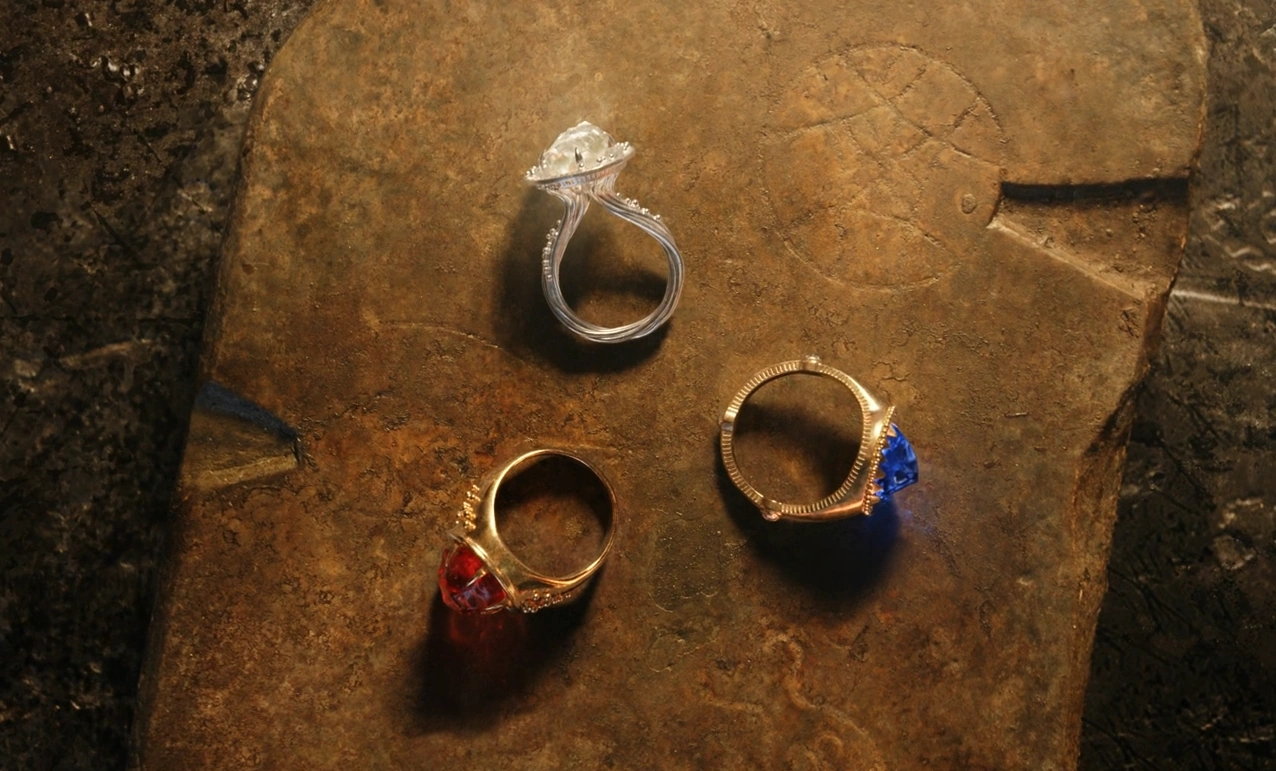
At the end of episode 8, they handle the creation of the elfin rings like any other TV drama. A main character, regardless of supposed skill, has to suggest the solution to the master craftsman. They hint that this craftsman is being manipulated, but please. There’s no strategy working here. It’s a line, a plot point, a touch of authenticity to say they know Tolkien’s history and are telling his story. The rings themselves look like trinkets (image via LOTR Fandom).

In episode 7, there’s a battle, and the “good” villagers give up their most defensible position for one that trained solders would have difficulty defending. And in doing so, they give the enemy the freedom to unlock an old plan that would nonsensically ignite Mt. Doom. Which is a big problem, but it doesn’t come before they mop the floor with their enemies because the elves and Númenórean men, whom Galadriel has been attempting to rally for half of the series, finally show up on the horses they brought overseas. How this cavalry knew the Southland village would be under siege at that moment is not important. What is important is that had the villagers stayed in the defensible outpost they fled to days ago, the cavalry would not have been able to charge in like they did.

A Kodak moment, I tell you.

Continue reading Can’t Recommend Pathetic Rings of Power

Sunday Singing: Alas! And Did My Savior Bleed?

“Alas! And Did My Savior Bleed” sung to a traditional Irish tune

This classic hymn, written by Isaac Watts in 1707, has been printed in over 2000 hymnals with one of a couple tune arrangements. The recording above pairs it with a traditional Irish song that has been called the Banks of Moorlough Shore and Foggy Dew. The mournful quality of this tune fits the words well, though they need to be rearranged.

1 Alas! and did my Savior bleed,
and did my Sov’reign die!
Would he devote that sacred head
for such a worm as I?

Was it for crimes that I had done
he groaned upon the tree?
Amazing pity! Grace unknown!
And love beyond degree!

2 Well might the sun in darkness hide,
and shut his glories in,
when Christ, the mighty Maker, died
for man the creature’s sin.

Thus might I hide my blushing face
while his dear cross appears;
dissolve my heart in thankfulness,
and melt mine eyes in tears.

3 But drops of grief can ne’er repay
the debt of love I owe;
here, Lord, I give myself away,
’tis all that I can do. . . .

The Powerful Rings So Far, Libraries, and Freedom in Commitment

Someone in our house picked up Amazon Prime, which means we’ve watched five episodes of The Rings of Power. If you remember what Lars said about not watching it, those reasons still stand. After the first two shows, I told the rest of my family it was not a Tolkien’s story, but a good fantasy that leaned heavily on Tolkien’s established world. It could have been independent of Middle Earth, but then it wouldn’t have gotten all of the hype, fans of Tolkien wouldn’t have come out of the woodwork to comment, and it wouldn’t have disappointed viewers as badly as it has.

I can’t say I’m in the most disappointed camp yet, though I have my complaints. Straight out of the gate, the writers tell us there was a time without darkness, which I took to mean evil had yet to come into the world, but they follow those words with little Galadriel getting bullied over her toy boat. Then they say, you know why a boat floats and a rock sinks? It’s because a boat has hope and keeps it head up. If the dialogue had maintained that level of inanity for the whole first episode, I would have dropped it, but it improved. Not before arguing that Galadriel, who had bent her life on stamping out Sauron, was in danger of sustaining the evil by seeking it, because if evil isn’t out there, but you think it is, then you could become the very thing you seek.

Those were meta level reasons I said the story wasn’t Tolkienesque, but it still seemed okay as we moved along. Characters weren’t doing stupid things until maybe episode five. A wizard-like character who fell from the sky has not been explained–he’s interesting. The Sylvan elf is the only one fighting at this point and has gotten in some good Legolas moves. The Duran-Elrond storyline is good overall.

But with episode five, things have begun to turn sour. There’s a laughable fighting tutorial that suggests swordmen should fight with their feet, not with their arms. An actor with stage fighting experience has a couple videos in response to this part of the show, in which he explains how actors swing weapons to appear lethally aimed when they aren’t and what the camera must do to make a battle look real.

  1. Fight Scene Autopsy
  2. How Fights Tell a Story

I could say more, but many others have said many things about this show already. I should just move on with blogroll links.

Bookcases: “We’re so enamored of digital technology we often presume its superiority; worse, we sometimes forget its alternatives even qualify as technologies.” Joel Miller recommends a bookcase as the most underrated user interface we have.

Coffee: Artist Alyssa Ennis paints detailed architecture and landmarks of Northeast Ohio using pencils and coffee. Her dad sculpts wildlife models from wood.

Liberty: Peter Mommsen writes about our love of liberty, fear of commitment, and the freedom found in making good vows. “I soon discovered that being bound [by a vow] didn’t feel like a loss of liberty. On the contrary, once the step had been taken, paralyzing daydreams about other possible life paths disappeared . . .”

Libraries: The Palafoxiana Library in Puebla, Mexico is the oldest public library in the Americas. “On the first floor, there are more than 11,000 Bibles, religious documents and theological texts. The second level is dedicated to the relationship between God and people — chronicles of religious orders and the lives of saints — and the third contains books on physics, mathematics, botany, language, architecture, even carpentry.” (via Arts Journal)

Photo: Springfield Library, Springfield, Massachusetts. 1984. John Margolies Roadside America photograph archive (1972-2008), Library of Congress, Prints and Photographs Division.

Trojan War Mosaic Found

A 1,300 sq. foot mosaic floor has been uncovered in Syria, depicting figures from the Trojan War–“Remarkably intact artwork that was created 1,600 years ago shows colorful images of Ancient Greek soldiers and Amazons who fought in the epic battle.” They’ve only uncovered 65 feet of it so far.

The Awakening of Miss Prim, by Natalia Sanmartin Fenollera

Herminia was a refined, intelligent, sensitive woman but that was no defense against self-deception. Miss Prim had a theory about self-deception: the female sex seemed particularly and cruelly vulnerable to it.

I read this 2014 novel with friends over the past month. It inspired moderate complaint and, after a bit of reflection, delivered a welcome finish. The Awakening of Miss Prim was originally written in Spanish in 2011, so we read the English translation by Sonia Soto.

The story takes place in the fictional Spanish village of San Ireneo de Arnois, an idyllic community of independent folk making their living by doing what they love. It’s implied that everyone here lives humbly, but you can’t tell from the wealth of flowers, cozy homes, tea cakes, fresh bread, and hot chocolate flowing every other page. Village business is bustling, but shops are only open for as long as they want to be, because people have healthier priorities than making as much money as they can in a day.

Miss Prim comes to San Ireneo to inquire into a job opening as a private librarian to one of the most important men in town. The advertisement states those with many credentials need not apply, and Prim has many credentials, but when asked about that and the possibility that she may be trying to escape a former life, she bristles and almost turns the job down–never mind that she implies she is seeking a refuge.

She accepts the job of organizing the library for six months, and in that time meets the wonderful village folk, the curious children folk, and seems to be unable to have a conversation without being offended. She frequently tells herself how proper and level-headed she is and frequently catches someone’s choice or opinion that clashes with her own. The quote above comes late in the book and it couldn’t be clearer that she’s talking about herself.

But after talking over the whole book in a group, I put my initial complaints aside. It’s possible this novel leans into the idea that beauty is truth and will save the world. Prim awakens to the idea that slowing down, breathing fresh air, meditating on old poetry, rejecting a narcissistic view of everyone around her, and particularly dwelling on the Gregorian chant coming from the crypt at St. Benedict’s is real living. One friend suggested this as a specifically Christian theme. It isn’t explicit in the book, but a few lines point to it.

From this perspective, the novel is worth reading. It can easily come across as the story of a young feminist longing for something better in the world while undermining every effort to take her there. Maybe instead it’s a gentle story of a woman who needs and finds Christ.

Sunday Singing: Come, Christians, Join to Sing

“Come, Christians, join to sing” sung by a congregation at St. Olaf’s College for the graduate conducting recital of Michael Devine

This classic hymn was written by English Moravian minister Christian H. Bateman (1813-1889) and is sung to a traditional Spanish melody, arranged by American Benjamin Carr. Carr studied music under Charles Wesley and Samuel Arnold.

1 Come, Christians, join to sing
Alleluia! Amen!
loud praise to Christ our King;
Alleluia! Amen!
let all, with heart and voice,
before his throne rejoice;
praise is his gracious choice:
Alleluia! Amen!

2 Come, lift your hearts on high,
Alleluia! Amen!
let praises fill the sky;
Alleluia! Amen!
he is our guide and friend,
to us he’ll condescend;
his love shall never end:
Alleluia! Amen!

3 Praise yet our Christ again;
Alleluia! Amen!
life shall not end the strain;
Alleluia! Amen!
on heaven’s blissful shore,
his goodness we’ll adore,
singing forevermore,
“Alleluia! Amen!”

Where Do You Want to Read?

Comfortable chair with plenty of light and books

Reading: Where do you like to read? A hammock, a couch, an overstuffed chair? At a desk, on a bench, or while walking somewhere? The chair in the photo above would suit me well for firmness and lighting.

I feel I can’t read in half of my house without falling asleep, and while it would be easy to blame my age now, I don’t think that has been the reason for my fatigue or maybe mental laziness before now. I am a poor, distracted, uncompelled reader for the most part. No one will learn of my literary habits in the coming years and find in them a pattern to follow.

Historic Novels: Some books are not comfort reads. Gina Dalfonzo says she had trouble sleeping after reading The Marriage Portrait by Maggie O’Farrell. It’s a novel about Lucrezia de’ Medici, the wife of Alfonso II d’Este, Duke of Ferrara, who died at age 16, and is remembered mainly as the subject of Robert Browning’s, “My Last Duchess.”

That’s my last Duchess painted on the wall,
Looking as if she were alive. I call
That piece a wonder, now; Fra Pandolf’s hands
Worked busily a day, and there she stands.

Saith the Duke with every indication that he suspected his Duchess of infidelity or perhaps, more vaguely, unworthiness.

Jotting Notes: Patrick Kurp has a few small notes in his Bible of 60 years. They don’t reveal much.

What is she holding? The woman in this 1860s painting by Ferdinand Georg Waldmüller has all the appearances of holding a smartphone.

Nobel Prize: French author Annie Ernaux has been awarded the Nobel Prize for Literature.

Photo by Nick Hillier on Unsplash

Sunday Singing: I Greet Thee, Who My Sure Redeemer Art

“I Greet Thee, Who My Sure Redeemer Art,” performed by Zachary Harris

This hymn is attributed to John Calvin and his arrangement of the Genevan Psalter for his congregation. He promoted lively psalms and spiritual songs in worship and leaned on such musicians as Claude Goudimel and Louis Bourgeois to compose them. This tune was published in 1551, and from what I understand was sung much quicker than the beautiful performance above.

1 I greet thee, who my sure Redeemer art,
my only trust and Savior of my heart,
who pain didst undergo for my poor sake;
I pray thee from our hearts all cares to take.

2 Thou art the King of mercy and of grace,
reigning omnipotent in ev’ry place:
so come, O King, and our whole being sway;
shine on us with the light of thy pure day.

3 Thou art the Life, by which alone we live,
and all our substance and our strength receive;
O comfort us in death’s approaching hour,
strong-hearted then to face it by thy pow’r.

4 Thou hast the true and perfect gentleness,
no harshness hast thou and no bitterness:
make us to taste the sweet grace found in thee
and ever stay in thy sweet unity.

5 Our hope is in no other save in thee;
our faith is built upon thy promise free;
O grant to us such stronger hope and sure
that we can boldly conquer and endure.