All posts by Lars Walker

‘Blott en Dag’

Another busy day. I have much translating to do. This situation would be more pleasant if it was all  paying work, but I found out yesterday I’d fallen behind in my volunteer stuff. The volunteer stuff pays better, of course, but I’ll have to wait till I get to Heaven to collect.

Beautiful day today. Temperature in the 50s. It was a genuine pleasure to be outside, the short time I spent there. That hasn’t been true for some time.

I continue listening to Norwegian radio, both secular and sacred. Today one of the hymns I listened to was one that’s very popular among my tribe, though it comes originally from the hated Swedes. “Blott En Dag” means, essentially, “one day at a time.” Above, a young Sissel does it on Norwegian TV. The standard English translation is called “Day by Day” (not to be confused with the ditty from “Godspell”). Its first verse goes:

Day by day, and with each passing moment, 
Strength I find to meet my trials here. 
Trusting in my Father’s wise bestowment, 
I’ve no cause for worry or for fear. 
He whose heart is kind beyond all measure 
Gives unto each day what He deems best. 
Lovingly, its part of pain and pleasure, 
Mingling toil with peace and rest.

You can read the rest here, along with a short bio of the lyricist, Carolina Sandell, a really excellent Swedish hymn writer.

That mention can suffice to make this my obligatory Women’s History Month post, now I think of it. Don’t say I never threw a bone to the feminists.

Maybe that wasn’t the best way to put it…

Swimming in linguistic waters

Nothing to review, and I’ve done little but work in the last few days (no, that’s not true. I loafed yesterday. It was Sunday). So I’m journaling today, I guess. Yet again.

It was warm today, in the upper 30s. Tomorrow will be even better, and I don’t see a freezing day on the horizon. I approve of this development. I shall tip the waiter generously.

I complained, the other day, about my inability to understand spoken Norwegian, the language I translate professionally in text form. One of our readers, Deborah HH, suggested I listen to Norwegian radio. I thought this an excellent suggestion, and installed a Norwegian radio app on my cell phone.

My strategy (or wishful thinking) is to attack the problem subconsciously. I will just have the radio on, listening idly as I do other things. No sustained effort to understand what I’m hearing. My working theory is that that effort is a part of the problem. I know all these words. I just don’t process them when they come in through the audible gate. When I consciously try to interpret, I get hung up on individual words and lose the flow. What I need is an involuntary response. I’m hoping that as I listen over time, my subconscious will jump the gap and connect to my dictionary storage unit. Something like “total immersion” learning.

It took some searching to find the channels I wanted. Most Norwegian radio is indistinguishable from American radio, except for the announcements. They play music, and it’s mostly American music. I wanted talk, and in the Old Country language. There’s an NRK (Norwegian National Broadcasting) channel that’s all news, and that’s just the thing, as far as it goes. But around 2:00 pm (our time) they switch to BBC News, which is no use at all (in more than one sense).

But I finally found a channel to listen to after that. It’s Jæren Misjonsradio (Jæren Mission Radio). If the name Jæren seems familiar, its old name is Jaeder, and it’s the region where Erling Skjalgsson lived in his time (around Stavanger). A region with a great evangelical tradition, of which my ancestors were a part.

They feature preaching in Norwegian, which is good. I recognize the Bible passages, and that helps me along. And the music they play is mostly in Norwegian too – and some of it’s quite excellent.

Today I heard one preacher – a good one – and happened to notice his name on the crawl. Carl Fredrik Wisløff. This was thrilling. Wisløff was a prominent evangelical preacher, teacher, and writer in Norway up to his death in 2004. I used to sell some of his books in the bookstore at the seminary – we had a large stock of one of them. He even visited our schools once, I’m told, but that was before my time.

Now, back to work.

‘Ormen Lange’

And the translation work keeps coming in. If I were tired of it, I would not tell you. Because I have an international trip this summer to support. Plus inflation to cover. Also, it’s nice to be needed, when you’re me.

It’s cold, cold, and I have to go somewhere tonight. But tomorrow’s supposed to be warmer, and Sunday warmer still. Maybe this will be the turning point – just as Daylight Savings Time falls, clattering like a muffler off an old car. Maybe spring is coming. Or milder weather, with some consistency, at least.

The song above is an old Faeroese ring dance song, translated into Norwegian. I heard it first from a Norwegian folk group, but their version doesn’t seem to be on YouTube. However, this one isn’t bad, and they illustrated it with footage swiped from the 1958 film, “The Vikings,” starring Kirk Douglas. For its time, that movie made commendable gestures in the direction of trying to be kind of authentic. In some ways. Sort of.

It’s still better than the History Channel series, now metastasized to Netflix, they tell me.

The song is about King Olaf Trygvesson (whom you may remember from The Year of the Warrior), and how he built and launched his great ship, Ormen Lange (the Long Serpent). The chorus goes:

The dance is loud in the hall, when we dance in the ring! 
Gladly ride the men of Norway to the Thing of Hildar (a kenning for battle).

The full text is here.

‘Fatal Sisters,’ by W. Glenn Duncan

Speaking in general terms, hard-boiled mysteries written before the turn of the millennium tend to be a good bet for me. A little more modern than the classics (which I also like), but before the explosion of Wokeness that has fatally infected so much recent literature. Jack Lynch’s Bragg books are a good example.

So I tried out W. Glenn Duncan’s Fatal Sisters, part of his Rafferty series. The intention seems to have been to produce something reminiscent of Robert B. Parker’s Spenser novels.

Sadly, it didn’t quite work for me. But read on. You might like it better.

Rafferty is a private eye in Dallas. Like Nick Charles and Spenser, he has a steady girlfriend (though because of the time of writing, the author didn’t feel it necessary to make the girlfriend a two-fisted martial artist. And that’s always nice). Rafferty operates alone, but has a dangerous friend called “Cowboy” who backs him up when things get hairy.

In Fatal Sisters (I haven’t figured out yet what the title means. Probably missed a clue), Rafferty gets a call from Patty Akkister, a fairly ordinary young wife. She says her husband Sherm is missing. But it’s all hush-hush, because, she says, Sherm is actually a spy, off on one of his secret assignments. He’s been gone so long, though…

Rafferty has run into situations like this before. Clearly, old Sherm is having an affair, and using the spy story to explain his absences. Rafferty takes the case, in the hope of catching Sherm and talking him into going back to Patty.

Unfortunately, Rafferty’s wrong. Sherm’s no spy, but he is involved in some very dangerous business. And before he’s done, Rafferty will find himself dodging bullets and protecting people – including Patty – from serious mayhem and murder.

I’m not entirely sure why Fatal Sisters didn’t work for me. Rafferty was an okay character, though he never really came alive in my mind. He’s a wisecracking PI, which is a great tradition, but it seemed to me his dialogue never quite hit the target. The book was interesting enough, in a “something to read while waiting for a plane” sort of way. And there was a pretty good surprise at the climax.

On the language side, the profanity quotient was much lower than we get in our decade. So it had that going for it.

Notes of an imposter

Busy, busy today. Busy like a maur, which is Norwegian for “ant.” Working on a project I won’t describe to you, of course, except to say that it’s more difficult than the usual fare. I’m dealing with some dialect here. I do surprisingly well with dialects (having figured out the “trick” of it some time back. You need to imagine the sounds of the words). But it still takes longer than the usual stuff. And involves harder thought.

It’s just as well I had inside work to do. It was cold outside. Clear, but cold, though it wouldn’t have seemed so bad a month ago. Yesterday was partly cloudy, and the temperature soared into the 40s, which feels pretty good in March. Exchanged a few words with one of the neighbors, who complained about his aches and pains due to moving snow. The warm day had been ushered in by a heavy snowfall. We have now, according to the neighbor, exceeded the average snowfall for the year. It’s been a yo-yo year, we agreed. The temps have gone up and down, and every time they passed the freezing point (either way, it seemed), we got another dump of snow.

My usual favorite radio talk show didn’t grab me today, so I slipped in my DVD of “Wisting” (a Norwegian production, you may recall, which I worked on a bit). I wanted to listen to some spoken Norwegian. When I go there this summer, I’d like to be able to understand people. I can speak TO them – haltingly, but understandably. But I can’t understand them when they talk. The words, so comprehensible on paper, blur together and mean nothing to me. It’s frustrating. Here I am a genuine Norwegian translator, with credits, and I can’t understand the spoken language.

One of my great fears is that someone will someday expose me for the imposter I am.

I guess I’m not the only person who feels that way.

‘Yesterday is Dead,’ by Jack Lynch

I like the late Jack Lynch’s Pete Bragg series of hard-boileds, starring Pete Bragg, better and better. Yesterday is Dead was right up my alley.

Pete Bragg, you may recall, is a private eye in the San Francisco area. But his origins are in Seattle, where he grew up and was a newspaper man for a while. He doesn’t have a lot of fond memories, though. Somehow, he says, nothing ever worked out for him there.

So it’s been a while since he’s been in touch with his best old friend up there, Benny Bartlett. Benny is freelance journalist, and a really nice guy. He works on human interest and feature stories. Woodward and Bernstein he’s not.

So why is somebody threatening him over the phone? There have been a couple strange incidents, too, which may have been attacks. But Benny’s not sure. The police aren’t impressed. But Benny’s worried about his family. Would Pete come up and look into things?

Of course Pete will. About the time he shows up in town, the danger to Benny becomes undeniable. But even more disconcerting is that Pete runs into his ex-wife, Lorna. Their relationship was complicated, and when she left him, it hurt. Now she seems interested again. Can Pete take another chance on her? Or should he be faithful to his California girlfriend?

Yesterday is Dead is classic hard-boiled, even down to Pete getting taken for a ride and given a professional beating. My only real complaint is a lingering one with this series – Pete’s judgment and ethics in dealing with women are pretty bad (and they’ve got to be bad when I can tell). But I guess that’s part of his character.

Recommended.

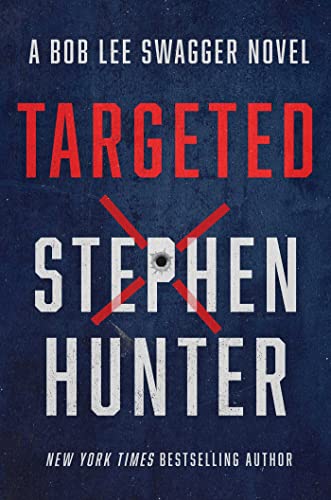
‘Targeted,’ by Stephen Hunter

The shooting stopped not out of mercy or rationality, but out of ammo depletion. Each automatic and semiautomatic weapon came up dry at almost the same second. Anyone whose eardrums had not been shattered by the ruckus would have heard an anvil chorus of clicks, snaps, slams, curses, and chunks as, momentarily drained of IQ, the troopers decided that if they pulled real hard the guns would start shooting again.

I always wonder (with anticipation) what stunt Stephen Hunter will pull to squeeze one more story out of the Bob Lee Swagger franchise. When you’re writing an action character who ages in real time, and you’ve gotten him up to his mid-seventies, generating drama turns into a real challenge. Generating plausible drama would seem nearly impossible.

And yet Hunter pulls it off again in Targeted. I won’t say the story is quite plausible, but it’s carried off with such style and verve that it works, in the grand tradition.

In our last story, old Bob Lee saved the country from a major terrorist plot with a near-impossible rifle shot. In the grand tradition of American politics, the reward he earns is a congressional investigation, led by a predatory old congresswoman who may, or may not, be based on a living person. Oh, we have nothing but respect for you personally, the investigators say (they are lying), but we need to seriously consider the procedures and protocols that led to your action. Were anyone’s civil rights violated? Did systemic racism inform the operation in any way?

Just when things look very bad for the old sniper, the whole thing gets turned upside down by the arrival by a group of mysterious convicts who take everybody hostage. Bob, plastic-cuffed to a wheelchair, is in a poor position to save the day, but a surprising ally will appear.

Lots of action, a good dollop of political satire, and one of the most dependable action heroes out there. I got a kick out of Targeted, and recommend it highly.

‘Molde Canticle’

The amazing number above was included on the album Sissel put out around the time of the 1994 Winter Olympics in Norway, where she sang the Olympic Hymn. This was a cassette album, and Molde Canticle was included as an “extra.” When I bought the album in CD form later on, it didn’t include this one. And I missed it a lot. But here it is. The composer is the Norwegian musician Jan Garbarek.

In some alternate universe, I would like to have The Year of the Warrior made into a major motion picture. And in the scene where Erling first meets King Olaf Trygvesson, in frost-covered ships on the sea, I’d like this to be the background music.

‘Savior, Like a Shepherd Lead Us’

I’m in the mood for ‘Savior, Like a Shepherd Lead Us’ tonight. I used to sing this song with my old musical group. We generally didn’t do it in performances, just for our own pleasure, because it works really well in four parts. This rendition is quite nice. It comes from the choir of Weimar University, of which I know nothing.

It’s assumed the hymn was written by Dorothy A. Thrupp. It was published with her tune in 1840 in London.. Historians assume she wrote the words too, but she took no credit. The tune we use was written by William Bradbury.

I needed this hymn tonight, for reasons I won’t go into. Mostly just the mood I’m in.

‘Look to Norway’

Well, this is nuts, isn’t it? And by “this,” I mean pretty much everything that’s going on in the world. I have never before in my long, marginal existence felt that listening to the news – and even to conservative talk radio – doesn’t do much to inform me about reality.

I think I know whom I’m against. I’m not entirely sure whom I should root for. I have a feeling of being awash in misinformation. And I have this fear in my heart that that will be our future – we will never again be sure what’s going on.

So, I’m concentrating on my translation (been fairly busy) and my developing plans for my Norway trip this summer.

I am now in contact with Vikingklubben Karmøy, the group that hosts the festival documented above (that was 2019, which I assume was the last festival held). This year they’re hosting a portion of the big Riksamlingen Festival (National Unification Festival). And they’ve told me I’m welcome to participate in costume. Not sure at this point whether I’ll actually be of any help to anyone, but I hope to be there, on the outskirts, an object of pity and horror, no doubt.

The prospect thrills me. And terrifies me. It involves interaction with actual human beings. I don’t always do well with those kinds of people.