Jeffrey Polet reviews Emory professor Mark Bauerlein’s second book on the “Dumbest Generation,” Millennials, whose poor education has underserved them. He says, they don’t have the “moral imagination” to speak to the real world. If only they’d read good books.
Multiculturalism didn’t multiply heritages and enhance each one; it left the students with no heritage at all, no relationship to past greatness.” As witness to this claim Bauerlein offers Malcolm X, who, he avers, would have scoffed at the denuding of such a wealthy heritage. Instead, Malcolm X transformed his life when his prison cell became a refuge from the world, allowing him to read day and night, thus awakening “the long dormant craving to be mentally alive.” It was by placing himself in the horizon provided by the great works of the past that Malcolm X was able to turn his life around and give it purpose.
As you may or may not recall (why should you?) I have a fondness for tales of the sea. The great age of sail warfare, the age of Nelson, has inspired several excellent series of novels. The original, great one is C. S. Forester’s Horatio Hornblower. He may (possibly) have been surpassed by Patrick O’Brien’s Aubrey and Maturin. Another contender, not to be scorned, is Alexander Kent’s (a pseudonym; Douglas Reeman was his real name) Richard Bolitho.
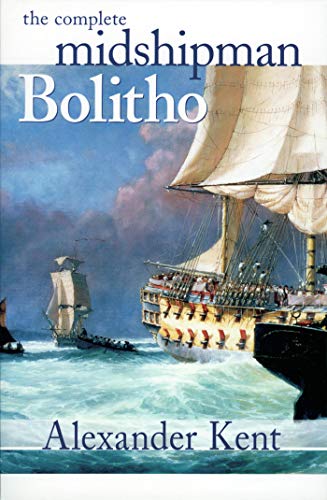
The Complete Midshipman Bolitho is a collection of three novellas describing Dick Bolitho’s service from 1772 through 1774, on the eve of the American Revolution. We find him, a sixteen-year-old with experience on a previous vessel, assigned to HMS Gorgon, a 74-gun warship. Richard is the son of a rear admiral, but all midshipmen (at least in theory) are treated the same – and the discipline is hard. His immediate superior, in fact, makes it clear to him that he’ll get no special treatment – rather the opposite.
In the each of these three stories, the young midshipman finds himself facing impossible challenges and pulling victory from the jaws of defeat through unwavering courage, original thinking, and an unusual empathy with the men he leads.
The Complete Midshipman Bolitho was an excellent (and educational) read, by and large. This reader personally had trouble with some of the action scenes. They reminded him of the quick-cut editing in modern action movies – characters seemed to suddenly appear in places without an adequate explanation of how they got there. But it’s possible I was just distracted and missed the clues.
Minimal bad language. Suitable for older teens and all adults. Recommended.
Here’s a hymn I hope all of us know well. “For All the Saints Who from Their Labors Rest” was written by the “poor man’s bishop” William W. How (1823-1897) to an original tune composed by the great Ralph Vaughan Williams.
1 For all the saints who from their labors rest, who thee by faith before the world confessed, thy name, O Jesus, be forever blest. Alleluia! Alleluia!
2 Thou wast their rock, their fortress, and their might; thou, Lord, their captain in the well-fought fight; thou, in the darkness dread, their one true light. Alleluia! Alleluia!
3 Oh, may thy soldiers, faithful, true, and bold fight as the saints who nobly fought of old and win with them the victor’s crown of gold. Alleluia! Alleluia!
Know then thyself, presume not God to scan, The proper study of mankind is man. Placed on this isthmus of a middle state, A being darkly wise, and rudely great: With too much knowledge for the sceptic side, With too much weakness for the stoic’s pride, He hangs between; in doubt to act, or rest; In doubt to deem himself a God, or beast; In doubt his mind and body to prefer; Born but to die, and reas’ning but to err;
I may have some entertaining posts for you soon. The links below have a couple bits of entertainment, but the rest are about matters to grave to laugh over.
Maria Stepanova: The Russian novelist, poet, and publisher has written about the war and her country. “Dreams about catastrophe are common in what was once called the ‘post-Soviet world’; other names will surely appear soon. And in these recent days and nights, the dreams have become reality, a reality more fearful than we ever thought possible, made of aggression and violence, an evil that speaks in the Russian language. As someone wrote on a social media site: ‘I dreamt we were occupied by Nazis, and that those Nazis were us.'” (via Books, Inq)
This episode of the Hillsdale Dialogues with Hugh Hewitt and Larry Arnn is provocative in clarity, especially if you’re inclined to believe the ill-considered conclusions Tucker Carlson has drawn lately (see the comments here). How closely will Zelensky follow the footsteps of Churchill?
Photo: Hanks Coffee Shop sign, Benson, Arizona. 1979. John Margolies Roadside America photograph archive (1972-2008), Library of Congress, Prints and Photographs Division.
Today is Tolkien Day – the day the Ring of Power was destroyed in the Crack of Doom, according to The Return of the King. It became New Year’s Day for the people of Middle Earth, and it’s no coincidence that it’s the Festival of the Annunciation in the western Christian calendar.
Tolkien was recorded reading excerpts from his work by friend George Sayer in 1952. Somebody has mixed his voice with music and images from the Peter Jackson movie to create this video. Works pretty well, I think. I still get the old thrill when I listen.
This is why I decided I wanted to write epic fantasy nearly 60 years ago, my friends.
Tolkien is reported to have had a speech impediment – he bit through his tongue in his youth and is said to have slurred his speech, and his tendency to talk fast did nothing to help it. But when he was lecturing he sounded like this. Clear-voiced like Theoden.
Anthony Sacramone reviews an episode of a recent TV series about a high school history teacher who became president that stars the lawyer-turn-comedian who is the current president of Ukraine.
“In short, no one believes what is in fact the truth: A common man without guile or political experience is now the most powerful person in the country, thanks to a popular assent collated by the internet, the same medium that brings you cats falling off pony walls and Russian disinformation. Can you blame them?”
He says it’s funny, endearing, and probably has more heart than many comedies.
As a man who likes to work (and needs to work) I’m pleased to say that I’m kind of snowed under these days. Which leaves me little time for either reading (for reviews) or composing those pearls of wit and wisdom that make me so beloved by more discriminating spirits on several continents. So of what shall I blog?
I remembered an old British TV series, “Wodehouse Playhouse,” of which I’ve seen a few episodes. I searched YouTube and found only one — this one, which I haven’t seen. However, it starts well, and it’s a Mulliner story. It’s presented in segments, and (if I understand correctly) you can follow them through the suggested links, collecting them all and impressing your friends.
This 1920 American film is only a little older than my pipes.
Ogden Nash wrote a poem long ago about owning an old house. In it he parodied a popular line from the popular poet Edgar A. Guest:
It takes a heap o’ livin’
To make a house a home.
Nash’s poem is called, with typical Nashian disregard for titling conventions, “Lines to a World-Famous Poet Who Failed to Complete a World-Famous Poem, or, Come Clean, Mr. Guest!” He discusses facts about home-ownership that Guest’s poem fails to mention.
It contains the lines,
And unless you’re spiritually allied to the little Dutch boy who went around inspectin’ dikes lookin’ for leaks to put his thumb in,
 It takes a heap o’ plumbin’.
These lines have haunted my lonely nights over all the years I’ve owned a house built in the same year as the Great Stock Market Crash. Yesterday I had a plumber out to clear a clog in my bathtub drain, a fairly common experience around here. And he gave me the Doleful Word I’d been expecting so long – “We can clear it out, but you’ve got pipes leaking in the basement, and you need some major work done down there.”
He went on to say that he wasn’t qualified to talk to me about the big job himself. But they could have a specialist come out to look at it today. He did, however, take a substantial down payment.
Hence, last night was an exercise in faith. It was one of those times when I have to say, “God has always made sure my financial needs were covered. I believe He’ll look after me now. And if He doesn’t (from a human point of view; it’s not out of the question he might want me to lose the place) then that will be in His blessing too.”
When I got up this morning, having uploaded last night the big script I’d been working on, there was a note from my boss: “We’ve got lots of work coming in, if you’re available.”
These are the words you want to hear on a day like this.
I feel that blessings of this kind coming from God must be acknowledged. And this is my acknowledgement.
It’s generally a mistake to look for excellence in contemporary Christian fiction (or any other kind of fiction, to be fair). When excellence does appear, it’s a wonderful gift. One to savor. It behooves a grumpy old reviewer like me to be thankful when a Christian novel is okay.
Parker House is a young attorney in New Bern, North Carolina. He’s working for a small firm, and his bosses work him pretty hard. But he’s proving a valuable asset (though his bosses won’t admit it yet) because of his remarkable talent for making good guesses.
Parker has a grandfather, Frank, who immigrated from Switzerland after World War II. But he’s mysterious about his origins. He is not, in fact, Swiss, but German. And during the war he was valued by his Nazi superiors as someone able to intuit enemy positions and intentions. And, incidentally, places where treasure might be concealed. Frank deserted at last, but he still bears a weight of guilt.
When a man Frank doesn’t remember, who tells him he saved his life once, shows up at his door, Frank is troubled. He only wants to put the past behind him. Frank’s intuition tells him more is going on than the old acquaintance told him.
Meanwhile, young Parker is being headhunted by a famous trial lawyer, who seems to have sensed his hidden gifts. The lawyer has a beautiful daughter whom Parker falls for, but that turns out to be a complication, as she’s bitterly estranged from her father. She gives Parker an ultimatum: You can work for my dad, or you can date me.
The Witnesses kept my interest all through, though I found the writing fairly flat. The Christian elements approached the awkward sometimes (for me, but I’m sensitive). However, the final spiritual climax was quite moving.
I have problems with the idea of anything like “extrasensory perception” as a gift of the Holy Spirit. The author seems to identify it with the gift of prophecy, but I’m wary of such things. So – at least from the point of view of my church – I’d call The Witnesses iffy on the orthodoxy side.
Your beliefs may vary. Nothing objectionable in the content. I think many of our readers may enjoy The Witnesses.
Photo credit: Franco Antonio Giovanella . Unsplash license.
Still busy with my big translating project. I expect it will be done tomorrow. I worked through the weekend, and even had to work on Sunday, which I generally try not to do. But I kept the hours short that day, and made sure I gave myself time to relax on the sofa with an e-book in the afternoon. It was a beautiful day – not as beautiful as today (it almost got up to 70 degrees), but sunnier.
And a wonderful thing happened.
You may recall how I’ve been talking about “totally immersing” myself in Norwegian, to improve my conversational skills. I read the language well, but have trouble understanding it when spoken. So I started listening to Norwegian radio through an app on my phone. News from the state broadcasting channel, and a gospel station from Stavanger. Which meant the gospel station all weekend, because the all-day news channel turns into a BBC feed on Saturdays and Sundays.
So I was lying there on the couch, reading my book and listening to the gospel station. A man was preaching. And suddenly I realized I could understand him, pretty much.
I stopped reading and listened closely. Yes, I could follow him, most of the time. 75% comprehension, I’d say. Enough to follow his line of thought.
Now I need to explicate. He was speaking very distinctly and clearly, in the way of good preachers (though he was using a dialect, but I know most of the variant terms). And he was preaching from the Bible, so I understood all the quotations right off. So I’d compare my experience to someone learning to read with a beginner’s level book.
But being able to read a beginner’s book is a start. Listening to other things, I’m pretty sure I’m understanding more than I did. A week ago I was catching nothing but a few scattered nouns and verbs.
I lay there for a while with a feeling of wellbeing I haven’t experienced in a long time.
There’s a negative side-effect I find interesting. When I think about what I’m doing, there’s a small voice in my mind screaming “NO! YOU CAN’T DO THIS! YOU AREN’T ABLE TO DO THIS!”
Examining it dispassionately, I think it’s related to my shyness/avoidance. The insane guy in my head is trying to protect me from the dangers of human interaction, terrified I’m going to open another portal by which enemies may enter.
That’s just part of the deal, I guess. I’ll have to handle it.
A more pleasant side effect is that I’ve been sleeping well. As an old man, I’ve gotten used to a state of things where I go to sleep around midnight and wake up around 6:00 a.m. Then I try to get back to sleep. Usually without success. But now I turn on Norwegian radio and listen to it idly while trying to get back to sleep, and so far it’s worked. Which means I’ve gotten three straight nights of relatively normal sleep hours.
I still feel tired, but that’s got to be a good thing.
Websites store cookies to enhance functionality and personalise your experience. You can manage your preferences, but blocking some cookies may impact site performance and services.
Essential cookies enable basic functions and are necessary for the proper function of the website.
Name
Description
Duration
Cookie Preferences
This cookie is used to store the user's cookie consent preferences.
30 days
These cookies are needed for adding comments on this website.
Name
Description
Duration
comment_author
Used to track the user across multiple sessions.
Session
comment_author_email
Used to track the user across multiple sessions.
Session
comment_author_url
Used to track the user across multiple sessions.
Session
These cookies are used for managing login functionality on this website.
Name
Description
Duration
wordpress_logged_in
Used to store logged-in users.
Persistent
wordpress_sec
Used to track the user across multiple sessions.
15 days
wordpress_test_cookie
Used to determine if cookies are enabled.
Session
Statistics cookies collect information anonymously. This information helps us understand how visitors use our website.
Google Analytics is a powerful tool that tracks and analyzes website traffic for informed marketing decisions.
Used to monitor number of Google Analytics server requests
10 minutes
__utmb
Used to distinguish new sessions and visits. This cookie is set when the GA.js javascript library is loaded and there is no existing __utmb cookie. The cookie is updated every time data is sent to the Google Analytics server.
30 minutes after last activity
__utmc
Used only with old Urchin versions of Google Analytics and not with GA.js. Was used to distinguish between new sessions and visits at the end of a session.
End of session (browser)
__utmz
Contains information about the traffic source or campaign that directed user to the website. The cookie is set when the GA.js javascript is loaded and updated when data is sent to the Google Anaytics server
6 months after last activity
__utmv
Contains custom information set by the web developer via the _setCustomVar method in Google Analytics. This cookie is updated every time new data is sent to the Google Analytics server.
2 years after last activity
__utmx
Used to determine whether a user is included in an A / B or Multivariate test.
18 months
_ga
ID used to identify users
2 years
_gali
Used by Google Analytics to determine which links on a page are being clicked
30 seconds
_ga_
ID used to identify users
2 years
_gid
ID used to identify users for 24 hours after last activity
24 hours
_gat
Used to monitor number of Google Analytics server requests when using Google Tag Manager
1 minute
_gac_
Contains information related to marketing campaigns of the user. These are shared with Google AdWords / Google Ads when the Google Ads and Google Analytics accounts are linked together.
90 days
Marketing cookies are used to follow visitors to websites. The intention is to show ads that are relevant and engaging to the individual user.
A video-sharing platform for users to upload, view, and share videos across various genres and topics.
Registers a unique ID on mobile devices to enable tracking based on geographical GPS location.
1 day
VISITOR_INFO1_LIVE
Tries to estimate the users' bandwidth on pages with integrated YouTube videos. Also used for marketing
179 days
PREF
This cookie stores your preferences and other information, in particular preferred language, how many search results you wish to be shown on your page, and whether or not you wish to have Google’s SafeSearch filter turned on.
10 years from set/ update
YSC
Registers a unique ID to keep statistics of what videos from YouTube the user has seen.
Session
DEVICE_INFO
Used to detect if the visitor has accepted the marketing category in the cookie banner. This cookie is necessary for GDPR-compliance of the website.
179 days
LOGIN_INFO
This cookie is used to play YouTube videos embedded on the website.