America’s Year of Peril

When she first heard that Pearl Harbor had been attacked, sixteen-year-old Elaine R. Engelson of Brooklyn was “amazed and ashamed” of her “weakness in facing a world crisis.” She wrote to the New York Times the next day that although she, like many others, had “felt the inevitability of war” for some time, “the thought of it actually having come upon us was sudden.” The horrifying events in Hawaii suddenly changed the rhythms of the teenager’s life. She had grown accustomed to countless airplanes flying overhead, but on December 8, the sound of an approaching plane produced a new sense of dread. Although “the world has not yet come to an end by any means,” she had the ominous feeling that “we are on the brink of a precipice overhanging a world of complete darkness.” What was at stake, she said, was something she and many Americans had not fully appreciated until then: “We are fighting to save the world from a fate worse than death.” For a stunned nation, it seemed impossible that the U.S. Pacific Fleet had been caught so unaware. Over twenty-four hundred Americans had died, and the navy had lost eight battleships…. Along with shock and anger came another reaction, shared by millions on both coasts. People wondered if Pearl Harbor was just a prelude to something far worse. In a Gallup poll taken shortly after December 7, 60 percent responded that it was “very likely” or “fairly likely” that the West Coast would be attacked in the next few weeks.

World News Group named Tracy Campbell’s The Year of Peril: America in 1942 their 2020 History Book of the Year for telling history with dramatic flair. They share an excerpt of the book in today’s Saturday series post.

‘A Poison Tree,’ by J. E. Mayhew

The template of the English police procedural novel seems to be fairly well established. There’s an experienced senior officer – perhaps a bit crusty – and a diverse team of younger detectives with more or less to learn. In my experience, one can usually expect good team rapport and friendly teasing. That pattern gets varied a little in A Poison Tree, first in a series about DCI Will Blake, who commands a squad in England’s Wirral district (outside Liverpool).

Blake (don’t mention the poet William Blake to him) has recently returned to work after upheaval in his family and the loss of his wife. (Right now one of his major concerns is his mother’s cat, which he has inherited and which seems to hate him.) His investigative team has not yet gelled; there’s tension between them and they’re not entirely confident about their boss yet. One particular problem is the obligatory homosexual on the team – much is made of the subtle hazing he receives – but on the other hand, there’s a suggestion he’s a bit of a prat for being so touchy about the matter.

When a beautiful teenaged girl is found murdered in a park, the major clue seems to be that someone took away the shoes she was wearing, vintage shoes she found at a charity shop. Then it turns out the shoes have a history – they belonged to a young girl who was similarly murdered decades ago – the shoes first disappeared at that time. Clues lead back to the story of a local celebrity, a rich girl who operated as a sort of Nancy Drew, “helping” the police to solve crimes.

The plot of A Poison Tree is complex and convoluted. I must admit I lost track of the characters, contemporary and historical, who figured in the story. The final solution was tragic, almost in the Greek sense, and possibly a little over the top.

I finished the book, but I’m not sure I can recommend it wholeheartedly. It was kind of hard to follow. I did like Blake, though.

Notes noted during a break in translation

Today is one of my industrious days. A little translation work came in. Proofreading, actually, which is fairly easy and I believe I do it well. It doesn’t pay much because it goes fast and this employer pays by the hour. But it’s income. And not devoid of fun.

The project – which I won’t give you a hint about, not even the format – is one we’ve been working on, off and on, for years now. I recall remembering it recently, and thinking, “Well, that one must have died in production.” But here it is again.

The wheels of cinema grind slowly.

Not long ago I saw a news item that announced they were starting production on the very first project I ever worked on. I’d long written it off as a sad casualty – I’d really liked it and wanted to see it made. And behold, it’s getting done, at last.

Makes me feel better about the rate my novels are coming out.

I expect I’ll be able to post something tomorrow, but if I don’t show up, remember I’ll be at the Little Log House Antique Power event in Hastings, Minnesota on Saturday and Sunday. God willing.

Novel-Writing and Mower

At last I found a lawn guy. I chose the guy who put up a flyer at my church, rather than any of the hard-sell sharks who went all feeding-frenzy on me after I waded into the Home Advisor waters. I may be sorry I made the choice one day, but at the moment I’m pleased with my sales resistance.

No word on the car yet, of course. I have a Viking event this weekend (the link to the Little Log House Antique Power Show is here, if you’re going to be near Hastings, Minnesota), and I’ve been forced to beg a ride from a fellow Viking who can accommodate all my stuff in his vehicle. I’ll owe him a favor now… heaven knows what might be asked of me one day. (I draw the line at felony-level violence.) I hope to have the new paper edition of The Year of the Warrior to sell at this event, and that kind of excites me.

I’m almost surprised to say it, but the new novel, King of Rogaland, is coming together, I think. Now that I’m starting to get the various plot threads tied up properly, I like what I’m seeing. I’ve got ongoing themes happening here; a uniformity of effect (I hope). One oddity of this book (for me) is that it includes more embedded stories than my previous books. By that I mean a character in my story sitting down and telling a story of his own. These interpolated tales, in general (I think), also advance the unified theme. Another oddity is that there are no major battles (hypocritical of me, I suppose, as I’ve criticized Stephen Lawhead for lacking the nerve to write battles). But the final confrontation is – I think – dramatic enough to have a similar artistic effect.

I read a quotation recently that impressed me. I don’t recall the source, or the exact words. But the gist of it was, “The better you get as a writer, the harder writing will be for you, because your critical standards will be raised.” So just go ahead and do it – if you’re having this problem, you’re probably a better writer than you think.

‘Tear It Down,’ by Nick Petrie

As far as pure entertainment goes, you can hardly do better than Nick Petrie’s bombastic Peter Ash thriller series. These books are extreme in every way. Nevertheless, speaking for myself, I’m growing a teeny bit uncomfortable with them.

Peter Ash is, if you remember, a Marine combat veteran who came home with a peculiar form of PTSD. He is claustrophobic, and mostly stays out of doors. Over the course of his adventures he’s acquired a fortune in “found” money, a faithful friend who is a former Milwaukee gangster, and a feisty journalist girlfriend. Tear It Down finds him trying to settle down with the girlfriend, June. He’s exerting himself to make it work, but June can tell it takes an effort. So when her friend Wanda calls from Memphis, saying people are harassing her, she tells Peter to scoot – go help Wanda. Work it out of his system.

Wanda is a photographer who suffers from PTSD of her own. She’s been photographing war zones, and is now taking pictures of urban gangs. She doesn’t know why somebody drove a pickup truck through the front wall of her house, though. It seems both extreme, and an odd way to make a statement, when they could just shoot her.

Peter has barely arrived when he’s confronted by a kid with a gun, who wants to hijack his camper truck. Peter could take the gun away, but he instinctively likes the boy, and gives the truck up rather than hurt him. Later he learns that the boy is a gifted musician in big trouble – Peter would like to help him, if he could only find him. And he’d also like his truck back.

Solving these problems will involve bringing in his dangerous friend Lewis from Milwaukee, and chasing down a couple of desperate rednecks with their sights on a historical treasure. These guys are crazy, and not above turning a machine gun on innocent bystanders.

It speaks well of author Petrie that he wants to do good as well as entertain with Tear It Down. He tries to confront issues of race and social oppression in a positive (and hopeful) way. And that was part of my problem. I found his solutions a little glib, and not much more plausible than the book’s over-the-top plot.

Also, I’m getting a little tired of Peter’s girlfriend, June. She seems to be a good person, and is good for Peter. But we are informed that a foul mouth is one of her “virtues.” I’ve gotten accustomed to profanity in books, but treating it as a positive good is kind of extreme for this small-town boy.

I don’t know. I may go back to the Peter Ash books after a while. They’re engaging and entertaining. But I’m going to cool it on them for now.

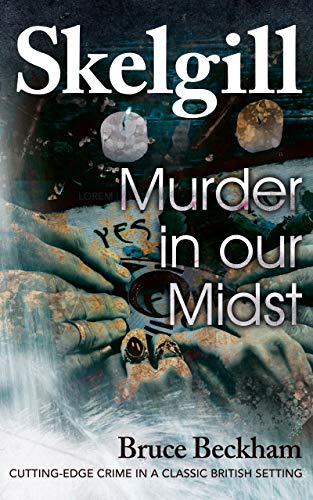
‘Murder In Our Midst,’ by Bruce Beckham

If you’re looking for big thrills, Bruce Beckham’s Inspector Skelgill mysteries are generally not for you. These stories take the cozy route, most of the time, and the plot of Murder In Our Midst is pretty much right out of Agatha Christie.

The school clique that centered around beautiful Daisy Mills decades ago has gathered again at a lodge in the English Lakes District, to support her after the death (by poisoning) of her third husband. For fun, they bring out a Ouija board, and the planchet spells out something about murder. The next morning, Daisy is found drowned in a pool near a waterfall.

When the police call goes out, Inspector Skelgill and DS Jones are in a boat on a nearby lake. He’s trying to teach her fly fishing. They answer the call and start interviewing witnesses. Evidence indicates murder, so it becomes a question of evaluating alibis. In some ways, we never really get out of high school; old loves and hatreds still endure…

I enjoy the Skelgill series, and the quiet nature of the stories has something to do with it. These books are almost as much about appreciation of the charms of the scenery as about murders and characters. Murder In Our Midst was not one of my favorites. It was the kind of story where you have to keep track of a lot of characters, some of whom aren’t all that memorable, along with various time lines.

But it was kind of like time with old friends, so I won’t pan the book.

I’ll say this – I hope this is a series where characters age slower than in real time. Because if DS Jones is waiting for Skelgill to make a romantic move on her, I fear she’s going to be waiting a while.

‘Aura Lea’

Another week has been transferred to history’s OUT box. On balance, it won’t be remembered by future biographers as one of my better ones. But it could have been worse.

No word about the car, of course. I keep hoping the July 30 date they gave me for part delivery was only a worst-case scenario, but we live in a fallen world. (In the Garden of Eden, I’m sure, car parts always arrived on time.)

Then there was my struggle to find a new lawn guy, which I chronicled yesterday. I’ve determined to leave the final decision until Monday, because I still want to talk to the guy who put a flyer up at my church. But if he doesn’t show this weekend, I’ll go with one of the Home Advisor sharks.

Had a couple plumbers over today, to look at my water heater, which has been making disquieting banging noises. The diagnosis? Sludge build-up – no doubt due to the high mineral content of our local water. Recommendation: new water heater. Which my home warranty program should pay for, but there will be the deductible. I expect that will be in addition to the deductible I already paid for the plumber’s visit today.

What else? I just put a package in the mail to Sweden. There’s a company (I won’t say its name) that advertises Viking accouterments on Jackson Crawford’s YouTube channel. I sent away to them for a linen tunic, because I wanted a new under-tunic (the ones I’ve been wearing are getting threadbare). I ordered XXL, and got it, and it was too small. So I ordered a XXXL, and that was too small too.

I mean no offense to Swedes when I say that their definition of “large” is somewhat different from mine. And I’m well aware that Americans in general, and I in particular, are way too fat. Which is too bad, because it seems to be well-made product.

But the fact remains that these shirts aren’t suited to a large segment of the American market. To add injury to ignorance, the return postage cost almost what one of the shirts cost me.

Little shocks to the bank account; they add up. But those are the terms of my life these days – the Lord provides. And sometimes I need to make small economies.

On the plus side, I’ve made substantial progress on King of Rogaland. I feel at this point that I’m beginning to get a handle on the project. In fact, I think this could be the best book I’ve ever written. I think I’m a better artist than I was 45 years ago, which ought to be expected, or I’m doing something wrong.

The song in the video above is “Aura Lee,” an American piece sometimes attributed (wrongly) to Stephen Foster. The lyrics were in fact written by the American poet W. W. Fosdick, who died in 1862, aged 37. The melody was by an English immigrant, George R. Poulton, who died in 1867, aged 38 (according to Wikipedia, he was tarred and feathered in 1864 for having an affair with a young student).

The song was published in 1861, and became tremendously popular with soldiers on both sides of the Civil War. One can understand why. I’ve always loved it. Elvis Presley used the melody for his song “Love Me Tender,” but I prefer the original. This rendition is done in period style by the 97th Regimental String Band.

May sunshine come along with your weekend, and swallows in the air.

Wanting mower

Photo credit: Daniel Watson @danielwatsondesign. Unsplash License.

What did I worry about before I owned a house? I’m sure there were issues, but that was in another time and another place…

Anyway, right now my concern is lawn mowing. I gave up doing it myself when my hips went bad; I’ve officially declared lawn mowing A Thing I’m Too Old to Do, like climbing ladders and enlisting in the Navy Seals.

I used to have a guy. A cheerful fellow who may not have been the best, but didn’t charge a lot. Last year, I noticed, he came around less and less often. And sometimes I had to call him and ask whether he was still in business. Then this year, he showed up and told me that from now on he wanted to be paid in cash.

I didn’t like the sound of that. The next time he came, I paid him with a check and told him I needed to do it that way, for my tax records. Which is true.

He has not shown up since. So I started looking for a new guy. I called one guy who put up a flyer at my church, but so far he hasn’t had time to come and look around. Which doesn’t bode well.

Then I did an inquiry through Home Advisor. And now I do not lack for applicants. I’ve had several calls today. Oddly enough, they all make pretty much the same pitch, and ask pretty much the same price. (I suspect they collude, like a cartel.) So I guess I could just pick one.

My problem now is, I don’t want to hire any of them.

I said their proposals were similar. Another similarity is their salesmanship. They try to keep me on the line until they can wear me down. They try to hold me hostage till they can close that deal.

I am well-known to be a pushover. I’m easily bullied.

But one thing I won’t do, is say “yes” when I’m not ready. If one of these guys had just said, “Here’s what I’m offering – think it over and get back to me,” I’d be his huckleberry.

I’ll probably end up hiring the one I hated least.

‘Fatal Decision,’ by Ted Taylor

I had an on and off relationship with this book, as a reader. Ted Taylor’s Fatal Decision is the first of a series about a former English police detective enticed out of retirement to lead a cold case unit in the city of Devizes. At the beginning I found it kind of slow; then I warmed to it; but in the end the author lost me.

Gus Freeman is our hero. He retired from the force three years ago, but lost his wife six months later. Since then he’s been kind of rudderless, spending a lot of time on his “allotment” (a patch of ground leased for public gardening).

Then his former superior gives him a call. They want to set up a new cold case unit. Modern police science is quite good at identifying criminals, but their thinking is that, in cases where criminals have sidestepped forensics and computers, good, old-fashioned cop experience and instinct might turn up new clues.

Gus agrees, on a test basis, not convinced he has anything to offer an up-to-date force. He is introduced to his (calculatedly diverse) team of young detectives, and they start by looking into the murder of Daphne Tolliver in 2008. Daphne was a retired postal worker, much liked in her community, whose head was bashed in while she was walking her dog. Gus finds his new team bright and eager, and they soon start learning things earlier detectives missed. It will all end in a major scandal.

At first I found Fatal Decision pretty slow reading. We begin with the lead-up to the murder, but then the author moves to a prolonged segment that just describes Gus’s quiet life as a retired cop. He’s likeable enough, but most authors would prefer to get straight to the mystery and fill the background stuff in as they went along. I suspect a lot of readers will lose patience with this part.

Once Gus goes back to work, things pick up. Author Taylor does a good job with characters. His are layered, and capable of surprising us – something I always like. So I grew more interested.

But a point came when we were informed of one of the characters’ politics. And the moment I read that, I knew with moral certainty who the culprit was, and what their motive was. The author had fallen into a plot trope that was fresh quite a long time ago (like when I was young), but has been used so many times – both on the printed page and on screen – that I can’t imagine every other reader won’t figure it out too. In short, I felt insulted – both as a reader and in my beliefs.

Final evaluation – the book had some virtues, but the slow start and the threadbare “surprise” outweigh them in my estimation. Not recommended.

Vision and re-vision

Yesterday and today have been quiet days for me, for reasons I won’t itemize. Suffice it to say I’ve been unwell, in a manner that makes leaving the house inadvisable. I think I’m beginning to recover now. No great distress, just… inconvenience.

And no, there’s no fresh news about my car. They told me the end of the month; kind of pointless to nag them until then. Maybe I’ll just keep the loaner and call it even.

But I’m working on my revisions to King of Rogaland. At this stage I’m working with red pen on a printed manuscript, rather on screen. There are two reasons for this. One is that ink on paper just reads differently for me. That’s an odd thing to say for someone who reads almost exclusively on Kindle. But I don’t feel I can “grasp” my manuscript until I’m literally grasping an inch or so of ream in my hands.

The second, more practical reason is that I often have to page back and forth to see if one passage about a character or subject matches things I’ve written about it elsewhere. Continuity, it’s called. I find that a whole lot easier to do with physical paper. Riffling through dead tree pages is different from scrolling through screen pages, and it feels less daunting.

What I’m doing at this stage is, I’m becoming a student of my own book. I wrote it all, but I wrote it in various moods and states of alertness. There are themes there I need to bring out, and rabbit trails I need eliminate. In a sense the book itself is telling me what it wants to be. I just have to listen to it.

Do I like what I’m reading?

As a matter of fact, I do. I even find it moving in spots.