I have a new column up at The American Spectator Online today: Slaves to Intellectual Fashion: 1619. A little more fiery and dismissive than my usual stuff, I think. This particular initiative gets my goat in a personal way. I consider it slander against a country I love and am grateful for.
The weekend was good, thanks for asking. We had a couple Viking groups at Nisswa, Minnesota for a one-day Viking event on Saturday. I took a few pictures, but they weren’t very good. Having 2 groups together made it possible to have some relatively impressive battles, with (I guess) 15 to 20 guys all together. I did not participate in those. I sat in my pavilion in Viking splendor, dispensing wisdom and information to all comers. Also selling books.
It was nice, the weather was beatiful, and I stayed with some very gracious hosts in Brainerd. All in all, pretty rewarding. The scuttlebutt is that the event will happen again next year.
If you’re in the Bemidji Minnesota area tomorrow, a lot of bloodthirsty Vikings will be gathered there for a brand new festival. I shall be among them, spreading sunshine on my way, as is my wont. Books shall be bought and sold.
This isn’t a review, just a signal-boosting mention of a new book by a woman I used to know online. We haven’t been in contact for a while, but Mary Grabar has obviously been fighting the good fight. She just released Debunking Howard Zinn, a book on Howard Zinn’s influential A People’s History of the United States. From the blurb:
Howard Zinn’s A People’s History of the United States has sold more than 2.5 million copies. It is pushed by Hollywood celebrities, defended by university professors who know better, and assigned in high school and college classrooms to teach students that American history is nothing more than a litany of oppression, slavery, and exploitation.
Zinn’s history is popular, but it is also massively wrong.
Scholar Mary Grabar exposes just how wrong in her stunning new book Debunking Howard Zinn, which demolishes Zinn’s Marxist talking points that now dominate American education.
I have approval now to tell you about another Norwegian TV miniseries I helped translate. You may recall the name Wisting, because I reviewed several of the books on which this series is based, written by Jørn Lier Horst. I couldn’t say it at the time, but I got interested in the books when I worked on the TV scripts (though I admit I only helped with a couple). The books seem to be out of print in English right now, but I suspect they’re preparing a new edition to tie in with the miniseries.
Should be interesting. It’s been broadcast in Norway already,
so I would look for it to show up on Netflix or something before very long.
Recommended, with cautions for the sort of things you’d expect.
Robert Crais switches off between books starring his private detective character, Elvis Cole, and books starring Joe Pike, Elvis’s associate, whose actual vocation is security and covert ops. The Elvis books are notable for the main character’s charm – he’s a laid back, slightly flippant character. Joe Pike is his dark shadow – grim and taciturn, physically conditioned and in perfect control of his body and reactions. He rarely speaks, wears sunglasses almost all the time, and lives an ascetic, squared-away life.
A Dangerous Man is (as you might have guessed) primarily a Joe Pike book. Joe is at the bank one morning when he witnesses the attempted abduction of one of the tellers, Isabel Roland (who has a secret crush on Joe). Joe intervenes and rescues the girl. Soon afterward the kidnappers are mysteriously released on bail and murdered. Then Isabel disappears again.
Nobody has hired Joe, but he makes it his case. He feels responsible. To locate Isabel, he needs to find out why a not very well-to-do bank teller would be kidnapped (this is Elvis’s job). The investigation will uncover old ties to Isabel’s parents, drug dealers, the witness protection program, and a whole lot of missing money.
The special delight of a Joe Pike novel is the moments when
we peek behind his armor. Joe is so stolid that he almost counts as a type
rather than a character. But that makes those rare human moments shine through
like sunbeams.
A Dangerous Man was an extremely satisfying read. Highly recommended, with mild cautions for language and violence.
A popular fact-checking, myth-busting website has been in something of a stare-down with a popular Christian satire site over everyone’s favorite topic since 2016–fake news. Worries flare over the possibility that readers will take headlines like this, “Portland Police: ‘We Wish There Were Some Kind Of Organized, Armed Force That Could Fight Back Against Antifa’,” as actual reporting.
Christianity Today’s “Quick to Listen” podcast interviewed an editor of the biggest Christian satire and humor magazine in our lifetime on that topic and what Christians should expect from satire.
The Wittenberg Door and other Christian satire at its best would be like the little boy in the old fable who was the only one who would say the king is buck naked. Everybody else was just nodding about how well-dressed the king was. Well, good satire is sometimes that little boy who points out what we’re all either afraid to say or just overlooking.
Court realized that people here in the U.S. were nicer to strangers than in the other places he’d traveled in the past five years–when they weren’t shooting you in the ribs, that was. And while Court had no problem with politeness, for a man who lived his life moving through society without leaving a trace, this was problematic.
In a fictional series, it seems to me, the reader expects a certain familiarity. The story ought to be the same kind of story as those that preceded it. But it can’t be too familiar. Mark Greaney does a very good job rejiggering the formula in his Gray Man novels, starring white hat international assassin Courtland Gentry, formerly of the CIA, now hunted by them.
Back Blast provides a dramatic new wrinkle — Court is finally back in the US. For five years, he’s been a man without a country, living in the shadows on several continents, taking contract hit jobs (but only against bad guys). He’s a consummate martial artist, a dead shot, and a master of camouflage — even in urban environments. But now, thanks to a grateful friend in Mossad, Court is back home. He’s in the Washington DC area, and he’s identified his target — Denny Carmichael, operations chief of the CIA. Denny put the kill order out on Court, and Court wants to know why. He wants it fixed. He wants to come home.
But Denny has deep and dark secrets to protect. His resources are almost unlimited. He has a plan — a devious and ruthless one — not only to kill or capture Court, but to make Court the scapegoat for his own crimes. It’s a David and Goliath fight — but this David is no simple shepherd boy. He does, however, have a big shock in store for him.
Lots of fun. Very satisfying. Be prepared to suspend your
disbelief, of course, and enjoy the ride.
Cautions for language and violence, but not too bad. Recommended,
like the whole series.
Years ago, author Randy Alcorn was a pastor, participating with his church in some resistance work at the local abortion clinic. For that work the courts penalized him and other members of the team thousands of dollars to be paid to the clinics. They would not pay. More court hearings came with more penalties, eventually landing the group in a jury trial before an angry judge.
“On February 11, 1991, nine of the twelve jurors agreed to award the abortion clinic $8.2 million dollars, averaging about $250,000 per defendant. It was the largest judgment ever against a group of peaceful protestors. “
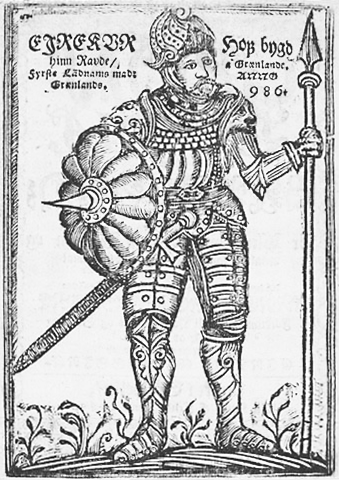
Scrupulously researched portrait of Erik the Red from Arngrimur Jonsson’s Gronlandia (ca. early 17th Century).
Sorry about the lack of a post last night. I actually posted one, and WordPress disappeared it. It vanished into the ether, like a childhood friend of Stalin. I don’t know what my sin was.
Let’s see if this one stays up.
Last night’s post wasn’t anything you’ll miss much, just a reminiscence from my childhood. Not even very dramatic. Maybe I’ll write about it again someday.
One of today’s big news stories is that President Trump, apparently, would like the US to purchase Greenland.
It ain’t gonna happen, according to the Danes. They have no need, or wish, to part with one of the very few remnants of their once-extensive empire.
And after all, people live in Greenland. I would hope they’d have a say in the matter.
Still, it’s an intriguing thought. It occurs to me that Donald Trump and Erik the Red, settler of Greenland, are kindred souls.
Both are larger-than-life characters, combative, practiced in self-promotion. The saga famously says that Erik called his country Greenland “because people would be more inclined to move there if it had a pleasant name.”
Thus he’s been called the first real estate developer.
I like to think that if Erik and Donald could meet, they’d take to one another right off. Sit down over some mead (though I understand Pres. Trump doesn’t drink) and talk deals.
I suspect Erik could have been talked out of Greenland, for
a sweet enough offer.
A multitude of stories of courage and endurance come out of World War II. Surely one of the most remarkable is that of Jan Baalsrud (pronounced “Yon Bowls-rood”), the subject of the book, The 12th Man by Astrid Karlsen Scott and Tore Haug. (If you see a book called Defiant Courage, it’s the same book. They changed the title to go with the release of a 12th Man movie a couple years back.)
Jan Baalsrud was one of a team of 12 saboteurs who sailed to Norway from Scotland in a fishing boat as part of a “Shetland Bus” operation in 1943. They were to deliver arms, munitions and supplies to the Resistance, and to attack some air bases. Tragically, a missed connection led to their betrayal, and a German patrol ship attacked them. They managed to blow their boat up, but the whole team except for Baalsrud were either killed on the spot or captured, tortured, and executed. Baalsrud himself escaped into the mountains with one foot bare and wounded.
Then followed months of working his way eastward toward the Swedish border through some of the roughest terrain in the world. He endured an avalanche, starvation, frostbite, gangrene (he amputated his own toes) and snow blindness. He received help and supplies from scattered farms along the way, but when he finally came to the great mountains around Manndalen he was unable to go further under his own power. He then became dependent on a team of Resistance sympathizers in the area who – in spite of killing weather and repeated missed appointments – refused to let this brave man die.
It’s a harrowing, almost unbelievable story. It was first publicized (I believe) by David Howarth in his book The Shetland Bus. Later he devoted a whole book, We Die Alone, to the tale.
Unfortunately (the authors report) Howarth didn’t get the
whole story. Apparently, the Norwegians he interviewed were suspicious of him,
and did not tell him everything they knew. Authors Scott and Haug spent five
years interviewing surviving participants and combing the records, in order to
provide what they believe to be an accurate account.
Sadly, their book isn’t very well written. Ms. Scott and Dr. Haug describe themselves as co-authors, but to me The 12th Man reads exactly like a bad translation (and I know bad translations). The phrasing is consistently Norwegian (hence awkward in English), the word choice poor. I wish I could say otherwise, but the book needed a good editor badly. I’m not quite satisfied with a few passages in Viking Legacy, but I felt better after reading this.
But if you can deal with the clumsy writing, it’s one heck
of a story. Cautions for intense situations.
Websites store cookies to enhance functionality and personalise your experience. You can manage your preferences, but blocking some cookies may impact site performance and services.
Essential cookies enable basic functions and are necessary for the proper function of the website.
Name
Description
Duration
Cookie Preferences
This cookie is used to store the user's cookie consent preferences.
30 days
These cookies are needed for adding comments on this website.
Name
Description
Duration
comment_author
Used to track the user across multiple sessions.
Session
comment_author_email
Used to track the user across multiple sessions.
Session
comment_author_url
Used to track the user across multiple sessions.
Session
These cookies are used for managing login functionality on this website.
Name
Description
Duration
wordpress_logged_in
Used to store logged-in users.
Persistent
wordpress_sec
Used to track the user across multiple sessions.
15 days
wordpress_test_cookie
Used to determine if cookies are enabled.
Session
Statistics cookies collect information anonymously. This information helps us understand how visitors use our website.
Google Analytics is a powerful tool that tracks and analyzes website traffic for informed marketing decisions.
Used to monitor number of Google Analytics server requests
10 minutes
__utmb
Used to distinguish new sessions and visits. This cookie is set when the GA.js javascript library is loaded and there is no existing __utmb cookie. The cookie is updated every time data is sent to the Google Analytics server.
30 minutes after last activity
__utmc
Used only with old Urchin versions of Google Analytics and not with GA.js. Was used to distinguish between new sessions and visits at the end of a session.
End of session (browser)
__utmz
Contains information about the traffic source or campaign that directed user to the website. The cookie is set when the GA.js javascript is loaded and updated when data is sent to the Google Anaytics server
6 months after last activity
__utmv
Contains custom information set by the web developer via the _setCustomVar method in Google Analytics. This cookie is updated every time new data is sent to the Google Analytics server.
2 years after last activity
__utmx
Used to determine whether a user is included in an A / B or Multivariate test.
18 months
_ga
ID used to identify users
2 years
_gali
Used by Google Analytics to determine which links on a page are being clicked
30 seconds
_ga_
ID used to identify users
2 years
_gid
ID used to identify users for 24 hours after last activity
24 hours
_gat
Used to monitor number of Google Analytics server requests when using Google Tag Manager
1 minute
_gac_
Contains information related to marketing campaigns of the user. These are shared with Google AdWords / Google Ads when the Google Ads and Google Analytics accounts are linked together.
90 days
Marketing cookies are used to follow visitors to websites. The intention is to show ads that are relevant and engaging to the individual user.
A video-sharing platform for users to upload, view, and share videos across various genres and topics.
Registers a unique ID on mobile devices to enable tracking based on geographical GPS location.
1 day
VISITOR_INFO1_LIVE
Tries to estimate the users' bandwidth on pages with integrated YouTube videos. Also used for marketing
179 days
PREF
This cookie stores your preferences and other information, in particular preferred language, how many search results you wish to be shown on your page, and whether or not you wish to have Google’s SafeSearch filter turned on.
10 years from set/ update
YSC
Registers a unique ID to keep statistics of what videos from YouTube the user has seen.
Session
DEVICE_INFO
Used to detect if the visitor has accepted the marketing category in the cookie banner. This cookie is necessary for GDPR-compliance of the website.
179 days
LOGIN_INFO
This cookie is used to play YouTube videos embedded on the website.