Tonight, like your high school teacher when he had a hangover and couldn’t face the prospect of lecturing, and so rolled out the old film projector, I once again fall back on video, bereft of useful ideas. I happened to be watching one of the old Inspector Dalgliesh mysteries with Roy Marsden, and Joss Ackland showed up in the cast. That always reminds me of his tour de force performance as C. S. Lewis in the original 1985 BBC television film of Shadowlands – which in my opinion remains the only watchable version. The travesty Richard Attenborough foisted on the public in 1993 was not actually about C. S. Lewis, but about some imaginary scholar Attenborough made up, who was emotionally stunted until being saved by True Love. (I’ll stipulate that Debra Winger was better as Joy Davidman than Claire Bloom was – purely because she was more abrasive. That is, in my opinion, almost the theatrical film’s only virtue.)
This version, excerpted above, is much closer to the original events, and to Lewis’ personality. Douglas Gresham praised Joss Ackland’s performance as his stepfather. Ackland didn’t much resemble Lewis, except in physical bulk, but he had a similar booming voice, and he seems to have sought out ways to make his performance authentic.
The clip above dramatizes the critical point in the plot where Joy, stricken with cancer and newly married to Jack Lewis, experiences a remission and goes home to the Kilns to live with Jack, his brother, and her two sons (there were, in fact, two boys – one got cut in the transition from small to large screen).
Joss Ackland usually played villains or rather nasty people (one exception was a cameo as D’Artagnan’s father in Richard Lester’s The Three Musketeers). I would pay considerable money (if I had any) for a voice like his. I looked him up on Wikipedia, and found that he died last November. 95 years old, which is a good run.
Joss Ackland and Claire Bloom in the 1985 “Shadowlands”
My metaphorical Advent calendar opened today and dispensed paying translating work. This is excellent. I’ve been idle for a couple months, and I can use the income. An interesting project, too.
So, little time for reading and no book to review today. Of what shall I write?
I watched the Most Reluctant Convert movie, as I said. Then I watched it again. And last night I thought, “Might as well watch Shadowlands too, and close the circuit.” And when I say Shadowlands, I mean, of course, the original 1985 BBC production with Joss Ackland and Claire Bloom. The 1993 version, with Anthony Hopkins and Debra Winger, isn’t even on my radar. I watched it once and was unimpressed (except by Winger, who is much closer to the real Joy Davidman than the refined Claire Bloom. But otherwise the 1985 version is more authentic and more concerned with the characters’ Christian faith. My impression of the 1993 movie is that it portrays Lewis as an immature man rescued by True Love. And his Christianity is regarded as one of his immature traits).
Anyway, you get a pretty good overview of Lewis’ life by watching the two movies in sequence. The Most Reluctant Convert offers a fairly authentic (though necessarily incomplete) picture of Lewis’ life up to his conversion. Shadowlands (if you watch the right version) gives a broadly decent impression of what happened in his later years, when he got married and suffered bereavement and a crisis of faith.
Of course, it’s an incomplete picture, as any cinematic portrayals must be. The Most Reluctant Convert leaves out much of the story, notably Lewis’ unhappy time in English public schools (what we’d call private academies in this country). And the book it’s based on, Surprised by Joy, omits much in the first place. In particular, Lewis’ domestic life with Mrs. Moore, the mother of a friend killed in the Great War, whom Lewis cared for in fulfillment of a promise to that friend. He wouldn’t have liked that story re-told; it began in infatuation in his atheist days and was transformed into voluntary servanthood after his conversion.
Shadowlands is a moving story, but heavily tailored to its dramatic form. Jack’s and Joy’s marriage actually lasted four years – her sons were nearly grown and away at school when she died. The affecting scene at the end where Jack and the boy Douglas Gresham grieve together never happened – sadly.
Most of all I was wondering what Jack himself would have thought about all this bother. And I thought I’d ponder that tonight in this post, to see if I could figure out what I think. I’m pretty sure Jack would have been mortified by the whole business. Aside from his personal modesty, there’s the fact that he deplored any examination of a writer’s life in order to interpret his work. The work, he frequently insisted, must stand on its own. It’s not for the critic to poke around in the author’s history and personality, hunting for repressions and obsessions.
Although I’m pretty sure he didn’t object to Boswell’s Life of Johnson. Because that’s a work of literature in its own right.
However, the two films I’m discussing are works of art in their own rights too. So does that make it OK?
Well, we have to deal with things as they are, I suppose. Whether he liked it or not, Jack Lewis was an interesting man. And people who love his books frequently want to know more about the man who wrote them.
This interest, surprisingly, even generally survives their first exposure to a picture of Lewis, something he himself described as a “most undecorative object.”
Maybe – and I’m very likely projecting here – it’s the fact that people experience Lewis’ writings as letters from a friend. We’d very much like to have a friend like that. Friendship is an experience that’s fallen on hard times in our evil world. Lewis had a splendid gift for friendship, as we know from his life story.
I know what he’d say to that, though – “Do you live on a deserted island? Is there no church in your community? You might be surprised what qualities lie concealed in the people in the next pew.”
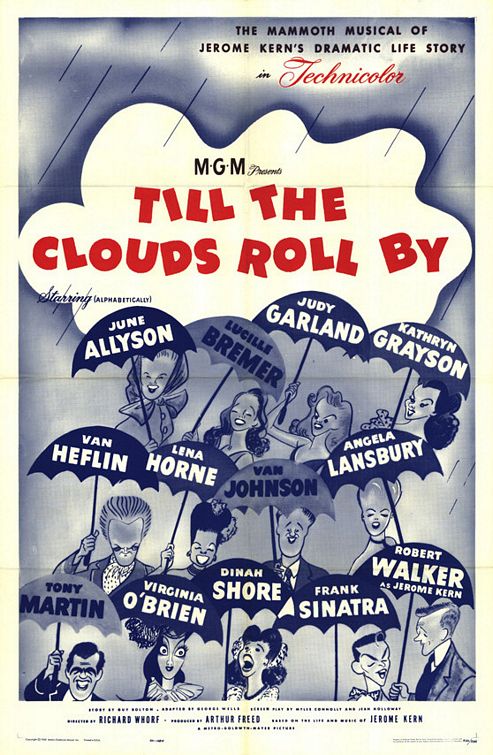
I caught an old movie the other day. “Till the Clouds Roll By,” starring Robert Walker (no relation). It’s a biographical film, based on the life of Broadway composer Jerome Kern.
I like old movies in general, but this one interested me because I knew Kern wrote along with P. G. Wodehouse and Guy Bolton in his early years, doing a lot to invent the American musical comedy as we know it. Up until their time, Broadway musical plays had been mostly adaptations of European ones. This team, plus a few others, invented more character-centric stories, where the songs always advanced the plot. I wondered how the movie would treat that collaboration.
They treated it, in typical Hollywood fashion, by replacing
it entirely. In the movie, instead of working with various collaborators, the
young Kern teams up with a fictional older lyricist named Jim Hessler (Van
Heflin). The Hessler character comes fully equipped with a fictional family,
including a young daughter who becomes a surrogate little sister to Kern, and
adds dramatic conflict to the third act so that all can be resolved in the big
musical climax.
That got me thinking about the subject of fictional
characters. That is, fictional characters included in real life stories, in
order to avoid using real people – who sometimes sue you (or their heirs do) if
they don’t like the way they’ve been depicted. (Movies were made about Wyatt
Earp before his widow died, but they had to change his name, because she
refused to give approval.)
Perhaps the most famous case is Shakespeare’s Sir John Falstaff, introduced in Henry V, Part 1. Falstaff was a stand-in for a genuine historical figure named Sir John Oldcastle. Oldcastle had a similar career to the fat man in the play, except that he joined the Lollards, the proto-Protestant followers of Wycliffe, and eventually died a martyr’s death, roasted over a fire. His descendants, who were influential, made it very clear that they did not want their ancestor belittled, so Will Shakespeare just wrote Oldcastle out, replacing him with Falstaff. Probably just as well.
In both versions of “Shadowlands,” the film about C.S. Lewis’s marriage to Joy Davidman (I prefer the original BBC version), we see Jack together with his friends, the Inklings, debating, laughing, smoking pipes, and drinking beer. Except for his brother Warnie, who plays a major role in the play, all these friends are fictional. There is no J. R. R. Tolkien there, nor any Hugo Dyson or Owen Barfield. Including them (especially Tolkien) would have been a distraction, I imagine. The audience would be trying to identify them rather than following the story.
And they all had living families, always potential complications.
It makes perfect prudential sense to fictionalize.
And yet I always feel a little cheated when it’s done.
Websites store cookies to enhance functionality and personalise your experience. You can manage your preferences, but blocking some cookies may impact site performance and services.
Essential cookies enable basic functions and are necessary for the proper function of the website.
Name
Description
Duration
Cookie Preferences
This cookie is used to store the user's cookie consent preferences.
30 days
These cookies are needed for adding comments on this website.
Name
Description
Duration
comment_author
Used to track the user across multiple sessions.
Session
comment_author_email
Used to track the user across multiple sessions.
Session
comment_author_url
Used to track the user across multiple sessions.
Session
These cookies are used for managing login functionality on this website.
Name
Description
Duration
wordpress_logged_in
Used to store logged-in users.
Persistent
wordpress_sec
Used to track the user across multiple sessions.
15 days
wordpress_test_cookie
Used to determine if cookies are enabled.
Session
Statistics cookies collect information anonymously. This information helps us understand how visitors use our website.
Google Analytics is a powerful tool that tracks and analyzes website traffic for informed marketing decisions.
Used to monitor number of Google Analytics server requests
10 minutes
__utmb
Used to distinguish new sessions and visits. This cookie is set when the GA.js javascript library is loaded and there is no existing __utmb cookie. The cookie is updated every time data is sent to the Google Analytics server.
30 minutes after last activity
__utmc
Used only with old Urchin versions of Google Analytics and not with GA.js. Was used to distinguish between new sessions and visits at the end of a session.
End of session (browser)
__utmz
Contains information about the traffic source or campaign that directed user to the website. The cookie is set when the GA.js javascript is loaded and updated when data is sent to the Google Anaytics server
6 months after last activity
__utmv
Contains custom information set by the web developer via the _setCustomVar method in Google Analytics. This cookie is updated every time new data is sent to the Google Analytics server.
2 years after last activity
__utmx
Used to determine whether a user is included in an A / B or Multivariate test.
18 months
_ga
ID used to identify users
2 years
_gali
Used by Google Analytics to determine which links on a page are being clicked
30 seconds
_ga_
ID used to identify users
2 years
_gid
ID used to identify users for 24 hours after last activity
24 hours
_gat
Used to monitor number of Google Analytics server requests when using Google Tag Manager
1 minute
_gac_
Contains information related to marketing campaigns of the user. These are shared with Google AdWords / Google Ads when the Google Ads and Google Analytics accounts are linked together.
90 days
Marketing cookies are used to follow visitors to websites. The intention is to show ads that are relevant and engaging to the individual user.
A video-sharing platform for users to upload, view, and share videos across various genres and topics.
Registers a unique ID on mobile devices to enable tracking based on geographical GPS location.
1 day
VISITOR_INFO1_LIVE
Tries to estimate the users' bandwidth on pages with integrated YouTube videos. Also used for marketing
179 days
PREF
This cookie stores your preferences and other information, in particular preferred language, how many search results you wish to be shown on your page, and whether or not you wish to have Google’s SafeSearch filter turned on.
10 years from set/ update
YSC
Registers a unique ID to keep statistics of what videos from YouTube the user has seen.
Session
DEVICE_INFO
Used to detect if the visitor has accepted the marketing category in the cookie banner. This cookie is necessary for GDPR-compliance of the website.
179 days
LOGIN_INFO
This cookie is used to play YouTube videos embedded on the website.