
New YouTuber Gavin the Medievalist breaks down what he found in Tolkien’s translation and commentary of the Old English epic Beowulf and whether you should be reading it in 2025.
Category Archives: Fiction
‘Foreclosure,’ by S. D. Thames

She wiped her eyes, smudging more grime around her eyes. “I remember when you started here out of law school. You seemed different than the others.”
“I take that as a compliment.”
“But you’ve changed, David.”
“I’ve grown up.”
She shook her head. “You’re really just like them now. And they’ll own you soon. Once you make partner, they’ll own you.”
Browsing through my old reviews, I found one of my posts on the novels of S. D. Thames, all of which I had enjoyed quite a lot. I realized I hadn’t read any of his books in a while, so I did a search on Amazon. Turned out he hasn’t put out any more of his Milo Porter novels, but there was a stand-alone I hadn’t read, from way back in 2015 – Foreclosure. I read the book and it impressed me. Think John Grisham, but darker and grittier.
David Friedman is a tough, scrappy Jersey boy, fighting to make partner as a real estate lawyer with a big South Florida firm. As the book begins, he’s furious at being denied a promised partnership. It’s the bad economy, his bosses say.
But one of them offers him a deal – acquire real estate developer Frank O’Reilly as a client. O’Reilly is facing big litigation over a condominium foreclosure, and if David can bring him in and win the case by the end of the year (2007), he’ll get his partnership.
Of course, Frank O’Reilly is the slimiest developer in all of Florida (which is saying a lot), crude and corrupt and cruel-minded. But David knows he can deal with that. If he has to make some ethical compromises, tell a few lies, even ruin a few lives, that’s all part of the game.
But he has no idea what this case will cost him, nor how close it’ll bring him to losing not only his career, but his very life. Not to mention his soul.
Foreclosure is a Christian novel, but of the better sort – better than my novels in the sense that the Christian message is implied, not baldly spelled out. It is, sadly, the kind of book that often fails to please the Christian audience, due to frank language and dark topics. The kind of book Andrew Klavan is writing today, with greater success.
I assume that Foreclosure didn’t sell well, because author S. D. Thames seems to have switched to the light Milo Porter series, and doesn’t seem to have done any publishing at all since before 2020.
I hope he’s all right.
In any case, Foreclosure is an excellent legal thriller for the mature reader. There are occasional rough spots in the writing, but overall I liked it a lot, and recommend it.
‘So Cold the River,’ by Michael Koryta

Artifacts of their ambition. Only through study of those things could you truly understand people long departed…. The reality of someone’s heart lay in the objects of their desires. Whether those things were achieved did not matter nearly so much as what they had been.
Eric Shaw, hero of Michael Koryta’s So Cold the River, is a failure in life. That’s his view of himself, and he confirms it constantly by self-sabotaging. He was a rising cinematographer in Hollywood, until he lost his temper and made himself radioactive in the industry. Now he’s home in Chicago, subsisting through making memorial films for funerals. He recently succeeded in driving his wife away too.
A wealthy woman, impressed with one of his films, offers him a well-paying project. She’d like him to go down to Indiana to research the early life of her father-in-law’s father, a very rich man who was always secretive about his origins. It’s supposed to be a gift.
Eric goes down to the area of French Lick, Indiana, where he finds two towns, each with surprisingly lavish old hotels, relics of the 1920s, when the area was a popular location for spas. It was famous for its mineral water, which connects to the only artifact Eric’s client was able to offer him as a clue to the old man’s story – a bottle of cloudy water, bottled back in the glory days.
Eric makes one major mistake. As an experiment, he drinks some of the old water to treat a headache. First it makes him deadly sick. Then he starts seeing vivid visions of the past. Before long, Eric realizes the water is addictive – and he only has a limited supply.
Meanwhile, an elderly widow in the area is watching the sky. She’s been a weather tracker for many years, and she can tell a very unusual storm system is approaching.
I feel I’m doing a bad job describing how very well So Cold the River works. It reminded me (if I may be forgiven for the comparison) to my own novel, Wolf Time – though I fear Michael Koryta has done a better job here of constructing an epic urban fantasy/ghost story. (You can even find Christian themes if you like, though I’m not sure they’re intended. I was particularly impressed by the way the story treats one particular, unexpected hero.)
It’s a very cinematic story, and indeed it has been made into a movie – though (surprise, surprise) they gender-swapped most of the main characters.
Nevertheless, I enjoyed So Cold the River very much. I recommend it highly.
‘The Cypress House,’ by Michael Koryta

She was that kind of beautiful. The crippling kind.
Probably later than any other fan, I’ve figured out that most (maybe all, for all I know) of Michael Koryta’s supernatural thrillers involve the same family. Arlen Wagner, hero of The Cypress House, seems to be the grandfather of Mark Novak, hero of the two books I previously reviewed.
Arlen grew up in West Virginia, and still carries the shame of having a crazy father who thought he could converse with the dead. Now he’s a veteran of World War I, and working for the Civilian Conservation Corps. He’s on a train with a group of other CCC men, headed to Florida to help construct a bridge to the Keys.
That’s when he has a vision of all his fellow passengers turning into skeletons. Arlen has had this experience before, during the war, and he knows it means they’ll die soon. He tries to persuade the men to leave the train, but they laugh at him. The only one who gets off with him is a young man named Paul Brickhill, a mechanical genius for whom Paul has conceived paternal sentiments. Left at loose ends, the two men get a ride to the Gulf Coast, so Paul can look at the ocean. There they find the Cypress House, a lonely boarding house near a dying town, overseen by a beautiful woman. They don’t plan on staying long, but a hurricane blows in (fulfilling, down in the Keys, Arlen’s grim prophecy about the CCC workers), and by the time it’s blown over, Paul has fallen in love with the landlady. Also, Arlen has noticed that something shady is going on at the Cypress House. He stays on to protect the boy.
A lot of protection will be called for, and Arlen will have to make peace with his father’s legacy before he can save the lives of the people he cares about.
The Cypress House is a compelling thriller. The tension ratchets up steadily, and the final showdown is as exciting and surprising as you’d expect from Koryta. In the tradition of Dean Koontz, Koryta’s story dabbles in the supernatural, but not in a way to greatly bother Christians.
My only quibble was that the Florida nights in this story seemed to be remarkably mosquito-free (though the mosquitoes finally showed up when they were needed to contribute to the dramatic tension).
The Cypress House was a superior thriller, verging on the epic. Recommended.
‘Rise the Dark,’ by Michael Koryta

The Billings airport was built on a plateau above the city, and while the mountains were far off in the hazy distance, the big sky was right there on top of you. The Montana sky felt older than time and endless as space itself.
It was a humbling sky.
Pushing on through the second book in Michael Koryta’s Mark Novak series. I was a little disappointed in the previous book, Last Words. Rise the Dark made up for that, and more. The claustrophobia of the first book contrasted with the open heights of the second (Rise the Dark is about mountains and power line towers), lending epic scope to the narrative as a whole.
Markus Novak now knows the name of the man who murdered his wife Lauren. His investigation takes him to the one place he needs to see, but always feared to visit – Cassadaga, Florida, a community founded on spiritualism. Raised by a fraudulent psychic mother, Marcus has always had a horror of psychic claims. But when he goes there, and nearly gets murdered in a burning house, he comes away with the last notation in Lauren’s notebook – the words, “rise the dark,” as well as a clue as to where the murderer is headed – to a town in Montana where he lived a while as a boy, with his mother and his two outlaw uncles. On the way, he joins forces with a beautiful private detective.
Meanwhile, in Montana, a young wife is kidnapped by the leader of a doomsday cult. Her husband, a power line worker, is informed that if he wants his wife to live, he’ll have to help the cult carry out a major act of sabotage. What no one knows is that he’s lost his nerve. If he is to do this thing he does not want to do, he’ll have to go far beyond his personal limits.
Rise the Dark was an epic story, full of Michael Koryta’s trademark plot twists and surprises. It strays further into the occult than I like, but there’s an ambivalence about the topic that comforted me. It looks like more books are coming, and I look forward to reading them.
I found Rise the Dark highly compelling. Recommended, with the usual cautions.
‘The Houseboat Detective,’ by Jay Allan Storey

I am, as you’ve doubtless noticed, a sucker for mysteries about detectives who live on boats. This is due to a (fruitless) yearning for some second coming of Travis McGee. The Houseboat Detective by Jay Allan Storey was available for free, so I gave it a shot.
It wasn’t bad, but it was (perhaps intentionally) about the polar opposite of a Travis McGee story.
Jake Sommers does not live on a luxurious seagoing barge yacht like McGee, but on a quaint little houseboat, never intended to sail anywhere. And it’s docked more than a nation away from Fort Lauderdale – in Victoria, British Columbia. Jake inherited the boat from his hippie aunt. He ekes out a marginal living playing piano in a bar (he’s a talented musician, but lacks ambition), and he’s working on a serious drinking problem.
One of his neighbors, just to send him a wake-up call, puts up an online ad, advertising Jake’s services as a private investigator. (Jake has a little intelligence training, from the military, but has neither experience nor interest in the work.) But when Evangeline, a beautiful young woman, shows up at his houseboat, offering him money to locate her missing sister, he can’t resist. The woman tells him she never knew she had a sister, and the woman’s profile has now been pulled from the DNA testing site where she found it. Purely by trial and error, Jake begins to turn up leads, though the sister has left suspiciously few traces behind. Meanwhile, the mercurial Evangeline is fascinating him more and more. Even as it becomes increasingly clear that she’s been lying to him from the start.
I get the impression that author Storey is still learning his craft, but he shows some promise. Jake Sommers is an intriguing, wry character (though his bravery when the action starts is a bit surprising to the reader), but he could have been more effective if he’d been written in the first person (there was no plot reason not to). The prose could have used some cutting. It’s not awful, but meanders.
Still, not bad.
‘Last Words,’ by Michael Koryta

…He had called on every resource for survival and found that your resources didn’t matter much when you were lost in the dark. You needed help from outside the blackness then. That had been the most unsettling realization of his life. I cannot save myself.
A while back I picked up a novella by Michael Koryta, my latest author enthusiasm. It was called The Last Honest Horse Thief, and told a story about Marcus Novak, a young boy living an itinerant life in the American mountain west. His mother, whom he loved but was ashamed of, was a fraudulent psychic and con woman. The story told how he got a chance at a different life, but chose to go back to her, honoring what he felt to be his responsibility. Like all Koryta stories, it didn’t go where I expected it to, but was satisfying in its own way.
On picking up Last Words, the first book in a series, I discovered that the novella had been a prequel, and that Marcus Novak is the hero here. He’s grown up now, having happily fled the mountains that carried so many bad memories. Now he lives the good life in Florida, as an investigator for a nonprofit foundation that investigates wrongful death penalty convictions. Or rather, it was the good life, until his wife was murdered. Since then he’s been obsessed with discovering her killer – so that he’s close to losing his job.
To get him out of the board of directors’ sight, Marcus’ boss sends him to Indiana, to investigate a case that doesn’t even match their organizational criteria. Ten years ago, a teenaged girl was lost in a cave. An eccentric local spelunker brought her dead body out, claiming he’d lost any memory of finding her. Public opinion agrees that this man must have murdered her, but there’s no evidence, and he’s never been charged or convicted. He is, in fact, the one who asked the foundation to send an investigator, to settle the truth once and for all.
Marcus has no interest in going to Indiana, and doesn’t care about the case. The secret lies in the cave, and he doesn’t like caves. The secret also involves a hypnotist, and he doesn’t trust hypnotists. Still, he will get drawn into it, and dark truths will be revealed.
I’m afraid I was a little disappointed in Last Words. The writing, as always with Koryta, was good. But I found the hero kind of passive. He got drawn into things against his will, and although he was tested in a major way, I wasn’t sure what he learned from it. But the big thing was that I wasn’t greatly surprised by the solution. I expect more surprises from Michael Koryta.
Also, there’s a lot of hypnotism in the story. I’m skeptical of hypnotism myself (someone tried to put me under once, but I’m a bad subject), and I thought the claims here were implausible.
But I’ll stay with the series. Last Words was all right, just not the author’s best work. In my opinion.
‘The Ridge,’ by Michael Koryta

At this point I’ll just cop to it – I’ve become a Michael Koryta junkie. I’m plowing through his books, one after the other, and when I run out I’ll probably have to check myself into a rehab center somewhere.
The Ridge is not my favorite of his books, but it kept me biting my nails. And Koryta’s great trademark – the head-fake, the illusionist’s trick of diverting the audience’s attention so they can be astonished when the rabbit (or, in this case, the cougar) emerges from the hat – is there in abundance. The wonderful thing about this artistic technique is that it increases verisimilitude (life is full of surprises like that) and offers plenty of opportunities for deeper, more complex characterization.
In the hills of eastern Kentucky an idealistic young couple has established a sanctuary for exotic cats. They are full of hopes and love for the animals, but they dislike their closest neighbor, a crazy old man who has built an actual lighthouse nearby, and keeps telling them this is a bad place for them to set up.
The same old man has been warning Deputy Sheriff Kevin Kimble about some weird danger that he can’t define. Kimble pays the old drunk little attention, but when the old hermit suddenly kills himself, Kimble finds a number of mysterious newspaper articles and photographs tacked up in his house. They all relate to accidents and murders that happened at , or to people who’d been at, the ridge. As he investigates, Kimble grows increasingly convinced that there is evil at work up there, and it’s his job to figure out how to fight forces not of this world.
The Ridge was a pretty complex story – perhaps a little too complex. It must have been a challenge to plot. But all the thrills were earned, and the the ending was dramatically satisfying. Think Dean Koontz, if you’re looking for a comparison.
Recommended. Cautions for grownup stuff.
‘Mean Business On North Ganson Street,’ by S. Craig Zahler
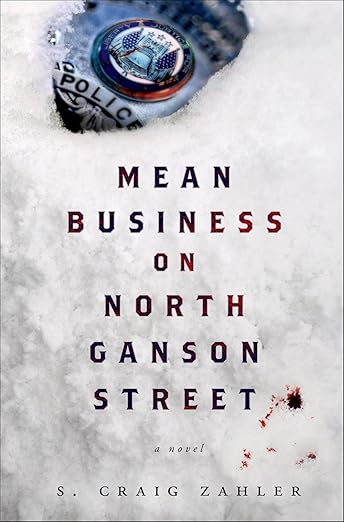
Someone suggested I read an S. Craig Zahler novel, just to see what I thought of it.
So I went and bought Mean Business On North Ganson Street.
There are many good things I could say about this book. First of all, it’s well written. Author Zahler is a very good stylist. He turns out punchy, neo-hardboiled prose, with a razor edge: “The silver luxury car rolled past a street that was blocked off by an overturned pickup truck, which had been torn open like a zebra on the plain.” “The windshield wipers shoved powder across the glass, and through the opening, Bettinger saw Victory. Covered with snow and viewed from a distance, the city resembled a mildewed autopsy.”
Also, the characters are vivid and the plotting propulsive. This is very good writing.
But the reading experience provided? That’s a whole other thing.
Jules Bettinger is a police detective in Arizona. His record is good, but his customer service attitude isn’t, and he gets himself fired. His only option to stay on the job is a transfer to the city of Victory, Missouri, notorious for having the worst crime rate in the country.
When he gets there, he finds his fellow detectives brutal and probably corrupt. He observes clear violations of suspects’ rights. Then he learns more, and discovers why the cops are acting the way they are – in Victory, the situation has gone far beyond law enforcement. It’s now total war. When his own family gets pulled into the violence, Jules takes the gloves off and enters fully into the battle.
And that battle will lead from the better parts of Victory, which are merely blighted, to the worst parts, which are post-apocalyptic.
It’s a descent into Hell.
Reading Mean Business On North Ganson Street was an uncomfortable experience. Shocking, offensive, full of disillusionment. This is Nietzche’s world; the cops are just patrolling it.
I can’t really recommend the book, unless you have a taste for scenarios out of a Hieronymus Bosch painting.
I also thought the sex scenes were unnecessarily explicit.
I fear I am not going to be a S. Craig Zahler fan.
Fiction Throwdown: Can Chat GPT Tell a Better Short Story?
Bestselling fantasy author Mark Lawrence asked three established fantasy authors to write 350-word short stories along with him and let his blog readers compare them to four similar stories produced by ChatGPT. He ran this experiment two years ago and concluded Team Human still had the edge. This year, not so much.
Read the eight stories here and keep your own tally on whether a story is written by AI or author and what rating you would give it out of five stars.
I read through them today and had hoped for better results at picking out the AI writing. I picked half of them correctly: two human written, two AI. I didn’t score the stories high in general, giving only one five stars and another four. Three I gave three stars. The remaining three earned twos and a one. It’s a little embarrassing to say my two high ranking stories were AI written. Two of the ones I disliked the most were manmade.
Jon Del Arroz, another fantasy author, reacts to the poll in this video.