Category Archives: Fiction

Old Ogden Nash Hardcovers, Praising e-Readers, and Brain-Changing Reading

For some years, I’ve had a water damaged copy of Ogden Nash’s Good Intentions. Here’s a look at a good copy of it; this one has the slip cover too (I hadn’t seen it before).

Yesterday, I found similar red, hardback copies of Many Long Years Ago, a collection of mostly previously published verse from 1931-1945, and The Private Dining Room, new verse published in 1953. I refrained from replacing Good Intentions or buying another volume they had, so you know what that says about me. We don’t need to say it out loud. I also could have purchased one of a couple more recently published anthologies. This is one of them. But, if I do anything, I’d like a set of the five red hardcovers.

Here are a few lines from Many Long Years Ago.

“Who wishes his self-esteem to thrive
Should belong to a girl of almost five.”

“We’ll remind each other it’s smart to be thrifty
And buy our clothes for something-fifty.”

“If turnips were watches they’d make as good eating as turnips.”

Reading: In praise of e-readers and the joy of winning an argument with a print-only reader who has so many books that he loses the ones he has.

How would Jesus advertise? I have a hard time believing Jesus would encourage us to spend millions on advertising his character traits. How many vice is being funded with a Super Bowl ad? But I also have a hard time throwing stones at this.

Does reading change the brain? “When it comes to a cultural trace in the form of literature, we would really like to know whether there is some sort of permanent alteration to the structure of the brain.” They chose Robert Harris’s Pompeii to see if they could detect a small brain change.

Banned Books: Anthony Sacramone has a book challenge for public schools. “Try and get all these at one go onto a public school curriculum (NYC, LA, SF) and see how that goes. I’d love to be proven wrong.”

Mystery: John Wilson reviews another Cameron Winter story, A Strange Habit of Mind, by Andrew Klavan, to be released in a few days.

‘The Good Client,’ by Dan Decker

Mitch Turner is a criminal defense lawyer, I’m not sure where (either author Dan Decker didn’t say, or I just didn’t notice). His practice is new, but he’s aggressive and doing well for himself.

As The Good Client begins, Mitch gets a call in the middle of the night from his office intern, Timothy Cooper. Mitch hasn’t been impressed with Timothy’s work. He considers him too shy and nerdy to ever succeed in criminal law. But now Timothy is knee deep in a criminal case of his own. His roommate, he says, has been shot to death, and the police are there. He thinks they suspect him of the crime. Mitch instructs him to say nothing more to the cops; he’ll be right over.

He finds that the police have, indeed, already homed in on Timothy as the killer. No one else was in the apartment, and there are no signs of forced entry. It isn’t long before Timothy is arrested, and Mitch has his investigator looking into the young man’s movements that night. This proves harder than expected — Timothy proves to be an uncooperative, and surprisingly temperamental, client. Also, his parents are strangely unsupportive, and they start looking suspicious in their own right. But that makes no sense – would they frame their own son? Mitch discovers evidence the police overlooked, which both surprises him and puts him in an ethical dilemma. The evidence is damaging to his own case, but professional ethics force him to turn it over anyway.

The whole thing is complicated – and somewhat improbable, in my view. Some of the legal and police actions taken strike me as implausible (of course, I’m not a lawyer). The final solution also seemed like a stretch, though the culprit was no big surprise.

The book wasn’t terrible. The writing was okay, with only minor syntax errors compared to most books I see nowadays. But it lacked spark. The characters seemed kind of dull (nobody had a sense of humor).

On the plus side, the occasional mentions of religion were fairly positive. No major cautions are needed for language or sexual content.

I’m on the bubble on this one.

Can’t Recommend Pathetic Rings of Power

Last month, one of the showrunners for Amazon’s The Rings of Power enthused about the series, saying it wasn’t their story but Tolkien’s. I think that’s how deeply deceived fan-fiction writers feel about their stories. This isn’t Tolkien’s story by a far cry.

I watched the remaining episodes of The Rings of Power yesterday, and all the wind has been taken out of my sails. Reading a bit from the showrunners has depressed me. Hearing from a few critics has soured me. Spoilers ahead.

I wasn’t hoping or expecting the show to become awesome in the last three episodes, but some errors hit you differently than others. You can roll with some lines of dialogue, some character motivations, and with others you can’t. Others just rattle the wheels right off your wagon and leave you on the hillside, wishing Santa would make things that last for a change.

They make up an origin story for Mithril to compel Elrond to push Duran IV to mine for it, because King Duran III believes it’s too dangerous to continue digging for it. They say a tree with the light of a silmaril is fought over by an elf and a balrog, is struck by lightning, and creates mithril by sending all the light into the rocky mountain earth. The elf king pulls out this story in episode 5 to say another tree that’s tied to the life of all elves is dying all of a sudden and if they don’t get that mithril stuff, all elves will be forced to flee to Valinor. It was a point in which the king seemed deceptive and manipulative. And the whole thing was dumb.

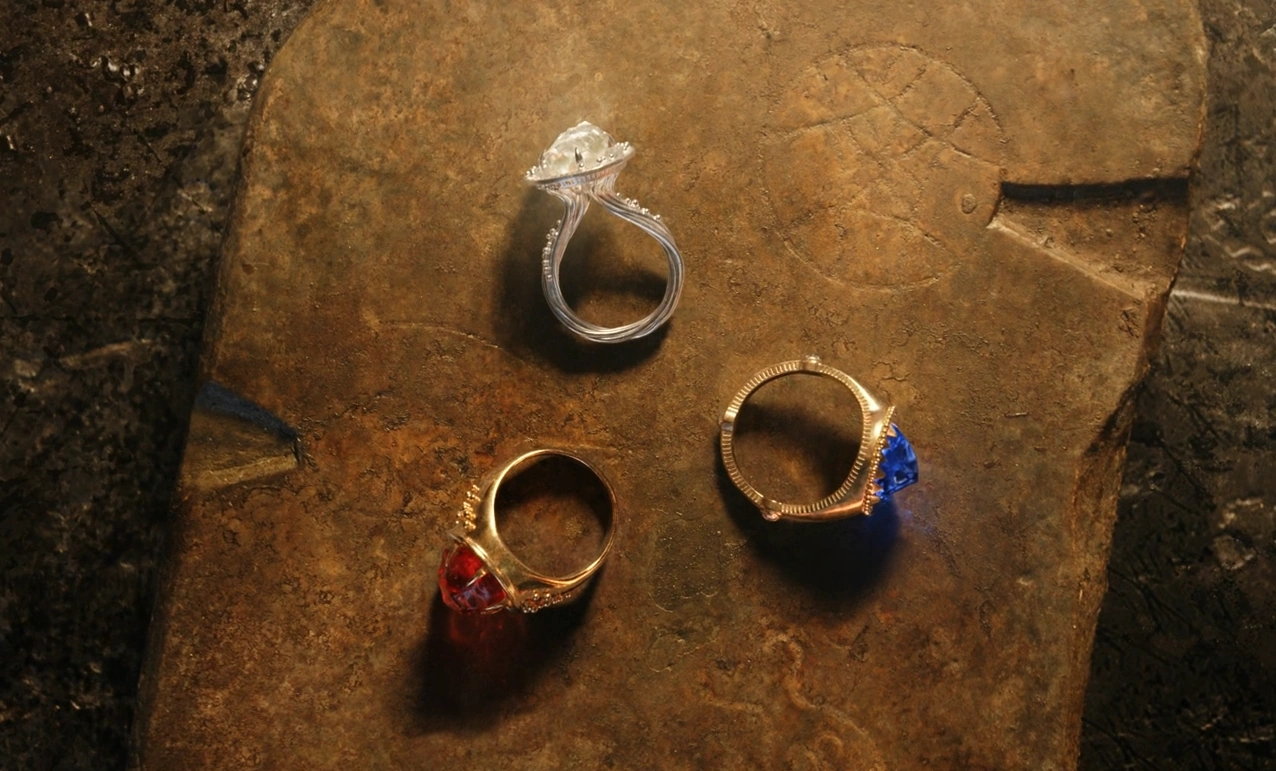
At the end of episode 8, they handle the creation of the elfin rings like any other TV drama. A main character, regardless of supposed skill, has to suggest the solution to the master craftsman. They hint that this craftsman is being manipulated, but please. There’s no strategy working here. It’s a line, a plot point, a touch of authenticity to say they know Tolkien’s history and are telling his story. The rings themselves look like trinkets (image via LOTR Fandom).

In episode 7, there’s a battle, and the “good” villagers give up their most defensible position for one that trained solders would have difficulty defending. And in doing so, they give the enemy the freedom to unlock an old plan that would nonsensically ignite Mt. Doom. Which is a big problem, but it doesn’t come before they mop the floor with their enemies because the elves and Númenórean men, whom Galadriel has been attempting to rally for half of the series, finally show up on the horses they brought overseas. How this cavalry knew the Southland village would be under siege at that moment is not important. What is important is that had the villagers stayed in the defensible outpost they fled to days ago, the cavalry would not have been able to charge in like they did.

A Kodak moment, I tell you.

Continue reading Can’t Recommend Pathetic Rings of Power →

‘Choices,’ by Scott W. Cook

I finally finished this book. I can’t have enjoyed Scott W. Cook’s Choices a whole lot, because I sure found it easy to put it down. But on the other hand, I kept with it to the end, which must mean something.

Apparently, Scott Jarvis is an established Florida private eye character (there are a lot of those; John D. MacDonald left a great big void in his wake), and Choices is the first book Cook wrote about the character. But it wasn’t published until now (I can see the reasons). Nevertheless, he’s worked it over now and released it as a prequel.

It… still needs work.

Scott Jarvis is a police detective in Orlando, Florida. He has high ideals about making the world a better place (the author goes on an on about this), and is frustrated by the legal limitations the job places on him. Finally, after he’s badly wounded and a vicious gangster gets released, he accepts friends’ advice and goes into business as a private investigator. In time, this gives him the opportunity to go after that same gangster in a big way, from a different angle.

The plot of Choices is pretty far-fetched, in my opinion. Jarvis gets away with a lot of stuff that I’m pretty sure wouldn’t go in the real world (including taking a couple of the classic Hollywood shoulder wounds without being permanently disabled). He carries a “silenced” Colt 1911 .45, which will make gun guys laugh. The text includes a number of textual errors such as mistaken homophones and missing section breaks. And sometimes the author forgets he’s writing in first person and slides into third.

But the biggest problem is a simple beginner’s problem, one most authors make and get over. Cook overwrites. He tells us things multiple times. He explains what he means too much. He likes to say someone “quipped” this or that, when it’s not really a quip, and you shouldn’t have to explain that to the audience anyway. If you want the audience to know it’s a joke, make it a better joke – don’t explain to them how they ought to be amused.

Still, I thought there were signs of good writing here. I might read the next book, to see if the author has learned anything.

The Awakening of Miss Prim, by Natalia Sanmartin Fenollera

Herminia was a refined, intelligent, sensitive woman but that was no defense against self-deception. Miss Prim had a theory about self-deception: the female sex seemed particularly and cruelly vulnerable to it.

I read this 2014 novel with friends over the past month. It inspired moderate complaint and, after a bit of reflection, delivered a welcome finish. The Awakening of Miss Prim was originally written in Spanish in 2011, so we read the English translation by Sonia Soto.

The story takes place in the fictional Spanish village of San Ireneo de Arnois, an idyllic community of independent folk making their living by doing what they love. It’s implied that everyone here lives humbly, but you can’t tell from the wealth of flowers, cozy homes, tea cakes, fresh bread, and hot chocolate flowing every other page. Village business is bustling, but shops are only open for as long as they want to be, because people have healthier priorities than making as much money as they can in a day.

Miss Prim comes to San Ireneo to inquire into a job opening as a private librarian to one of the most important men in town. The advertisement states those with many credentials need not apply, and Prim has many credentials, but when asked about that and the possibility that she may be trying to escape a former life, she bristles and almost turns the job down–never mind that she implies she is seeking a refuge.

She accepts the job of organizing the library for six months, and in that time meets the wonderful village folk, the curious children folk, and seems to be unable to have a conversation without being offended. She frequently tells herself how proper and level-headed she is and frequently catches someone’s choice or opinion that clashes with her own. The quote above comes late in the book and it couldn’t be clearer that she’s talking about herself.

But after talking over the whole book in a group, I put my initial complaints aside. It’s possible this novel leans into the idea that beauty is truth and will save the world. Prim awakens to the idea that slowing down, breathing fresh air, meditating on old poetry, rejecting a narcissistic view of everyone around her, and particularly dwelling on the Gregorian chant coming from the crypt at St. Benedict’s is real living. One friend suggested this as a specifically Christian theme. It isn’t explicit in the book, but a few lines point to it.

From this perspective, the novel is worth reading. It can easily come across as the story of a young feminist longing for something better in the world while undermining every effort to take her there. Maybe instead it’s a gentle story of a woman who needs and finds Christ.

‘Righteous Prey,’ by John Sandford

Four cars were parked in a line, with two side-by-side overhead doors: a gunmetal gray Lexus SUV, a red Ferrari, a black Mercedes SUV, and a reddish-orange Porsche Carrera Turbo. A group of cops were discussing whether the Ferrari and the Porsche should be seized as evidence, and if so, who’d get to drive them to the impound lot.

I’ve been a big fan of John Sandford’s exciting and amusing “Prey” series for a good percentage of its long history (the hero, Lucas Davenport, would be retired and out of action long ago in real life, but fiction permits active employment for the life of the author [at least]). Today, hero Lucas Davenport, long with the Minnesota Bureau of Criminal Apprehension, is sort of a freelance US Marshal. He gets to work on only the jobs that interest him, due to his immense personal wealth and Washington connections. In Righteous Prey, he teams up (again) with his buddy Virgil Flowers, who’s still in the BCA, to deal with a domestic murder ring.

One thing I’ve always appreciated in the series is the author’s ability to set aside his personal politics (which I’m pretty sure must be far to the left of mine) and present fairly balanced pictures of conservatives and liberals. And he’s generally avoided controversial subjects.

This book is less evenhanded, though I’m sure he made an effort.

What’s happening here is that a group of anonymous individuals, all of them Bitcoin billionaires, have formed a group called “the Five.” Their purpose is to kill “a**holes” (hereinafter to be called “targets” in this review). People they consider evil, who do only harm to the world, and who are personally hateful. Each of them will kill one of the five targets, after which they will distribute a news release, and then make a generous donation to some charitable organization whose work counteracts whatever harm they think the target has done.

When one target is murdered in Minneapolis, Lucas and Virgil get involved. They’ll be traveling around the country playing catch-up with these billionaire killers, and it will all culminate in a running fight in Long Island, New York.

Generally, Sandford is as evenhanded as usual. He does one thing that’s uncharacteristic, though, if my recollection of the previous books is correct. He throws in a message this time – the evils of bump stocks.

Now, I’ll confess I’m pretty ignorant about bump stocks. No personal experience. The sources I’ve read have generally defended them, saying they really don’t translate into anything drastically new and lethal. But the way Sandford describes them, they turn an AR rifle into the equivalent of a tommy gun, spraying death all around, turning a lone gunman into a one-man commando team against whom the police are helpless.

I don’t know. I’m skeptical.

Other points of interest – Virgil is now writing a novel, and he complains that he “only” expects an advance of $2,500.00 or so. This proves John Sandford lives in a different universe than the one I’m in.

I believe I read he no longer lives in Minneapolis. One piece of evidence for that development is that he thinks the Bakers Square in Highland Park is still open. Sadly, it closed down forever, early in the Lockdown.

There’s a vile conservative talk show host in the story, who may be very loosely based on the late Rush Limbaugh. However, he’s such a caricature that I found it hard take offense. Liberals, no doubt, will think the portrait spot on.

On the plus side, there’s a Travis McGee reference.

Recommended, except that strong gun rights activists probably won’t like it. Cautions for foul language and violence.

‘A Deadly Shade of Gold,’ by John D. MacDonald

I motioned him back and had him get himself a shot glass. I filled it from my bottle. I held my glass up and said, “Drink to me, my friend. Drink to this poisonous bag of meat named McGee. And drink to little broken blondes, and a dead black dog, and a knife in the back of a woman, and a knife in the throat of a friend. Drink to a burned foot, and death at sea, and stinking prisons and obscene gold idols. Drink to loveless love, stolen money and a power of attorney, mi amigo. Drink to lust and crime and terror, the three unholy ultimates, and drink to all the problems which have no solution in this world, and at best a dubious one in the next.”

He beamed without comprehension, and said, “Salud!” We drank and bowed and I filled the glasses again.

I have favorites and less favorites among John D. MacDonald’s Travis McGee series. I would not list A Deadly Shade of Gold as one of my favorites. It’s dark and convoluted, and unfortunately contains several authorial thoughts that annoy me. Still, it’s McGee, and I wouldn’t be without it.

Travis McGee, Florida houseboat-dwelling beach bum and “salvage specialist,” gets a call from his old buddy Sam Taggart, who’s been gone two years. Sam wants to know if Trav still “operates like he used to.” That means recovering stolen property for people and keeping half the value. He invites Trav to his seedy motel room and shows him an ugly golden statuette. There are 23 more like that, he tells Trav. Somebody took them from him and he wants them back.

Trav tells Sam that Nora wants to see him. That takes him aback. Sam was engaged to Nora before he ran off. Sam then says he’s changed his mind. If Nora will take him back, forget the salvage job. He says he’ll just dispose of this statue, and then Trav should bring Nora to see him tomorrow.

But when Trav and Nora show up, Sam is dead – killed with a knife in an ugly way.

Now it’s more than a salvage. It’s personal. Trav makes a trip to New York to talk to dealers and find out who might have owned the collection of gold statuettes. That leads him to a trip to Mexico (Nora comes along), to surveille the home of a reclusive, exiled Cuban government official.

Then things start getting complicated and violent, and it grows difficult to tell the good guys from the bad guys. It will all culminate in a fiery showdown in a billionaire’s home in Beverly Hills.

None of the Travis McGee books are exactly cheery, but A Deadly Shade of Gold is particularly dark. I think the author must have been depressed that year (1965). Aside from people dying in ways they don’t deserve, MacDonald expresses opinions which (in my view) have not largely held up well. He disses religion, and takes an entirely gratuitous swipe at all hunters. He warns of overpopulation. He talks about the dangers of right-wing extremism without even considering (apparently) that there might be an equal and opposite danger on the other side.

However, the story is consistently anti-communist. And a large part of the plot involves attempts by Communist agents to influence American politicians and entertainment people through sexual blackmail. That’s a theme right out of the headlines (or rather, the buried ledes).

If you’ve never read a Travis McGee novel, I wouldn’t recommend A Deadly Shade of Gold for a starter. Otherwise, buy it. Cautions for sex scenes and violence.

‘Sam Keaton Wild West Mysteries Omnibus,’ by Sigmund Brouwer

I enjoyed Sigmund Brouwer’s Christian-oriented Nick Barrett mystery novel, Out of the Shadows. I didn’t enjoy the sequel, Crown of Thorns, quite as much, so I won’t review it here (it dealt with racial issues, and was as awkward as such stories generally are).

But when I saw Brouwer had written a series of Western stories, I thought, hey. I’ve been meaning to read more Westerns. I’ll give it a try. I bought the Sam Keaton Wild West Mysteries Omnibus. There was much to enjoy there, but in the end it didn’t work for me.

Sam Keaton (an alias) was once a bounty hunter. Now he’s a cowboy, trying to live a peaceable life and avoid an old wanted poster. One day in Laramie, Wyoming he comes upon a big man trying to kick a little Indian to death in an alley. He’s no great lover of Indians, but the injustice of the thing rankles him, so he tries to stop it. The big man goes for his gun, and the next thing he knows the man is dead, and Sam is on the run again. Oddly enough, the Indian follows right at his heels.

The “irksome Injun,” as he calls him, turns out to be a sort of emissary, delivering messages periodically from a mysterious woman named Rebecca Montcalm. The messages give Sam instructions, with a promise of gold.

The story was interesting, but it seemed a little contrived to me. Improbable situations staged to orchestrate plot points. Insufficient credibility.

But my big problem was what I saw as major factual errors. This especially applied in the area of Colt’s handguns, about which the author knows far less than he thinks. He overestimates the ubiquity of the brass cartridge in 1871. He thinks gunfighters fanned their pistols (though in the second book he describes fanning in a way that makes me wonder what he’s talking about). He thinks you can unload a Colt by holding it upside down and shaking it.

But worst of all, he says really mean things about Wild Bill Hickok. I consider Wild Bill one of my pards, and I don’t cotton to that kind o’ talk.

So I didn’t finish the second book.

I will try the next Nick Barret book though, if I see it. Because the author is clearly learning his craft.

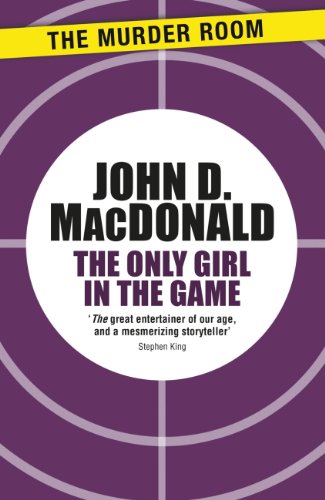
‘The Only Girl in the Game,’ by John D. MacDonald

It seemed to Hugh as he sat there that this was a very bad place on the face of the earth, that it was unwise to bring to this place any decent impulse or emotion, because there was a curiously corrosive agent adrift in this bright desert air…. It would not be a good thing to stay in such a place too long, because you might lose the ability to react to any other human being save on the level of estimating how best to use them, or how they were trying to use you. The impossibility of any more savory relationship was perfectly symbolized by the pink-and-white-and-blue neon crosses shining above the quaint gabled roofs of the twenty-four-hour-a-day marriage chapels.

As I’ve been reacquainting myself with John D. MacDonald’s non-McGee novels, happily republished by The Murder Room in Kindle format, I’ve had one nagging worry. I remembered that one of these books in particular was a heartbreaker, a really tragic story. Now I don’t have to worry about it anymore, because I just read The Only Girl in the Game, and it turns out that’s the one. It knocked me down, made me cry, and took my lunch money. Excellent book.

Hugh Darren manages the Cameroon Hotel in Las Vegas. It’s interesting work and it pays well, which will help him with his dream of eventually opening his own resort in the Bahamas. He knows that the mob owns the place, but they’re on the casino side. Hugh just deals with food suppliers, employees, and customer complaints, that sort of thing. Oh, from time to time his genial, party animal boss asks him for a little favor, and he gets an off-the-books gift when he does it, but they’ve never asked him to do anything illegal.

He particularly delights in Betty Dawson, his new girlfriend. She’s a singer with a regular show in one of the small lounges. She’s tall and beautiful, smart and funny. Hugh is head over heels in love with her, but she’s made it clear she wants only a casual relationship.

What he doesn’t know is that their boss owns Betty. He has leverage on her, and that enables him to require her – not often, only once or twice a year – to do something that makes her hate herself, that makes her feel dirty. Nothing personal, it’s just business.

One day they’ll ask Betty to do something she knows she can’t do. And that day she’ll break free. Then everything will go very bad, very quickly.

The Only Girl in the Game was originally written for the cheap paperback originals market. It includes the obligatory scenes of sex and violence (though fairly mild by 21st Century standards). But it’s also a remarkably well-written and morally centered book. It’s all about the effects of gambling, on individuals and on communities. We’ve come to accept those effects since casinos have been legalized most everywhere, but we’ve paid a price. If you want to understand that price, this is a good book to start with. If you’re thinking of going to a casino for fun, this is a good book to read.

Highly recommended, with cautions as specified above.

The Incredible Hulk Has Lost Some of the Incredible Part

Fans of comic books and some of the Marvel shows and movies have been talking about where the writers have taken the Incredible Hulk character. They compare the Ed Norton Hulk, who looks enraged while standing still, and the Eric Bana Hulk, also a rage monster, to the Mark Ruffalo Hulk, who was last seen patiently listening to his She-Hulk cousin explain how being a woman enabled her to control her anger “infinitely more” than he could.

Years ago, we talked about the first Avengers movie and the controversy of Bruce Banner appearing to be able to transform on command. The point in the movie was the wildness of the Hulk. Banner could use the Hulk’s power to a degree, but if things got out of hand, the Hulk would bring even more chaos.

In Avengers: Infinity War, the Hulk is beaten into submission right out of the gate. This takes one of the strongest characters out of the picture to make room for many others who need a few seconds of their own. The movie proceeds to follow Thanos to each of the remaining Infinity Stones and half of the time sets up an identical scenario: Thanos threatens to abuse and kill one character unless another one forfeits a stone.

But what if Thanos’s brutal beating had caused the Hulk to go wild? Initially, he would appear beaten, Thanos would leave, and the heroes would plot their defenses. Then Thanos would confront a group about the stone they’re guarding, and a wild, uncontrolled Hulk would return with more rage than ever, turning everything to chaos. It wouldn’t be repeated bad decisions that give Thanos the stones in the end. It would be the impossibly strong Avenger who couldn’t be stopped.

This movie would have villain and anti-villain with a hoard of heroes to manage both. They could even have Captain Marvel fight him. She should be able to handle him for a while. Maybe Wanda Maximoff could even save him in the end by pulling him out of his rage.

Or he could be taken by the snap, in which case he’d have to come back as Bruce to give everyone a breather.

But I guess they’ve taken that wildness away from the cinematic Hulk to make him more of a team player.