Today is one of my industrious days. A little translation work came in. Proofreading, actually, which is fairly easy and I believe I do it well. It doesn’t pay much because it goes fast and this employer pays by the hour. But it’s income. And not devoid of fun.
The project – which I won’t give you a hint about, not even the format – is one we’ve been working on, off and on, for years now. I recall remembering it recently, and thinking, “Well, that one must have died in production.” But here it is again.
The wheels of cinema grind slowly.
Not long ago I saw a news item that announced they were starting production on the very first project I ever worked on. I’d long written it off as a sad casualty – I’d really liked it and wanted to see it made. And behold, it’s getting done, at last.
Makes me feel better about the rate my novels are coming out.
I expect I’ll be able to post something tomorrow, but if I don’t show up, remember I’ll be at the Little Log House Antique Power event in Hastings, Minnesota on Saturday and Sunday. God willing.
At last I found a lawn guy. I chose the guy who put up a flyer at my church, rather than any of the hard-sell sharks who went all feeding-frenzy on me after I waded into the Home Advisor waters. I may be sorry I made the choice one day, but at the moment I’m pleased with my sales resistance.
No word on the car yet, of course. I have a Viking event this weekend (the link to the Little Log House Antique Power Show is here, if you’re going to be near Hastings, Minnesota), and I’ve been forced to beg a ride from a fellow Viking who can accommodate all my stuff in his vehicle. I’ll owe him a favor now… heaven knows what might be asked of me one day. (I draw the line at felony-level violence.) I hope to have the new paper edition of The Year of the Warrior to sell at this event, and that kind of excites me.
I’m almost surprised to say it, but the new novel, King of Rogaland, is coming together, I think. Now that I’m starting to get the various plot threads tied up properly, I like what I’m seeing. I’ve got ongoing themes happening here; a uniformity of effect (I hope). One oddity of this book (for me) is that it includes more embedded stories than my previous books. By that I mean a character in my story sitting down and telling a story of his own. These interpolated tales, in general (I think), also advance the unified theme. Another oddity is that there are no major battles (hypocritical of me, I suppose, as I’ve criticized Stephen Lawhead for lacking the nerve to write battles). But the final confrontation is – I think – dramatic enough to have a similar artistic effect.
I read a quotation recently that impressed me. I don’t recall the source, or the exact words. But the gist of it was, “The better you get as a writer, the harder writing will be for you, because your critical standards will be raised.” So just go ahead and do it – if you’re having this problem, you’re probably a better writer than you think.
As far as pure entertainment goes, you can hardly do better than Nick Petrie’s bombastic Peter Ash thriller series. These books are extreme in every way. Nevertheless, speaking for myself, I’m growing a teeny bit uncomfortable with them.
Peter Ash is, if you remember, a Marine combat veteran who came home with a peculiar form of PTSD. He is claustrophobic, and mostly stays out of doors. Over the course of his adventures he’s acquired a fortune in “found” money, a faithful friend who is a former Milwaukee gangster, and a feisty journalist girlfriend. Tear It Down finds him trying to settle down with the girlfriend, June. He’s exerting himself to make it work, but June can tell it takes an effort. So when her friend Wanda calls from Memphis, saying people are harassing her, she tells Peter to scoot – go help Wanda. Work it out of his system.
Wanda is a photographer who suffers from PTSD of her own. She’s been photographing war zones, and is now taking pictures of urban gangs. She doesn’t know why somebody drove a pickup truck through the front wall of her house, though. It seems both extreme, and an odd way to make a statement, when they could just shoot her.
Peter has barely arrived when he’s confronted by a kid with a gun, who wants to hijack his camper truck. Peter could take the gun away, but he instinctively likes the boy, and gives the truck up rather than hurt him. Later he learns that the boy is a gifted musician in big trouble – Peter would like to help him, if he could only find him. And he’d also like his truck back.
Solving these problems will involve bringing in his dangerous friend Lewis from Milwaukee, and chasing down a couple of desperate rednecks with their sights on a historical treasure. These guys are crazy, and not above turning a machine gun on innocent bystanders.
It speaks well of author Petrie that he wants to do good as well as entertain with Tear It Down. He tries to confront issues of race and social oppression in a positive (and hopeful) way. And that was part of my problem. I found his solutions a little glib, and not much more plausible than the book’s over-the-top plot.
Also, I’m getting a little tired of Peter’s girlfriend, June. She seems to be a good person, and is good for Peter. But we are informed that a foul mouth is one of her “virtues.” I’ve gotten accustomed to profanity in books, but treating it as a positive good is kind of extreme for this small-town boy.
I don’t know. I may go back to the Peter Ash books after a while. They’re engaging and entertaining. But I’m going to cool it on them for now.
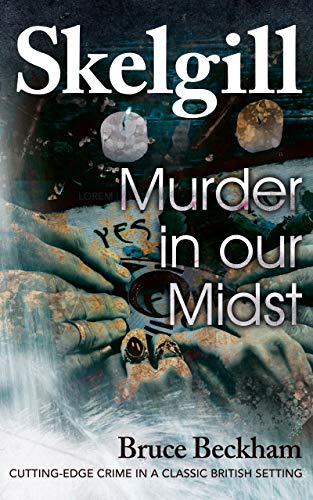
If you’re looking for big thrills, Bruce Beckham’s Inspector Skelgill mysteries are generally not for you. These stories take the cozy route, most of the time, and the plot of Murder In Our Midst is pretty much right out of Agatha Christie.
The school clique that centered around beautiful Daisy Mills decades ago has gathered again at a lodge in the English Lakes District, to support her after the death (by poisoning) of her third husband. For fun, they bring out a Ouija board, and the planchet spells out something about murder. The next morning, Daisy is found drowned in a pool near a waterfall.
When the police call goes out, Inspector Skelgill and DS Jones are in a boat on a nearby lake. He’s trying to teach her fly fishing. They answer the call and start interviewing witnesses. Evidence indicates murder, so it becomes a question of evaluating alibis. In some ways, we never really get out of high school; old loves and hatreds still endure…
I enjoy the Skelgill series, and the quiet nature of the stories has something to do with it. These books are almost as much about appreciation of the charms of the scenery as about murders and characters. Murder In Our Midst was not one of my favorites. It was the kind of story where you have to keep track of a lot of characters, some of whom aren’t all that memorable, along with various time lines.
But it was kind of like time with old friends, so I won’t pan the book.
I’ll say this – I hope this is a series where characters age slower than in real time. Because if DS Jones is waiting for Skelgill to make a romantic move on her, I fear she’s going to be waiting a while.
Another week has been transferred to history’s OUT box. On balance, it won’t be remembered by future biographers as one of my better ones. But it could have been worse.
No word about the car, of course. I keep hoping the July 30 date they gave me for part delivery was only a worst-case scenario, but we live in a fallen world. (In the Garden of Eden, I’m sure, car parts always arrived on time.)
Then there was my struggle to find a new lawn guy, which I chronicled yesterday. I’ve determined to leave the final decision until Monday, because I still want to talk to the guy who put a flyer up at my church. But if he doesn’t show this weekend, I’ll go with one of the Home Advisor sharks.
Had a couple plumbers over today, to look at my water heater, which has been making disquieting banging noises. The diagnosis? Sludge build-up – no doubt due to the high mineral content of our local water. Recommendation: new water heater. Which my home warranty program should pay for, but there will be the deductible. I expect that will be in addition to the deductible I already paid for the plumber’s visit today.
What else? I just put a package in the mail to Sweden. There’s a company (I won’t say its name) that advertises Viking accouterments on Jackson Crawford’s YouTube channel. I sent away to them for a linen tunic, because I wanted a new under-tunic (the ones I’ve been wearing are getting threadbare). I ordered XXL, and got it, and it was too small. So I ordered a XXXL, and that was too small too.
I mean no offense to Swedes when I say that their definition of “large” is somewhat different from mine. And I’m well aware that Americans in general, and I in particular, are way too fat. Which is too bad, because it seems to be well-made product.
But the fact remains that these shirts aren’t suited to a large segment of the American market. To add injury to ignorance, the return postage cost almost what one of the shirts cost me.
Little shocks to the bank account; they add up. But those are the terms of my life these days – the Lord provides. And sometimes I need to make small economies.
On the plus side, I’ve made substantial progress on King of Rogaland. I feel at this point that I’m beginning to get a handle on the project. In fact, I think this could be the best book I’ve ever written. I think I’m a better artist than I was 45 years ago, which ought to be expected, or I’m doing something wrong.
The song in the video above is “Aura Lee,” an American piece sometimes attributed (wrongly) to Stephen Foster. The lyrics were in fact written by the American poet W. W. Fosdick, who died in 1862, aged 37. The melody was by an English immigrant, George R. Poulton, who died in 1867, aged 38 (according to Wikipedia, he was tarred and feathered in 1864 for having an affair with a young student).
The song was published in 1861, and became tremendously popular with soldiers on both sides of the Civil War. One can understand why. I’ve always loved it. Elvis Presley used the melody for his song “Love Me Tender,” but I prefer the original. This rendition is done in period style by the 97th Regimental String Band.
May sunshine come along with your weekend, and swallows in the air.
Photo credit: Daniel Watson @danielwatsondesign. Unsplash License.
What did I worry about before I owned a house? I’m sure there were issues, but that was in another time and another place…
Anyway, right now my concern is lawn mowing. I gave up doing it myself when my hips went bad; I’ve officially declared lawn mowing A Thing I’m Too Old to Do, like climbing ladders and enlisting in the Navy Seals.
I used to have a guy. A cheerful fellow who may not have been the best, but didn’t charge a lot. Last year, I noticed, he came around less and less often. And sometimes I had to call him and ask whether he was still in business. Then this year, he showed up and told me that from now on he wanted to be paid in cash.
I didn’t like the sound of that. The next time he came, I paid him with a check and told him I needed to do it that way, for my tax records. Which is true.
He has not shown up since. So I started looking for a new guy. I called one guy who put up a flyer at my church, but so far he hasn’t had time to come and look around. Which doesn’t bode well.
Then I did an inquiry through Home Advisor. And now I do not lack for applicants. I’ve had several calls today. Oddly enough, they all make pretty much the same pitch, and ask pretty much the same price. (I suspect they collude, like a cartel.) So I guess I could just pick one.
My problem now is, I don’t want to hire any of them.
I said their proposals were similar. Another similarity is their salesmanship. They try to keep me on the line until they can wear me down. They try to hold me hostage till they can close that deal.
I am well-known to be a pushover. I’m easily bullied.
But one thing I won’t do, is say “yes” when I’m not ready. If one of these guys had just said, “Here’s what I’m offering – think it over and get back to me,” I’d be his huckleberry.
I’ll probably end up hiring the one I hated least.
I had an on and off relationship with this book, as a reader. Ted Taylor’s Fatal Decision is the first of a series about a former English police detective enticed out of retirement to lead a cold case unit in the city of Devizes. At the beginning I found it kind of slow; then I warmed to it; but in the end the author lost me.
Gus Freeman is our hero. He retired from the force three years ago, but lost his wife six months later. Since then he’s been kind of rudderless, spending a lot of time on his “allotment” (a patch of ground leased for public gardening).
Then his former superior gives him a call. They want to set up a new cold case unit. Modern police science is quite good at identifying criminals, but their thinking is that, in cases where criminals have sidestepped forensics and computers, good, old-fashioned cop experience and instinct might turn up new clues.
Gus agrees, on a test basis, not convinced he has anything to offer an up-to-date force. He is introduced to his (calculatedly diverse) team of young detectives, and they start by looking into the murder of Daphne Tolliver in 2008. Daphne was a retired postal worker, much liked in her community, whose head was bashed in while she was walking her dog. Gus finds his new team bright and eager, and they soon start learning things earlier detectives missed. It will all end in a major scandal.
At first I found Fatal Decision pretty slow reading. We begin with the lead-up to the murder, but then the author moves to a prolonged segment that just describes Gus’s quiet life as a retired cop. He’s likeable enough, but most authors would prefer to get straight to the mystery and fill the background stuff in as they went along. I suspect a lot of readers will lose patience with this part.
Once Gus goes back to work, things pick up. Author Taylor does a good job with characters. His are layered, and capable of surprising us – something I always like. So I grew more interested.
But a point came when we were informed of one of the characters’ politics. And the moment I read that, I knew with moral certainty who the culprit was, and what their motive was. The author had fallen into a plot trope that was fresh quite a long time ago (like when I was young), but has been used so many times – both on the printed page and on screen – that I can’t imagine every other reader won’t figure it out too. In short, I felt insulted – both as a reader and in my beliefs.
Final evaluation – the book had some virtues, but the slow start and the threadbare “surprise” outweigh them in my estimation. Not recommended.
Yesterday and today have been quiet days for me, for reasons I won’t itemize. Suffice it to say I’ve been unwell, in a manner that makes leaving the house inadvisable. I think I’m beginning to recover now. No great distress, just… inconvenience.
And no, there’s no fresh news about my car. They told me the end of the month; kind of pointless to nag them until then. Maybe I’ll just keep the loaner and call it even.
But I’m working on my revisions to King of Rogaland. At this stage I’m working with red pen on a printed manuscript, rather on screen. There are two reasons for this. One is that ink on paper just reads differently for me. That’s an odd thing to say for someone who reads almost exclusively on Kindle. But I don’t feel I can “grasp” my manuscript until I’m literally grasping an inch or so of ream in my hands.
The second, more practical reason is that I often have to page back and forth to see if one passage about a character or subject matches things I’ve written about it elsewhere. Continuity, it’s called. I find that a whole lot easier to do with physical paper. Riffling through dead tree pages is different from scrolling through screen pages, and it feels less daunting.
What I’m doing at this stage is, I’m becoming a student of my own book. I wrote it all, but I wrote it in various moods and states of alertness. There are themes there I need to bring out, and rabbit trails I need eliminate. In a sense the book itself is telling me what it wants to be. I just have to listen to it.
Do I like what I’m reading?
As a matter of fact, I do. I even find it moving in spots.
“For a lot of people, the definition seems to change to fit the times and the culture of the moment. My definition doesn’t change. It isn’t about judges, who can be biased. It’s not about courts and laws that can be corrupted. To me, justice is nothing more or less than truth. Justice requires that the truth of Dr. Siphuncle’s actions must be revealed, and that he must suffer the consequences of that truth.”
Dean Koontz, who likes nothing better than changing things up, has given us a second “season” of novellas about his character known only as “Nameless.” But there are differences. In the first series, released back in 2019, we followed Nameless on his strange “assignments.” He is a man with no memory of the past (he suspects this was by his own choice). When he arrives in a town he finds a car waiting, and he has hotel reservations, a weapon, and support resources. He is given instructions about his assignment, which generally involves either exposing or killing some genuinely evil person who thinks himself untouchable. At the end of the first series, Nameless (and the reader) learned his true identity, along with the shattering causes that led him to this mission.
Now he’s back for Season 2, with his amnesia restored, carrying out missions following the same pattern. But things have changed a little. His missions seem less well-planned now. He encounters surprises – sometimes dangerous ones – that weren’t bargained for. And for some reason, arrangements of roses greet him in every hotel room he stays in. But strangest of all, he’s having disturbing premonitions, of a dystopian near-future in which a great popular movement of hatred and authoritarianism transforms America into a ruthless killing ground.
The stories have sufficient continuity that they could have been published as a single novel, albeit an episodic one. But the author and publisher have chosen to release them as novellas, and they work fine in that form. I enjoyed them very much, though be prepared for a few tears at the end.
Author Ian Rankin said his first two Inspector Rebus novels were based somewhat on Robert Louis Stevenson’s Dr. Jekyll and Mr. Hyde. Readers, he said, didn’t notice the similarities in Knots and Crosses, released in 1987, so he dropped all subtleties and screamed out parallels in Hide and Seek, released in 1990.
Sections begin with Jekyll-and-Hyde quotations. Character names are borrowed. The plot focuses on someone or something named Hyde. And there’s an anti-drug campaign gearing up in the background. It’s a much darker story than the other two Rankin novels we’ve reviewed here, which may point in the direct of future books. The next one deals with a cannibal–maybe I won’t jump into that one just yet.
In Hide and Seek, the police are called to a dilapidated row house, one of many squats for junkies and other homeless. They find Ronnie dead of an apparent overdose, arranged on the living room floor with a couple candles and a pentagram drawn almost perfectly on a near wall. Could this be the victim of some black coven’s ritual or did his hard life simply catch up to him?
Forensics reveal the drug found by the body were not the same as what was found in the body. This man injected himself with rat poison, so it would be natural to conclude his dealer wanted him dead. Plus the last person likely to have seen Ronnie alive claims he knew someone wanted him dead.
As Rebus is pulled off of all other cases in order to give time to the chief’s new anti-drug campaign, he has the time to ask questions and make requests of DS Brian Holmes for some shoe-leather work.
In one sense there is no case here. Someone unreliable is claiming foul play, and it doesn’t make sense that Ronnie would inject himself with poison. But maybe that’s all that happened and the pentagram is art on the wall. But what does Rebus’s gut tell him? It tells him to keep asking questions.
I’ve enjoyed what Rankin’s writing so far and intend to read more. I think they will improve as they go. He winks at us with his new Detective Sargent Holmes, a young, well-grounded officer who isn’t sure Rebus is trustworthy yet, and Chief Superintendent “Farmer” Watson, who sees the good in everyone he meets and drinks orange juice at a bar.
Rebus spent a little time looking for a new church between this book and the last, possibly having trouble finding one sufficiently gospel-free. Repentance is no good. Cheery optimism isn’t either.
There’s an odd description of a minor character as the most Calvinist-looking man in the room. That’s a Scottish way of saying someone is severe-looking, I think. Perhaps Americans would use “puritan” the same way. There’s also a mild defense of homosexuality, but it seems realistic, not advocative.
Websites store cookies to enhance functionality and personalise your experience. You can manage your preferences, but blocking some cookies may impact site performance and services.
Essential cookies enable basic functions and are necessary for the proper function of the website.
Name
Description
Duration
Cookie Preferences
This cookie is used to store the user's cookie consent preferences.
30 days
These cookies are needed for adding comments on this website.
Name
Description
Duration
comment_author
Used to track the user across multiple sessions.
Session
comment_author_email
Used to track the user across multiple sessions.
Session
comment_author_url
Used to track the user across multiple sessions.
Session
These cookies are used for managing login functionality on this website.
Name
Description
Duration
wordpress_logged_in
Used to store logged-in users.
Persistent
wordpress_sec
Used to track the user across multiple sessions.
15 days
wordpress_test_cookie
Used to determine if cookies are enabled.
Session
Statistics cookies collect information anonymously. This information helps us understand how visitors use our website.
Google Analytics is a powerful tool that tracks and analyzes website traffic for informed marketing decisions.
Used to monitor number of Google Analytics server requests
10 minutes
__utmb
Used to distinguish new sessions and visits. This cookie is set when the GA.js javascript library is loaded and there is no existing __utmb cookie. The cookie is updated every time data is sent to the Google Analytics server.
30 minutes after last activity
__utmc
Used only with old Urchin versions of Google Analytics and not with GA.js. Was used to distinguish between new sessions and visits at the end of a session.
End of session (browser)
__utmz
Contains information about the traffic source or campaign that directed user to the website. The cookie is set when the GA.js javascript is loaded and updated when data is sent to the Google Anaytics server
6 months after last activity
__utmv
Contains custom information set by the web developer via the _setCustomVar method in Google Analytics. This cookie is updated every time new data is sent to the Google Analytics server.
2 years after last activity
__utmx
Used to determine whether a user is included in an A / B or Multivariate test.
18 months
_ga
ID used to identify users
2 years
_gali
Used by Google Analytics to determine which links on a page are being clicked
30 seconds
_ga_
ID used to identify users
2 years
_gid
ID used to identify users for 24 hours after last activity
24 hours
_gat
Used to monitor number of Google Analytics server requests when using Google Tag Manager
1 minute
_gac_
Contains information related to marketing campaigns of the user. These are shared with Google AdWords / Google Ads when the Google Ads and Google Analytics accounts are linked together.
90 days
Marketing cookies are used to follow visitors to websites. The intention is to show ads that are relevant and engaging to the individual user.
A video-sharing platform for users to upload, view, and share videos across various genres and topics.
Registers a unique ID on mobile devices to enable tracking based on geographical GPS location.
1 day
VISITOR_INFO1_LIVE
Tries to estimate the users' bandwidth on pages with integrated YouTube videos. Also used for marketing
179 days
PREF
This cookie stores your preferences and other information, in particular preferred language, how many search results you wish to be shown on your page, and whether or not you wish to have Google’s SafeSearch filter turned on.
10 years from set/ update
YSC
Registers a unique ID to keep statistics of what videos from YouTube the user has seen.
Session
DEVICE_INFO
Used to detect if the visitor has accepted the marketing category in the cookie banner. This cookie is necessary for GDPR-compliance of the website.
179 days
LOGIN_INFO
This cookie is used to play YouTube videos embedded on the website.