Tag Archives: J.R.R. Tolkien

Reading report: ‘The Letters of J. R. R. Tolkien’

I picked up the first version of The Letters of J. R. R. Tolkien, getting it a bargain rate that day. You, if you want the book, will probably prefer to get the Revised and expanded edition, which has the further advantage of being cheaper (in the Kindle edition) than the one I’m reading (which, aside from containing fewer letters, features an unfortunate number of typos – “orcs” often comes out as “ores,” for instance.

It is, for me, a somewhat emotional read. Though I am not such a coxcomb as to compare my own work to The Professor’s, I can certainly identify – within my limits – with the agonies he went through getting the whole thing written down and published – a process that took something in the neighborhood of two decades. (He openly admits that he probably wouldn’t have finished it without the encouragement, or even the nagging, of C. S. Lewis.)

His publishing history, at least, is almost as complicated as mine. George Allen & Unwin published The Hobbit. They very much wanted a sequel, but when Tolkien went to work, his story expanded in an alarming way. His correspondence with them, over many years, focused on his frequent excuses why he hadn’t been able to do much work, because of obligations at Oxford. Which was no doubt true, especially during the war years. He was also working on the Silmarillion, and he seems to have come to consider that work the real center of the project, with the Lord of the Rings a more peripheral matter. Allen & Unwin were interested in the “Hobbit sequel,” and happy enough to discuss that, whenever it would be finished at last. When they decided against publishing the Silmarillion, Tolkien clearly took offense. When another publisher (Collins) made noises of interest, Tolkien actually tried to push Allen & Unwin away. He says in one letter to them:

My work has escaped from my control, and I have produced a monster: an immensely long, complex, rather bitter, and very terrifying romance, quite unfit for children (if fit for anybody); and it is not really a sequel to The Hobbit, but to The Silmarillion.

But Allen & Unwin didn’t want the Silmarillion (at that point). Then the Collins editor changed his mind, and Tolkien seems to have despaired, having gone from a strong to a weak negotiating position. Eventually Rayner Unwin, his former student, reopened communications, and Tolkien – visibly humbled – agreed at last to let Allen & Unwin publish it without the Silmarillion, and (against his preferences) in three volumes.

The rest is history.

I too know the experience of wrong-footing it with a publisher – without quite so happy an outcome. But I could identify, certainly. One feels so attached to one’s own books that it’s hard to distinguish literary criticism from personal slight. No matter how you try to be objective, it’s hard to keep feelings leashed. The situation is too subjective; there are no landmarks to go by. Especially if you’re slightly unstable – and what author was ever very stable? Publishers must lead frustrating lives and require thick skin, dealing with us. Some of them are rumored to drink, and it’s hard to blame them.

As for my own delayed work The Baldur Game, I’ve got all the notes from my readers now, and am doing (what I hope is) the final read-through. Still waiting for my cover art, which I’m confident will be a masterpiece, and well worth the wait.

Tolkien on world-building

Just found this fascinating excerpt from an old TV interview with J. R. R. Tolkien. It’s easy to understand how people complained that he often spoke rapidly and was hard to understand — the subtitles are very welcome. He always attributed the slurred speech to an old tongue injury.

The interviewer seems a tad clueless, not only about Tolkien’s mythopoeic philosophy (which is understandable) but about the basic Christian worldview.

Have a wonderful weekend!

Death, Tolkien, and sagas

I’m feeling better today, thanks for asking, so let’s think about death, shall we?

The short Tolkien clip above resonated with me. I forget where I saw it first – probably on Facebook, where I waste too much time.

I’m not sure what I’d have thought about that statement, that great books are all about death, before I started working on The Baldur Game (not to say I’m claiming it’s a great book). If you’ve been following the Erling Saga, you know that this will be the last book in the series. And that can only mean one thing. We’re going to be saying goodbye to at least one important character.

A weird, semi-intentional chronological harmony has followed my Erling books. The first novel, The Year of the Warrior, came out in 2000. That’s precisely 1,000 years after the events described, which culminate in the Battle of Svold, usually dated to the millennium year. That’s what the title means – the Latin numeral for 1,000 is M. And (according to one of my characters) M also stands for Miles, which is Latin for soldier or warrior.

The books have loosely kept pace with the millennial anniversaries since then. If I were following the pattern strictly, I’d have left The Baldur Game’s release to 2030, because it ends in 1030. But the book begins in 1024, and I figure that’s close enough for my purposes. It would be hubristic to assume I’ll still be alive in 2030. I won’t give you my precise age, but I’ll be a little surprised if I live that long. (Though it’s looking more likely as it approaches, which astonishes me.)

And yes, the book is about death. I realized that as I was constructing it. There are recurring images of the sea, of chaos, which in the Old Testament evoked death.

And of course Norse sagas are always about death. There may be numerous other themes – honor, love, freedom, loyalty – but in the end they’re about how the characters faced their deaths.

Like all men, I’ve mostly tried to avoid thinking about my own death – though I’ve made an effort to prepare for it as a Christian. But old age tends to concentrate the mind, as Dr. Johnson said about the prospect of being hanged in a fortnight.

One of the values of literature, I think (and I think Tolkien would agree) is that it prepares us to face the things that must be faced.

Maybe we authors can help ourselves too.

(And before you ask – my health is fine, as far as I know. My chief malady, from my youth, has been melancholy.)

The Hobbit Illustrated and Animated

One book I own that I wish was in perfect condition is a Rankin & Bass edition of The Hobbit (1977). It’s a coffee table book, perhaps designed to read with two or more children in and around your lap. The full text is included, so you won’t miss any details, except maybe those skewed by the illustrations.

The cover of the Rankin/Bass edition of The Hobbit
The death of Smaug can't be held to one page.

I assume my parents bought this, and I don’t remember it being a gift to me. I just acquired it at the appropriate hour. My own children rough it up a good bit, as they have done with many books.

Continue reading The Hobbit Illustrated and Animated

Merry Old Christmastide Links

Heap on more wood! the wind is chill;
But let it whistle as it will,
We’ll keep our Christmas merry still.

Letters: J.R.R. Tolkien wrote and illustrated letters to his boys as Father Christmas. They were originally published in 1976, the third anniversary of his death. Here’s the start of the one from 1925, copied from BritishHeritage.com.

My dear boys,

I am dreadfully busy this year — it makes my hand more shaky than ever when I think of it — and not very rich. In fact, awful things have been happening, and some of the presents have got spoilt and I haven’t got the North Polar Bear to help me and I have had to move house just before Christmas, so you can imagine what a state everything is in, and you will see why I have a new address, and why I can only write one letter between you both.

Domestic and religious rite
Gave honour to the holy night;
On Christmas Eve the bells were rung;
On Christmas Eve the mass was sung:

Historic Peace: Here’s a review of Tom Holland’s Pax, a history of the Roman Empire. It covers from the end of Nero to Hadrian, about 70 years. “He is the rare breed of serious historian who is fluent in the material, confident in his interpretations, and able to write with a novelistic flourish. Honestly, all 400+ pages of Pax are just so fun to read.

Hadrian’s Wall: Speaking of Emperor Hadrian, the 200-year-old sycamore tree that stood to the side of Hadrian’s Wall between two hillocks was cut down in September by vandals, but the tree is not lost. “The National Trust confirmed that the seeds from the 200-year-old tree are expected to be able to grow new trees.” And the stump will likely grow again too.

The heir, with roses in his shoes,
That night might village partner choose;
The Lord, underogating, share
The vulgar game of ‘post and pair’.

C.S. Lewis: A 1946 Christmas sermon for pagans by the author of The Abolition of Man. “When something is wrong, Lewis suggests, the post-Christian Englishperson points to the Government or the education system or to God or whatever as the problem. Rarely does a post-Christian carry around a sense that they might be at fault.”

England was merry England, when
Old Christmas brought his sports again.
‘Twas Christmas broach’d the mightiest ale;
‘Twas Christmas told the merriest tale;
A Christmas gambol oft could cheer
The poor man’s heart through half the year.

The poetry in this post is taken from a Christmas section of Sir Walter Scott’s Marmion: A Tale of Flodden Field, via the Scottish Poetry Library

Photo: “Child holding Christmas card” by Annie Spratt/ Unsplash

Tolkien, in his own words

I found the above video on YouTube, and as you can see it’s entitled, “There’s no way Tolkien was speaking English here.”

This is fascinating. If you’ve read biographies of Tolkien, you’ll have read about the fact that his speech in conversation tended to be garbled. (He’s said to have blamed it on an injury to his tongue, though that’s disputed.) The most famous recording of his voice, where he reads short excerpts from The Lord of the Rings, is not hard to understand — and that isn’t surprising, since everyone agreed that when he was lecturing he was always loud and clear.

But here we hear him casually enthusing about one of his favorite topics — trees, and he’s babbling away pretty incomprehensibly.

So now we can share the confusion. I’m gratified.

Old Book Love, a Pub Renewed, and More

Here’s a Thoroughly Professional Video showing a couple of my antique books. They aren’t commercially valuable, but they’re pretty and have the humanistic value of a great books. On the left is the Complete Works of Shakespeare, a Walter J. Black edition, which I think means it’s cheap. I say it’s leather bound, but I’m sure it’s imitation leather. On the right is the Works of Edmund Spenser, an 1895 MacMillan edition.

It’s too bad I don’t have something really nice to show you, but I may record more physical books to better reveal their tangible value, especially if I can up my A/V quality.

Inklings: “The Ellison Institute of Technology (EIT) has purchased the historic Eagle and Child pub on St Giles’ from St John’s College, with plans to refurbish and reopen the space to the public.”

Poetry: From Philip Larkin
“For nations vague as weed,
For nomads among stones,
Small-statured cross-faced tribes
And cobble-close families
In mill-towns on dark mornings
Life is slow dying.”

Horror: Mike Duran has written on horror stories and how they fit with a Christian worldview.

Also, some of the story of the man who portrayed Father Damien Karras in The Exorcist.

(Photo: “The Eagle and Child,” Hofendorf/ Wikimedia Commons CC BY-SA 4.0)

Snow and hope

Photo by hideobara. Unsplash license.

Disclaimer: You did not mistake the date on your calendar. This is a rare Saturday post by Lars Walker. Due to a certain weirdness in my life right now, I’m posting book reviews every day (two yesterday). What you’re reading now is a personal post, so I’m squeezing it in on the weekend.

March did not go out like a lamb in Minnesota last night. It went out like Mike Tyson, or Chronos the Titan, or a Frost Giant, or any kind of large, brutal mythological creature you might want to imagine. Yesterday the spring melt was well underway. Today it’s underway too, but with a difference. Nearly ten inches of snow fell overnight, even though the temperatures only slipped below freezing for a few hours. We woke to piles – sometimes towers – of thick, heavy white precipitate, already congealing into a dense, waterlogged mass. My neighbor with the snow blower cleared the driveway. But I had to clear the steps, front and back. And that meant hacking through knee-high piles of white stuff that looked like Styrofoam but weighed like sandbags.

But I cleared it out, and didn’t have a heart attack. I went to a restaurant for lunch (went to the farther Applebee’s rather than the closer Applebee’s, because they just closed the closer Applebee’s forever. More fruits of scientific, infallible Progressive governance). It was a strange environment in the parking lot. The sky is clear and the sun shines with full force, producing that wonderful effect (it’s called “apricity”) in which one feels warmer than the actual temperature, due to the intensity of the light. Yet all around us were mountains of snow. Kind of an alien, fantasy world for a day, where the physical laws are different.

Anyway, that’s not what I came to post about. Just thought I’d mention it.

Thursday night I attended a lecture in St. Paul. I don’t generally go out at night anymore; I have gained that wisdom of age that tells me very little good is likely to happen to me after dark in the urban area. But a friend invited me and urged me to come, so I acquiesced. In the end I was glad I did.

The lecture was held at the Cities Church on Summit Avenue, which is the Beacon Hill of St. Paul. It’s where James J. Hill and F. Scott Fitzgerald lived. Where the governor has his mansion. (The roads, by the way, are full of potholes. Even plutocrats can’t get basic services in that city.) The lecture was part of a series sponsored by Bethlehem College and Seminary, a small Baptist school.

The lecturer was one of their professors, Professor Matt Crutchmer, who looked impossibly young to me. He spoke on “Hope Beyond the Walls of the World” in J.R.R. Tolkien’s The Lord of the Rings.

The core of his theme – as I understood it – was the nature of Christian hope, as portrayed by Tolkien. Hope for the Christian, he said, is not attached to any particular thing in this world (I wish I could recall the word he used for this idea, but it’s slipped my mind). Our hope isn’t for a good election result, or a military victory, or for rain or a successful business deal or a stroke of luck. Our hope is a more basic one – like the star Earendil that Sam spied through the clouds on the way to Mordor. Our hope is just there. It’s part of God’s creation and immovable. We may be defeated; we may suffer; we will surely die. That affects our hope not at all. “It’s like in the great stories, Mr. Frodo.” We believe that God shapes all ends, regardless of what we do or what happens to us now. In that lies our peace.

I needed that message just now, for reasons I won’t detail. I was just glad I heard it.

Can’t Recommend Pathetic Rings of Power

Last month, one of the showrunners for Amazon’s The Rings of Power enthused about the series, saying it wasn’t their story but Tolkien’s. I think that’s how deeply deceived fan-fiction writers feel about their stories. This isn’t Tolkien’s story by a far cry.

I watched the remaining episodes of The Rings of Power yesterday, and all the wind has been taken out of my sails. Reading a bit from the showrunners has depressed me. Hearing from a few critics has soured me. Spoilers ahead.

I wasn’t hoping or expecting the show to become awesome in the last three episodes, but some errors hit you differently than others. You can roll with some lines of dialogue, some character motivations, and with others you can’t. Others just rattle the wheels right off your wagon and leave you on the hillside, wishing Santa would make things that last for a change.

They make up an origin story for Mithril to compel Elrond to push Duran IV to mine for it, because King Duran III believes it’s too dangerous to continue digging for it. They say a tree with the light of a silmaril is fought over by an elf and a balrog, is struck by lightning, and creates mithril by sending all the light into the rocky mountain earth. The elf king pulls out this story in episode 5 to say another tree that’s tied to the life of all elves is dying all of a sudden and if they don’t get that mithril stuff, all elves will be forced to flee to Valinor. It was a point in which the king seemed deceptive and manipulative. And the whole thing was dumb.

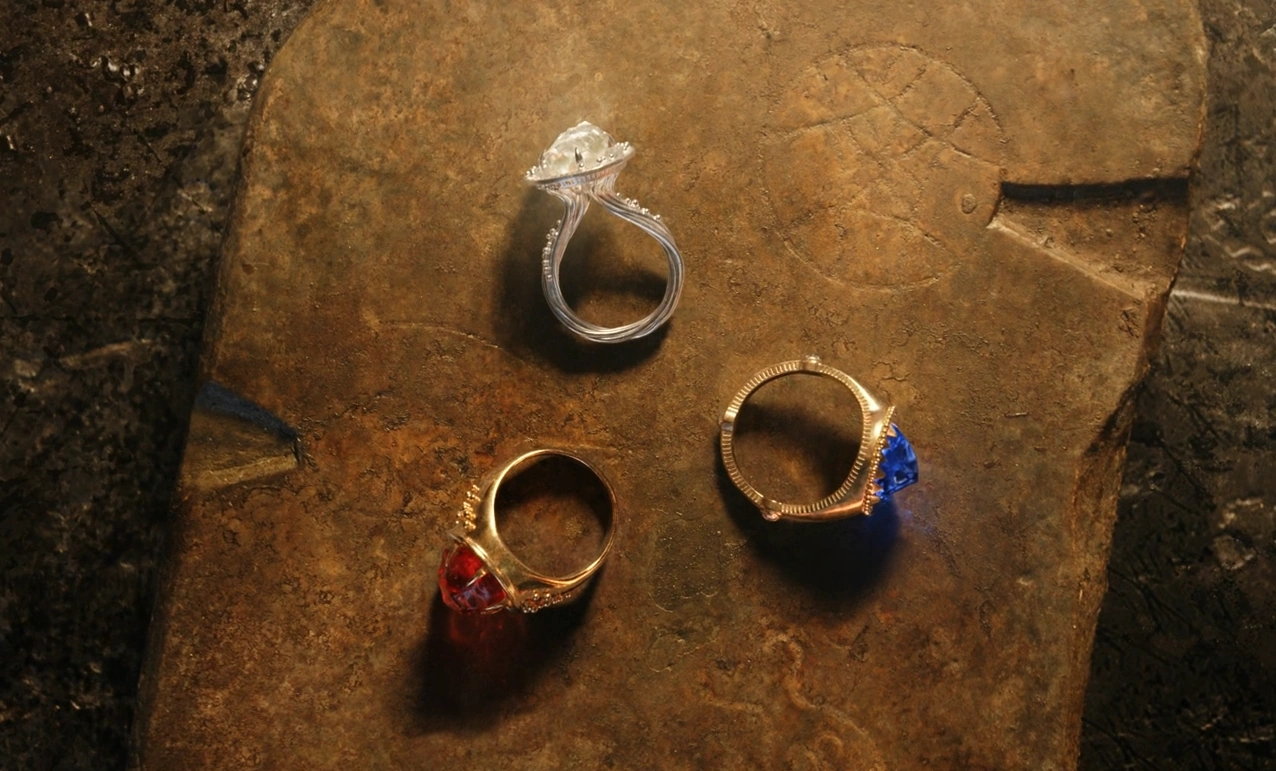
At the end of episode 8, they handle the creation of the elfin rings like any other TV drama. A main character, regardless of supposed skill, has to suggest the solution to the master craftsman. They hint that this craftsman is being manipulated, but please. There’s no strategy working here. It’s a line, a plot point, a touch of authenticity to say they know Tolkien’s history and are telling his story. The rings themselves look like trinkets (image via LOTR Fandom).

In episode 7, there’s a battle, and the “good” villagers give up their most defensible position for one that trained solders would have difficulty defending. And in doing so, they give the enemy the freedom to unlock an old plan that would nonsensically ignite Mt. Doom. Which is a big problem, but it doesn’t come before they mop the floor with their enemies because the elves and Númenórean men, whom Galadriel has been attempting to rally for half of the series, finally show up on the horses they brought overseas. How this cavalry knew the Southland village would be under siege at that moment is not important. What is important is that had the villagers stayed in the defensible outpost they fled to days ago, the cavalry would not have been able to charge in like they did.

A Kodak moment, I tell you.

Continue reading Can’t Recommend Pathetic Rings of Power

Vulgar Swedish dwarfs

An illustration by Gustaf Tenggren for “Grimm’s Fairy Tales” (1923)

I think it says a lot about my tremendous personal modesty that, on the rare occasions when I learn something I didn’t know about Scandinavian history and culture, I share it here in public, in front of our FBI surveillance team and everybody, instead of concealing it. And I did learn something new today, in the August issue of the Sons of Norway’s Viking Magazine.

Even better, there’s an Inkling connection. An adversarial connection, but a connection nonetheless.

C. S. Lewis wrote, in Surprised by Joy:, Chapter III

I fell deeply under the spell of Dwarfs—the old bright-hooded, snowy-bearded dwarfs we had in those days before Arthur Rackham sublimed, or Walt Disney vulgarized, the earthmen.

He wrote, further, in a 1939 letter to his friend A. K. Hamilton Jenkin, “Dwarfs ought to be ugly of course, but not in that way. And the dwarfs’ jazz party was pretty bad.”

Tolkien, it is reliably reported, rebuffed offers from Disney for film rights to the Lord of the Rings, based on similar feelings.

According to “The Art of Trolls,” an article by Rowdy Geirsson in the August Viking Magazine, the fault for this “vulgarization” of dwarfs lies solidly on the head of a Swedish artist, Gustaf Tenggren (1896-1970). Tenggren made his name as an artist in his native Sweden, becoming known for illustrations of fantastical subjects, becoming the featured artist for “Bland tomter och troll,” an annual publication devoted to fairy stories. In 1936 he went to work for Disney Studios, becoming their chief conceptual artist. It was in this capacity that he designed the characters for “Snow White and the Seven Dwarfs,” as well as later productions like “Pinocchio,” “Fantasia” and “Bambi.”

Judging by his Swedish work (an example is posted above), I would guess that Lewis would have been equally displeased by Tenggren’s earlier dwarfs, considering them “sublimed” in the Rackham style. (Though Arthur Rackham was an artist whose Wagnerian work he cherished.)

There’s something in Lewis’ and Tolkien’s criticism, of course, and it’s grown more apparent with the years. Animation is subject to fashions over time. I believe I read somewhere that when “Snow White” first came out, critics admired Disney’s dwarfs but found the “human” characters rather bland. Today the human characters look far better than the dwarfs, who possess a rubbery quality that’s gone out of style. (I personally particularly dislike the works of Fleischer Studios. Except for Popeye. I likes me Popeye.)

It’s a rule that we Norwegians have understood for many centuries – you can never go wrong blaming the Swedes.