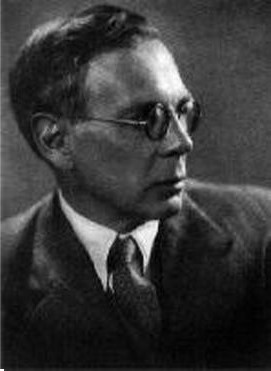
Here is a portion of a radio talk C. S. Lewis gave on Charles Williams, whose Descent Into Hell I reviewed last night.
I’ve heard the complete talk, which is very short in its own right. I don’t know why they cut it down, except that Lewis starts with an anecdote about the poets Leigh Hunt and Thomas Babington Macauley as an example of bad literary criticism. I suppose nowadays nobody knows who either of them is. (To be honest, I don’t know much about them myself.)
Below, an introduction to Williams by the scholar Jessica Hooten Wilson, for whom I recently did some translation work. I did not in fact know she was into such good stuff. Turns out that, counting David Llewellyn Dodds, who comments here from time to time, I know two important Inklings scholars.
He could enjoy; at least he could refuse not to enjoy. He could refuse and reject damnation.
With a perfectly clear, if instantaneous, knowledge of what he did, he rejected joy instead.
Charles Williams’ novels have been a major influence on my own works (partly, certainly, by way of C.S. Lewis’ That Hideous Strength, but to a great degree on their own account). Of all those books, it’s the 1937 urban fantasy Descent Into Hell that has most kept me company through the years, because I recognize my own vulnerabilities in it.
The book is misleadingly simple to explain, yet complex in the execution. The action centers on the production of a new play by the poet Peter Stanhope, in his home town and residence of Battle Hill, a suburb north of London. Among the actors is Pauline Anstruther, a young woman crippled by constant fear. Occasionally through her life, and increasingly frequently in recent weeks, she has been seeing her doppelganger, a double of herself, approaching her up the street. Her fear of the apparition is increased by her fear that she is losing her mind. She’s ashamed to share the problem with anyone, until finally Stanhope himself draws it out of her. He is surprisingly unsurprised, and explains to Pauline the doctrine of exchange, by which Christians may literally bear one another’s burdens. He promises to carry her fear for her, and the results are immediate. But Pauline learns that this relief is only the first step in her own assignment, that of carrying the burden of yet another person – an ancestor of hers who was martyred under Bloody Mary. (In Williams’ view, as in quantum physics, an effect may precede its cause.)
Meanwhile, we also have the chilling tale of Lawrence Wentworth, a noted but superficial military historian, also a resident of Battle Hill. Wentworth is experiencing what we now call a midlife crisis. He has grown obsessed with Adela Hunt, a pretty and superficial young woman who’s engaged to a young man but likes to flirt with him. Through the machinations of a local witch, Lawrence is presented with a simulacrum of Adela, a soulless automaton which embodies his lustful imaginations of what he thinks Adela ought to be. Under the spell of the false Adela, Lawrence gradually disengages from everything that mattered to him – even some of his petty sins might have offered a roundabout road to salvation, if he desired it, but all he really loves, at bottom, is himself as he seems himself reflected in the false Adela. And so he is damned.
There’s yet another plot thread, touching both Pauline’s and Lawrence’s stories, involving a pitiful ghost who never lived much of a life and died a suicide. He wanders in a sort of limbo in another dimension of Battle Hill, and a way to salvation is offered to him as well.
What I had forgotten about Descent Into Hell was how dense and difficult the prose is. The characters’ actions are fairly straightforward. But the author is constantly informing us what is going on on the heavenly or spiritual level. And that commentary is what makes the book a difficult read. Author Williams goes very deep into his theology and his personal speculations on theology here. I’m more familiar with Williams’ thinking than most people, but I often had trouble following.
And yet it was worth it – for me. I do love Descent Into Hell.
There were interesting points I noticed for the first time on this reading: for instance, Lawrence neglects his scholarship as part of his process of damnation, but Stanhope, in another place, sets aside his poetry, in a different way, and that’s part of his process of sanctification. Nice touch, symmetrical and instructive.
Recommended, if you’re up for a challenge. This e-book edition contains some OCR errors.
Here’s the latest news from the Saga Heritage Foundation, the organization that produced the wonderfully translated book, Viking Legacy.
Their next projects, as I understand it, are English versions of the Flatey Book and Tormod Torfaeus’ Latin history of Norway. I doubt there’ll be much work for me in all this, but it’s worth spreading the news.
Prof. Titlestad, who wrote Viking Legacy, is the fellow in the wide-brimmed hat.
I’m re-reading Charles Williams’ Descent Into Hell. It’s my favorite of his novels, and (I was pleased to learn) often considered his best by critics. If you haven’t read it, it centers on two characters – a young woman who repeatedly meets her doppelganger walking up the street, and a middle-aged historian who becomes obsessed with a young woman and is offered a soulless simulacrum of her. One of them is drawn into the community of God’s grace, while the other “descends into Hell” through self-indulgence. I have an idea I can write an article about this book that might illuminate some current issues.
Because I have my finger, you know, on the pulse of societal change.
Silly, I admit, but I think I may actually be in a unique position to comment, due not to my wisdom but to my failures and sins.
Anyway, it’s also in this novel that Williams demonstrates most clearly his doctrine of exchange, the idea that the Christian teaching that we should bear one another’s burdens is more than a metaphor. He believed that we can pray to literally take on our brothers’ and sisters’ fears, difficulties, and pains, suffering them for them – because it’s lighter to bear when it’s someone else’s. And they in turn can bear ours.
Williiams’ friend C. S. Lewis reported that he attempted this exercise with his wife Joy, when the pain of her cancer was most difficult. He felt some pain, he said, and she told him her own was diminished.
That’s all very subjective, of course. Not nearly as dramatic as what happens in the novel. I made the experiment myself at least once. As I recall, the sick friend I prayed for did report he was feeling better soon. But again, it’s subjective. Not the sort of dramatic outcome we would like to see.
Of course we can always spiritualize it. Regard it in terms of the mystery of Christian community, the fellowship of the saints.
But that wasn’t what Williams believed. He took it literally.
What is on Walker’s TV as he writes this blog post, America asks.
The TV series above. It’s been my habit for some time to turn to some old TV show or movie at this time of day, as a sort of white noise. Quite often it’s been some old British crime TV series. I watched, for instance, several episodes of an ancient series called “Z-Cars” (pronounced, of course, “Zed cars”), which in its earliest seasons featured a beardless Brian Blessed as a uniformed cop – one of his early acting jobs.
Now I’ve found this 1985 British miniseries set in Norway, entitled “Maelstrom.” It was broadcast in the US, on one of the cable networks, back in the late ’80s, and I recorded it on VHS at the time because, after all, it was set in Norway, and it wasn’t awful.
It stars an English/Swedish actress named Tussi Silberg as a British woman who discovers that a Norwegian millionaire she’s never heard of has left her some property and a dried fish factory. Mystified, she flies over there, where she finds everyone welcoming, and nobody seems to begrudge her a share of the family’s rather large fortune. But strange occurrences… occur, and behind it all there’s the continued puzzle of what possible connection the old man might have had to her.
It’s not bad. The acting’s fair, except for some histrionics at the end. The psychology is pretty naïve. And, of course, there’s the beautiful Norwegian scenery.
For some reason, perhaps because of the old TV series (which I hated as a kid but quite like now), I never really considered reading a Perry Mason book until fairly recently. I’ve been pleasantly surprised how much I’ve liked them. There’s no great writing here – the prose can be pretty shopworn – but Erle Stanley Gardner was a top-notch plotter. One reads these books for the surprises. Today’s review: The Case of the Dubious Bridegroom.
Attorney Perry Mason is putting in late hours in his office one night, when he spots a pair of lovely female legs on the fire escape. He confronts the possessor of those legs, persuading her to come inside. (Mason is certain that she tosses a gun into the alley in the process, but she insists that’s not true.) She tells him that she has been concerned about the oil exploration company that occupies offices directly above his. She thinks someone is up to something shady there, and as a relative is an investor, she wanted to see what was going on. The story’s a little thin, but she manages to escape Perry in the end.
The next day Perry meets the manager of the office upstairs, who wants to hire him on a divorce matter. He recently went to Mexico to get married, not realizing that his first wife, who had told him she had divorced him in Reno, did no such thing – and now she’s trying to use bigamy as a lever against him. Perry learns that she has gotten the police involved, and accompanies his client and the new wife to Mexico, where they can get a Mexican divorce and marry legally.
But when the police put out a warrant for murder against his client, things get complicated.
There are some very nice plot twists in The Case of the Dubious Bridegroom. I especially liked one where Perry tries to get a jump on the prosecution strategy and it comes back to bite him. Lots of lies, lots of twists, and a surprise ending in the Gardner style.
First class, undemanding entertainment. I enjoyed The Case of the Dubious Bridegroom.
The Viking knarr “Snorri,” at L’Anse Aux Meadows, Newfoundland. My photo.
I have read a couple more stories from The Complete Sagas of Icelanders, and I shall describe them for you. These two are not sagas in the proper sense of the word, but Þátturs, a word that more or less means stories or anecdotes. They are generally found as appendages to longer sagas – this particular pair were attached to the last major saga we considered, “Killer-Glum’s Saga.”
The first is “The Tale of Ogmund Bash.” Ogmund is a freedman of Killer-Glum’s. He has prospered better than one would expect, having the resources to buy himself a merchant ship (knarr) for a business voyage to Norway. Freedmen, former slaves, remained in a dependent relationship with their former masters, so he appeals to Killer-Glum for his endorsement, which he receives, and Glum’s son comes along.
Arriving in Norway, Ogmund makes a rookie sailing mistake, entering a harborage at night and colliding with another merchant ship, which sinks. The ship’s owner responds angrily, and their conflict ends with the man boarding Ogmund’s ship and knocking Ogmund senseless with the hammer of his axe. Ogmund takes no action to avenge his honor, so that though he comes home with profit, his reputation is ruined. Killer-Glum cuts off their relationship, saying, in spite of Ogmund’s protestations that he was only trying to protect Killer-Glum’s son “You shouldn’t have considered that… when he didn’t want to himself. It would have seemed worth it to me to have you both dead, provided you’d shown your courage by taking vengeance.”
Ogmund, however, is just biding his time. In a few years he goes back to Norway, encounters King Olaf Trygvesson, and kills the man who humiliated him.
In an odd sequel, a new character introduced into the story, wrongly accused of the killing, flees to Sweden, which is still heathen, and falls in with a priestess of Frey. He accompanies her on her annual rounds, transporting an idol on a wagon. In time the idol gets broken, and Ogmund himself pretends to be the god. He and the woman collect a lot of treasure, and in time she accompanies him back to Norway, where he renews his faith, she converts, and they live happily ever after.
The next Þáttur is “The Tale of Thorvald Tasaldi” (the editors might have done us a favor by informing us what “tasaldi” means. I can’t find it online either). Anyway, Thorvald is the nephew of Killer-Glum, and he also travels to Norway in the time of Olaf Trygvesson. There, as every young Icelander must in every saga, he is met with honor and favor by the king. King Olaf gives him a place at his table between two of his men, one of whom is friendly, the other hostile. The hostile one maneuvers a situation where Thorvald feels obligated to go on the king’s behalf on a mission to try to convert an obstinate, rich heathen. Thorvald goes, accompanied by the friendly table-mate.
On arriving at the rich man’s estate, they find that he has no visible help running his farm – it’s just the farmer and his daughter there. When Thorvald and his friend explain their errand, they end up wrestling with both the father and daughter, but Thorvald prevails because he has heeded a dream he had, telling him to bind a letter containing the names of God onto his chest. So the farmer summons up “those who live in the undercroft” (the elves, the Underground Folk as I call them in my novels) who have been the ones doing the farm work here. Those powerful beings capture them, but the farmer lets them go. They leave, then return, determined to fulfill their mission. They finally succeed, and return to great honor from the king.
My general impression of these stories is that when a man had voyaged to Norway, he was expected to have a fine tale to tell. And when his descendants re-told that story, they were expected to embroider it. The saga accounts of life in a king’s court tend to follow familiar patterns that recur from story to story. The tale of the man masquerading as the god Frey, too, mimics other similar accounts (which likely have some factual basis, as we know such ceremonial circuits were part of the old religion).
We’re approaching Easter, friends. Today’s hymn comes from German hymnist and missionary Nikolaus Ludwig, Reichsgraf von Zinzendorf und Pottendorf (1700-1760). It was translated into English by the great John Wesley (1703-1791).
“. . . justified by his grace as a gift, through the redemption that is in Christ Jesus, whom God put forward as a propitiation by his blood, to be received by faith. This was to show God’s righteousness, because in his divine forbearance he had passed over former sins.” (Romans 3: 24-25 ESV)
1 JESUS, Thy blood and righteousness My beauty are, my glorious dress; Midst flaming worlds, in these arrayed, With joy shall I lift up my head.
2 When from the dust of death I rise, To claim my mansion in the skies– E’en then this shall be all my plea, “Jesus hath lived and died for me.”
3 Bold shall I stand in Thy great day, For who aught to my charge shall lay? Fully through these absolved I am From sin and fear, from guilt and shame.
4 This spotless robe the same appears, When ruined nature sinks in years; No age can change its glorious hue; Thy blood preserves it ever new.
5 And when the dead shall hear Thy voice, Thy banished children shall rejoice; Their beauty this, their glorious dress, Jesus, Thy blood and righteousness!
“Listen to me, boy. Only gods and heroes can be brave in isolation. A man may call upon courage only one way, in the ranks with his brothers-in-arms, the line of his tribe and his city. Most piteous of all states under heaven is that a man alone, bereft of the gods of his home and his polis. A man without a city is not a man. He is a shadow, a shell, a joke and a mockery….”
Radio talk show host Hugh Hewitt has a custom, whenever he interviews a new guest, of catechizing them on books they might have read. One he always asks about is Steven Pressfield’s Gates of Fire, a fictionalized account of the Battle of Thermopylae. So when a deal on the book showed up, I decided to buy it, though Greek antiquity is outside my usual field of interest.
What I encountered was a story of astonishing intensity. There were enough incidental resemblances to my own recently finished Erling Skjalgsson saga that I’m glad I waited till now to read it, so I can say without any doubt that I wasn’t influenced by it any way. (Though my books are not nearly so hard-barked.)
In the aftermath of the Battle of Thermopylae, where 300 Spartans died in a heroic last stand against the invading forces of the Persian Empire, one severely wounded Greek is discovered on the battlefield, and brought before the victorious King Xerxes, who wishes to know what sort of men these were who stood so valiantly.
The Greek, whose name is Xeones, explains that he is not properly a Spartan, but a servant, a squire to one of the officers. He is happy, even proud, to tell the story of his life and of how he came to know the Spartans and their ways, and how they bore themselves up through that last terrible massacre.
Gates of Fire is a harrowing book, one that dives deep into the warrior ethos in its most purified form, not sparing the horrific details of what happens during a battle. I read it with both horror and fascination, as I imagine most readers will. This is not a book for the faint of heart.
Historically, from my own reading, I know that in spite of all this, author Pressfield has done a little covering up. The Spartans, whose courage is unquestioned, were in fact one of the cruelest cultures we know of in history. There are only hints in this novel of the pederasty that was taken for granted in their military training of boys, and the actual condition of the slaves is softened here – among other cruelties, the Spartan ritual of manhood involved hunting down and murdering a slave.
For all that, Gates of Fire is without question a monument of historical fiction. Author Pressfield dares to stare far more directly into the face of battle that I ever have in my own writing.
Tolkien and Lewis didn’t like this Snow White, but they’d have liked it better than the new one.
Just to show my vigorous independence of mind, I’m going to confess before the world that I think Rachel Zegler is very pretty. There have been a lot of jokes about how no character played by Gal Gadot (admittedly a knockout) needs to fear that poor Rachel would be a threat to her status as “fairest of them all.” Several commenters have disparaged Ms. Zegler’s looks. But she appeals to me. The delicate-figure and-big-eyes look works, as far as I’m concerned. Kind of like a… what comes to mind? A Disney princess.
But it’s not just Rachel’s appearance that I feel I need to defend. Granted, she has certainly earned (at least) a lot of the ridicule that’s been heaped on her, for her public condescension and tone-deafness. She has become the poster girl for Woke arrogance – and she’s earned it.
And yet, I don’t think she’s entirely to blame.
In a real sense, I think, she’s been trying to play it by the book. Only she’s been using the wrong book.
She has relentlessly said the wrong thing in almost every situation. First she insulted her audience, and then she doubled down on the insults. Apparently the studio people tried to rein her in, to explain that you can’t alienate half your potential audience and then expect them to want to see you sing and dance. But she didn’t seem to get the message.
This, I think, was not because she didn’t care about the Disney enterprise. I think she did it because she believes deeply in the Disney enterprise, in a different way.
She believes in what the Disney movies say.
And what do the Disney movies say?
The Disney movies, especially the recent ones, tell young women like Rachel, “You go, girl! You speak your truth! Don’t let anybody – especially any man – tell you what to do! You are a strong woman, and if you only stand your ground and never compromise, you must triumph in the end!”
And that’s how she’s played it. She hasn’t listened to anybody who told her she was off course – even if they paid her salary. Because she has to be true to the truth of her heart. In the end everyone will be forced to admit that they were wrong, and that she – the Princess, the Girl Boss – was right all along. And everyone will love her.
That didn’t exactly work out.
Instead, she now finds herself out of work and a public laughingstock.
The cognitive dissonance must be horrific. Her goddess has failed her. The promise of the Disney Princess came up snake eyes; she wished upon a star and her wish didn’t come true.
I feel sorry for her at this place in her life. It must be very lonely.
Now, if Rachel’s life were a film script, I know what I’d do in Act II.
I’d have her meet a Big Guy. A guy with broad shoulders, a farmer or a trucker or a plumber or something. Some plot contrivance would throw them together, and she would hate him at first sight. It would be like dog and cat. Everything he did would be seen as an insult, a male chauvinist provocation. She would harangue him about his privilege and scream about how he was oppressing her just by existing.
Finally, in a rage, she’d attack him with her fists. He’d grab her wrists until she stopped struggling. Then he’d kiss her hard. And her insides would turn to goo.
And then they’d get married, move to a small town, and have lots of babies.
Of course, such a heretical story could never get filmed today.
Websites store cookies to enhance functionality and personalise your experience. You can manage your preferences, but blocking some cookies may impact site performance and services.
Essential cookies enable basic functions and are necessary for the proper function of the website.
Name
Description
Duration
Cookie Preferences
This cookie is used to store the user's cookie consent preferences.
30 days
These cookies are needed for adding comments on this website.
Name
Description
Duration
comment_author
Used to track the user across multiple sessions.
Session
comment_author_email
Used to track the user across multiple sessions.
Session
comment_author_url
Used to track the user across multiple sessions.
Session
These cookies are used for managing login functionality on this website.
Name
Description
Duration
wordpress_logged_in
Used to store logged-in users.
Persistent
wordpress_sec
Used to track the user across multiple sessions.
15 days
wordpress_test_cookie
Used to determine if cookies are enabled.
Session
Statistics cookies collect information anonymously. This information helps us understand how visitors use our website.
Google Analytics is a powerful tool that tracks and analyzes website traffic for informed marketing decisions.
Used to monitor number of Google Analytics server requests
10 minutes
__utmb
Used to distinguish new sessions and visits. This cookie is set when the GA.js javascript library is loaded and there is no existing __utmb cookie. The cookie is updated every time data is sent to the Google Analytics server.
30 minutes after last activity
__utmc
Used only with old Urchin versions of Google Analytics and not with GA.js. Was used to distinguish between new sessions and visits at the end of a session.
End of session (browser)
__utmz
Contains information about the traffic source or campaign that directed user to the website. The cookie is set when the GA.js javascript is loaded and updated when data is sent to the Google Anaytics server
6 months after last activity
__utmv
Contains custom information set by the web developer via the _setCustomVar method in Google Analytics. This cookie is updated every time new data is sent to the Google Analytics server.
2 years after last activity
__utmx
Used to determine whether a user is included in an A / B or Multivariate test.
18 months
_ga
ID used to identify users
2 years
_gali
Used by Google Analytics to determine which links on a page are being clicked
30 seconds
_ga_
ID used to identify users
2 years
_gid
ID used to identify users for 24 hours after last activity
24 hours
_gat
Used to monitor number of Google Analytics server requests when using Google Tag Manager
1 minute
_gac_
Contains information related to marketing campaigns of the user. These are shared with Google AdWords / Google Ads when the Google Ads and Google Analytics accounts are linked together.
90 days
Marketing cookies are used to follow visitors to websites. The intention is to show ads that are relevant and engaging to the individual user.
A video-sharing platform for users to upload, view, and share videos across various genres and topics.
Registers a unique ID on mobile devices to enable tracking based on geographical GPS location.
1 day
VISITOR_INFO1_LIVE
Tries to estimate the users' bandwidth on pages with integrated YouTube videos. Also used for marketing
179 days
PREF
This cookie stores your preferences and other information, in particular preferred language, how many search results you wish to be shown on your page, and whether or not you wish to have Google’s SafeSearch filter turned on.
10 years from set/ update
YSC
Registers a unique ID to keep statistics of what videos from YouTube the user has seen.
Session
DEVICE_INFO
Used to detect if the visitor has accepted the marketing category in the cookie banner. This cookie is necessary for GDPR-compliance of the website.
179 days
LOGIN_INFO
This cookie is used to play YouTube videos embedded on the website.